
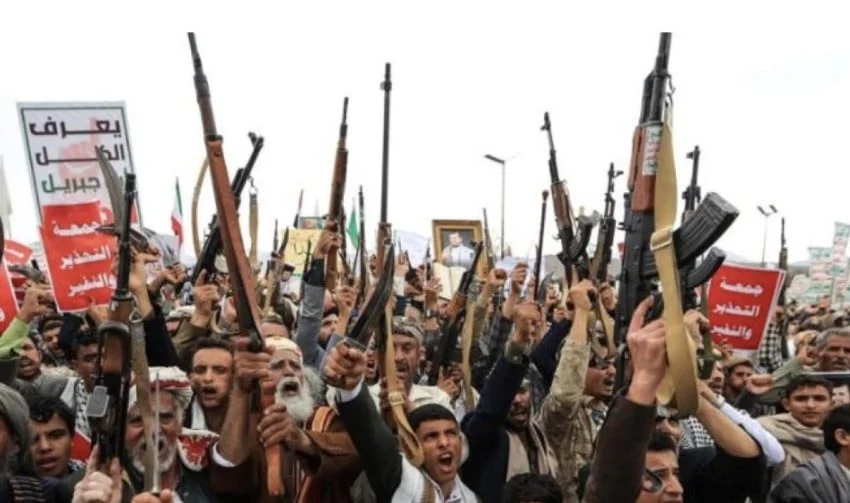
The geopolitical landscape in the Middle East has long been defined by the delicate balance of power surrounding the Bab el-Mandeb Strait, a vital maritime chokepoint through which a significant portion of the world’s energy supplies flows. Recently, this stability has been challenged by the persistent advancement of Houthi rebels in Yemen, a development that has prompted intense scrutiny of United States foreign policy. Kenneth Katzman, a senior fellow at the Soufan Center, has emerged as a vocal critic of the current administration’s posture, arguing that the U.S. possesses the military capability to halt the Houthi advance but lacks the executive direction to do so.
According to Katzman, the lack of a clear, assertive strategy from Washington has transformed a regional conflict into a strategic vulnerability for international commerce and regional security. By failing to respond to specific requests for enhanced military support from Saudi Arabia—the primary coalition partner fighting the Houthis—the U.S. has effectively allowed the conflict to metastasize. Katzman suggests that the precision and efficacy of the U.S. Air Force could have provided the necessary leverage to curb Houthi momentum, potentially preventing the humanitarian and security catastrophe that now dominates the region.
The Strategic Failure of Indecision
The core of the criticism leveled against the administration concerns the role of the President as the commander-in-chief. Katzman characterizes the current U.S. approach as one of bewilderment, suggesting that the administration is operating without a coherent doctrine for the Yemeni theater. For decades, the foundational pillar of U.S. Middle East policy has been the protection of freedom of navigation and the uninterrupted flow of energy. Today, those interests are being directly challenged by Iranian-backed Houthi forces, yet the response from the White House has been perceived as passive.
"Trump is essentially sitting on the sidelines, hoping that the Saudi-led coalition will resolve a crisis that has proven far beyond their independent capacity to contain," Katzman remarked. This "wait and see" approach is viewed by many military analysts as a fundamental misreading of the conflict’s trajectory. By relying on regional partners to shoulder the burden entirely, the U.S. risks losing its influence over the post-conflict architecture of Yemen, while simultaneously signaling to adversaries that the American commitment to its traditional allies is wavering.
A Chronology of Conflict: The Descent into Chaos
To understand the current impasse, one must examine the timeline of the conflict that began in earnest in 2014. The Houthi insurgency, a Zaydi Shia movement, captured the capital city of Sanaa in September 2014, forcing the internationally recognized government of Abdrabbuh Mansur Hadi into exile.
- March 2015: The Saudi-led coalition, backed by U.S. intelligence and logistical support, launched Operation Decisive Storm to restore the Hadi government and counter Iranian influence.
- 2016–2018: The war devolved into a grinding stalemate, characterized by a humanitarian crisis that the United Nations described as the world’s worst.
- 2019: Increased drone and missile strikes against Saudi energy infrastructure, attributed to the Houthis and their Iranian backers, brought the conflict to the forefront of global oil market stability.
- 2020–Present: Despite various ceasefire attempts and the Stockholm Agreement, the Houthis have continued to consolidate control over the western highlands, while the Yemeni government has shifted its focus from total territorial reclamation to a defensive posture aimed at preventing further collapse.
Data-Driven Perspectives on Regional Security
The economic implications of the instability in Yemen are profound. The Bab el-Mandeb Strait serves as the gateway to the Suez Canal. Approximately 4.8 million barrels of crude oil and petroleum products flow through this passage daily, bound for Europe, Asia, and the United States. Any threat to this maritime corridor imposes a "risk premium" on global energy prices.
Data from the U.S. Energy Information Administration (EIA) highlights that the closing of such chokepoints would force tankers to divert around the Cape of Good Hope, adding weeks to transit times and significantly increasing shipping costs. Furthermore, the persistent Houthi threat has diverted significant military resources from other regional objectives, stretching the naval and aerial surveillance capacities of the coalition thin. Critics argue that a more proactive U.S. posture could have mitigated the need for such extensive defensive deployments by neutralizing Houthi launch sites earlier in the conflict’s lifecycle.
Official Responses and Coalition Dynamics
While Washington remains reticent, the Saudi-led coalition has repeatedly called for a more robust American role. Officials within the Saudi government have signaled that while they remain committed to the security of the Red Sea, the lack of coordinated U.S. air support has limited their operational freedom. In diplomatic circles, there is a growing consensus that the "light footprint" strategy favored by recent U.S. administrations has emboldened non-state actors.
Conversely, some proponents of the administration’s restraint argue that deeper military entanglement in Yemen would only serve to prolong the conflict and increase the risk of American casualties. They advocate for a diplomatic solution, prioritizing a negotiated settlement between the Houthis and the Yemeni government. However, Katzman and other regional experts contend that diplomatic pressure without the backing of a credible military deterrent is destined to fail, as the Houthis perceive the lack of action as a green light to continue their territorial expansion.
Broader Implications for U.S. Foreign Policy
The situation in Yemen serves as a litmus test for the future of U.S. foreign policy in the Middle East. As the administration balances competing priorities—such as the pivot toward the Indo-Pacific and the management of tensions with China—the Middle East remains a volatile theater that cannot be ignored. The "confusion" noted by observers in Washington may reflect a deeper struggle to reconcile the desire to reduce military footprints with the imperative to maintain global order.
The shift in the Yemeni government’s strategy—moving from offensive operations to defensive consolidation—is a tacit admission that the status quo is unsustainable. By adopting a defensive stance, the government is essentially acknowledging that the territory lost to the Houthis may remain outside their control for the foreseeable future. This creates a de facto partition of the country, which poses long-term security risks for the Arabian Peninsula.
Analysis: The Cost of Inaction
From an analytical standpoint, the crisis in Yemen illustrates the dangers of strategic ambiguity. When a superpower signals a withdrawal of support or a lack of clear objectives, it creates a power vacuum that is almost immediately filled by opportunistic actors. In this case, the Houthis have utilized the lack of clear U.S. strategic direction to modernize their arsenal, reportedly with assistance from external state sponsors, and to project power far beyond their traditional strongholds.
The implications for the U.S. are twofold. First, there is the immediate security concern regarding maritime navigation. Second, there is the reputational damage incurred among allies who feel abandoned during critical junctures. If the United States is unable or unwilling to leverage its military assets to protect its stated interests—in this case, the stability of the Red Sea energy transit routes—it may find that its influence in the region continues to erode, irrespective of its diplomatic efforts.
In conclusion, the situation in Yemen has evolved into a complex web of humanitarian, economic, and security challenges. The criticisms voiced by figures like Kenneth Katzman highlight a perceived disconnect between Washington’s stated commitments and its operational reality. As the conflict continues to simmer, the administration faces a binary choice: either commit to a more decisive role in supporting its allies and securing regional stability, or accept a diminished role in the Middle East that may leave its long-term strategic interests vulnerable to the shifting tides of regional warfare. The path forward remains uncertain, but the urgency for a coherent, well-defined, and assertive strategy has never been more apparent.
