

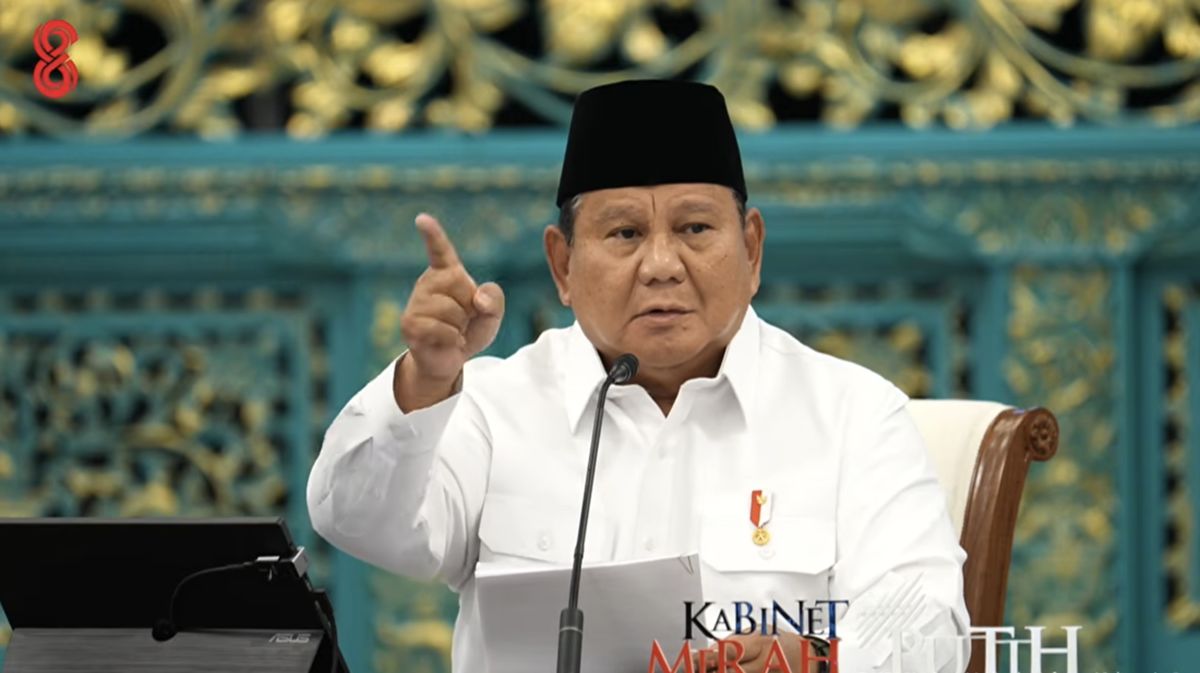
President Prabowo Subianto has issued a stern directive to his cabinet and relevant government agencies to implement a "use it or lose it" policy regarding business and land utilization permits. Speaking during a Plenary Cabinet Session at the State Palace in Jakarta, the President emphasized that the government will no longer tolerate the stagnation of assets and licenses that have been granted to private and state entities but remain idle. Under this new mandate, various business permits—including Right to Cultivate (HGU), Right to Build (HGB), and Trading Business Licenses (SIUP)—will be subject to immediate revocation if the holders fail to demonstrate significant activity or progress within a two-year window.
The President’s stance marks a significant shift toward a more aggressive utilization of national resources, aimed at eliminating "land banking" and bureaucratic bottlenecks that have historically hindered Indonesia’s economic momentum. By enforcing a strict two-year deadline, the administration seeks to ensure that every hectare of land and every operational license contributes directly to the national economy, energy security, and the welfare of the people.
A No-Tolerance Approach to Idle Permits
During the cabinet session, President Prabowo was unequivocal in his instructions, stating that the era of holding onto permits without execution is over. He noted that many licenses are currently being held for speculative purposes or are trapped in internal corporate delays, preventing other potentially more productive players from utilizing those resources.
"We will no longer tolerate HGU, HGB, SIUP, or any permits we grant if there is no activity for two years," the President stated. "Two years without activity, and we revoke it!" This directive is intended to send a clear signal to both domestic and foreign investors that the Indonesian government prioritizes tangible progress over mere administrative possession.
The types of permits mentioned—HGU (Hak Guna Usaha) and HGB (Hak Guna Bangunan)—are critical to Indonesia’s primary sectors. HGU is typically granted for large-scale agricultural, plantation, and fishery activities, while HGB allows the holder to construct and own buildings on land they do not own. SIUP (Surat Izin Usaha Perdagangan) is the fundamental license for companies to engage in trading activities. The stagnation of these permits often results in vast tracts of fertile land or strategic urban locations remaining unproductive, which the President views as a direct loss to the state.
The Case of the Masela Block: A 28-Year Delay
To illustrate the necessity of this firm approach, President Prabowo highlighted the case of the Abadi Masela Gas Block in the Arafura Sea. The project, one of Indonesia’s most vital National Strategic Projects (PSN), has faced staggering delays for nearly three decades. Despite its massive potential as a cornerstone of Indonesia’s energy independence, the project has been bogged down by changes in development schemes, divestments, and long-term negotiations.
The President recounted his recent visit to Tokyo, where he met with the leadership of Inpex Corporation, the Japanese energy giant leading the project. He described his approach as "polite but firm," reflecting the traditional Indonesian value of "ramah tamah" (friendliness) while maintaining a focus on national interests.
"I spoke to them nicely and politely," Prabowo shared with his ministers. "I asked, ‘Are you still interested? Because if you are not, I will allocate it; I will appoint another company.’"
The Masela Block is estimated to hold 18.5 trillion cubic feet (Tcf) of gas and 225 million barrels of condensate. For the President, the 28-year wait is an unacceptable timeline for a nation striving to achieve 8% economic growth. He emphasized that the Japanese side was informed clearly that Indonesia requires the project to start moving immediately to support domestic energy needs and generate much-needed foreign exchange (devisa).
Strategic Context: Energy Security and Foreign Exchange
The push for permit revocation is not merely an administrative exercise but a core component of President Prabowo’s broader economic strategy. The administration is currently focused on two primary pillars: energy self-sufficiency and the stabilization of the national balance of payments.
Indonesia’s energy demand is projected to rise sharply as the government pushes for downstream industrialization (downstreaming). Projects like the Masela Block are essential to ensuring a steady supply of natural gas for both domestic power generation and industrial feedstock. Furthermore, by accelerating these projects, the government aims to reduce its reliance on energy imports, which currently place a significant strain on the state budget and the value of the Rupiah.
From a fiscal perspective, the President noted that idle permits represent "dead capital." When land and resources are locked in inactive HGUs or HGBs, the state loses out on tax revenue, employment opportunities, and export potential. By revoking and reallocating these permits to active investors, the government expects a surge in capital expenditure (CAPEX) and a revitalization of the regional economies where these projects are located.
Historical Precedent and Legal Framework
This policy aligns with and intensifies efforts initiated during the previous administration under President Joko Widodo. In early 2022, the Indonesian government revoked over 2,000 mining, forestry, and land-use permits that were deemed inactive or "non-productive." President Prabowo’s current mandate effectively institutionalizes this process with a clearer timeframe and a broader scope that includes general trading licenses (SIUP).
The legal basis for such revocations is rooted in the Basic Agrarian Law and the more recent Government Regulation (PP) No. 20 of 2021 regarding the Treatment of Abandoned Land. These regulations stipulate that land rights can be revoked if the land is not utilized according to the nature and purpose of the rights granted. However, the "two-year" hard limit articulated by Prabowo adds a layer of urgency that suggests a more streamlined, less bureaucratic process for reclamation.
Industry analysts suggest that the Ministry of Agrarian Affairs and Spatial Planning (ATR/BPN) and the Ministry of Investment (BKPM) will likely form a joint task force to audit existing permits. This audit will focus on identifying "sleeping" assets and providing a final warning period before the two-year revocation trigger is pulled.
Potential Implications for the Investment Climate
While the President’s directive is aimed at boosting productivity, it also presents challenges for the investment climate that the administration must navigate carefully. Legal experts point out that "inactivity" must be clearly defined to avoid arbitrary revocations that could lead to protracted legal battles in the Administrative Courts (PTUN).
For many large-scale projects, the first two years are often spent on Environmental Impact Assessments (AMDAL), securing community consent, and arranging complex financing. If the government applies the two-year rule too rigidly, it could inadvertently penalize legitimate investors who are navigating Indonesia’s often complex regulatory landscape.
To address these concerns, the President noted that the government’s approach would remain consultative. "It is not an ultimatum; it is an appeal," he clarified, suggesting that the government is willing to listen to the challenges faced by investors, provided there is a good-faith effort to move forward. The goal is to move away from a culture of "permit hoarding" toward a culture of "project execution."
Reaction from Stakeholders and Market Participants
The business community has reacted with a mixture of caution and optimism. The Indonesian Chamber of Commerce and Industry (KADIN) has previously expressed support for land reform but urged the government to ensure that the revocation process is transparent and provides due process.
On the other hand, small and medium enterprises (SMEs) and local agrarian groups have welcomed the move. For years, local farmers and smaller developers have complained that vast areas of land are fenced off by large corporations holding HGUs, yet remain covered in shrubs and unused, while local communities lack land for subsistence farming or local development.
In the energy sector, the pressure on Inpex and the Masela Block partners is seen as a litmus test for how the Prabowo administration will handle international consortiums. By successfully pushing for the reactivation of Masela, the government could set a precedent for other stalled energy projects, such as the Indonesia Deepwater Development (IDD) and various geothermal concessions that have remained dormant for years.
Conclusion: A Vision for Decisive Governance
President Prabowo Subianto’s mandate to revoke idle permits after two years is a cornerstone of his "Fast Action" (Gerak Cepat) philosophy. By removing the "dead weight" of inactive licenses, the administration hopes to clear the path for new investments that can contribute to the ambitious goal of transforming Indonesia into a developed economy by 2045.
The policy emphasizes that permits are not a right to own, but a right to utilize for the benefit of the nation. As the government prepares to implement this directive, the focus will now shift to the implementing ministries to create a fair, transparent, and efficient mechanism for monitoring permit activity. For investors, the message is clear: Indonesia is open for business, but only for those ready to break ground and contribute to the country’s rapid development trajectory.
The coming months will be crucial as the Ministry of Investment and the Ministry of ATR/BPN begin the process of auditing thousands of licenses. This move is expected to trigger a significant reallocation of resources, potentially sparking a new wave of industrial and agricultural activity across the archipelago. Through "soft but firm" diplomacy and internal discipline, President Prabowo is signaling that the era of patience for unproductive assets has officially come to an end.
