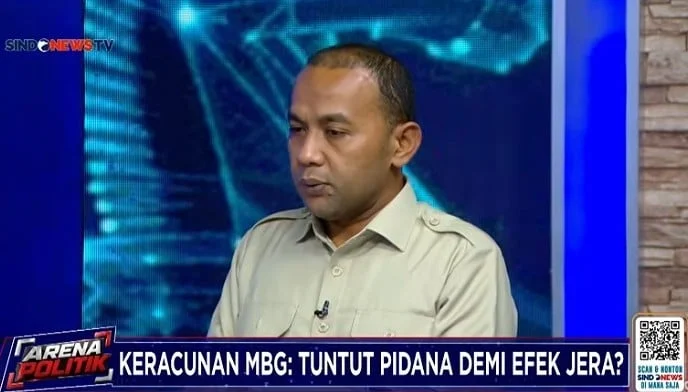
The implementation of the national Free Nutritious Meal (Makan Bergizi Gratis or MBG) program, a cornerstone policy of the current administration, has faced significant scrutiny following a series of mass food poisoning incidents. Hariqo Satria, a technical expert at Bakom RI, recently clarified the government’s stance on accountability, stating that the administration is prepared to defer to law enforcement regarding potential criminal charges against those responsible for the safety lapses.
Speaking during the SindoNews program "Arena Politik" on Sunday, September 13, 2026, Satria emphasized that while the government is actively pursuing administrative disciplinary actions, it remains open to legal proceedings if authorities determine that criminal negligence occurred. This development marks a pivotal shift in how the government manages the quality control of a program designed to feed millions of school-aged children across the country.
The Scope of the Crisis
The Free Nutritious Meal program was designed to improve student health and academic performance by providing standardized, nutritionally balanced meals. However, the rapid scaling of the program—which involves thousands of decentralized kitchens—has introduced significant logistical and sanitation challenges.
Reports of mass poisoning have emerged from various regions, prompting public outcry and intense media attention. Investigations into these incidents have often pointed toward lapses in the cold chain management, poor hygiene in temporary kitchen facilities, and inadequate training for kitchen staff handling perishable ingredients. The government’s acknowledgment of these failures represents an attempt to regain public trust in a program that is vital to the administration’s social welfare agenda.
Administrative Accountability and Disciplinary Actions
According to Satria, the primary mechanism currently employed to address negligence is administrative sanctioning. Because the program relies heavily on the coordination of the SPPG (Satuan Pelayanan Pangan Gratis or Free Food Service Units), many of the personnel involved in the food preparation chain are civil servants (ASN).
"The heads of the SPPG units, accountants, and the nutritionists involved in the supervision of these kitchens are civil servants," Satria explained. "We have proposed, and in many cases executed, the termination of employment for those found to be negligent."
Data provided by the oversight body indicates that approximately 353 individuals, primarily those serving as heads of kitchens, have already been dismissed from their positions. Furthermore, the government has taken aggressive steps to audit the quality of the facilities involved. To date, nearly 2,000 kitchens found to have incomplete health certifications or failing sanitation standards have been ordered to cease operations indefinitely. This mass suspension of kitchen permits underscores the government’s recognition that the previous oversight mechanisms were insufficient to handle the volume and complexity of the program.
A Timeline of Regulatory Challenges
The trajectory of the MBG program has been marked by a transition from rapid implementation to a period of mandatory recalibration:
- Initial Rollout (Q1 2026): The government launched the nationwide expansion of the Free Nutritious Meal program, aiming to reach schools in all provinces.
- Detection of Systemic Issues (Q2 2026): Early reports of food-borne illnesses began to surface in urban school clusters, leading to the first round of government-led food safety investigations.
- Crisis Point (Q3 2026): Following a series of high-profile poisoning incidents, public and political pressure mounted. Experts and legal professionals began calling for a clear definition of liability for those managing the food supply chain.
- Government Intervention (September 2026): Bakom RI and the Ministry of Health announced the systematic closure of substandard kitchens and the initiation of disciplinary hearings for responsible ASN personnel.
Legal Perspectives on Liability
The question of whether administrative sanctions are sufficient in the face of widespread food poisoning has sparked a debate among legal scholars. Critics argue that when a government program results in physical harm to minors, internal disciplinary action may not satisfy the requirements of justice.
Legal experts have noted that the "chain of responsibility" in the MBG program is complex. It involves local education departments, health departments, private contractors, and the SPPG units. Determining liability—whether it lies with the individual cook, the facility manager, or the oversight body that certified the kitchen—is the current challenge for investigators. Satria’s recent statement suggests that the government is no longer shielding the program’s operators from the reach of the criminal justice system. If law enforcement agencies find evidence of gross negligence, corruption in procurement, or failure to adhere to mandatory safety protocols, those individuals could face criminal charges beyond their loss of employment.
Broader Implications for National Policy
The implications of these incidents extend far beyond the immediate health impact on students. The Free Nutritious Meal program is a high-visibility project that serves as a benchmark for the administration’s bureaucratic efficiency. The failure of kitchen sanitation suggests that the "last mile" of the policy—the actual delivery of safe, nutritious food—was not adequately prepared for the realities of local-level infrastructure.
- Supply Chain Integrity: The government is now moving toward a more centralized verification process for suppliers. The reliance on smaller, less-regulated kitchen units is being reconsidered in favor of more robust, industrial-scale catering facilities that can maintain strict food safety standards.
- Public Health Vigilance: The Ministry of Health has increased the frequency of unannounced inspections at all participating schools. This has created a more stringent environment for those operating within the program.
- Fiscal Accountability: With the closure of 2,000 kitchens, the government faces the challenge of reallocating resources to ensure that students do not lose access to their meals while the supply chain is being sanitized. This involves a potential budgetary shift to support more expensive, but safer, food production models.
Future Outlook and Conclusion
The path forward for the Free Nutritious Meal program remains precarious. While the administration is committed to the program’s continuation, the public’s confidence is directly tied to the ability to prevent future poisoning incidents. The proactive stance taken by Bakom RI, as articulated by Hariqo Satria, represents an attempt to align the government’s response with the gravity of the situation.
By acknowledging that criminal prosecution remains a viable path for the most serious cases of negligence, the government is signaling a shift toward greater accountability. However, the success of this strategy will depend on the transparency of the ongoing investigations. The public and the media are expected to monitor the progress of the dismissed personnel, the reopening of compliant kitchens, and the findings of the law enforcement agencies currently reviewing the cases.
As the program undergoes this period of intense scrutiny and restructuring, the ultimate goal remains the protection of the students who rely on these meals. Whether the current measures—administrative dismissals, facility closures, and the threat of criminal prosecution—are enough to stabilize the program will be the defining challenge for the administration in the final quarter of 2026. The government’s ability to balance the humanitarian goals of the program with the stringent requirements of public health and safety will dictate the long-term legacy of the initiative.