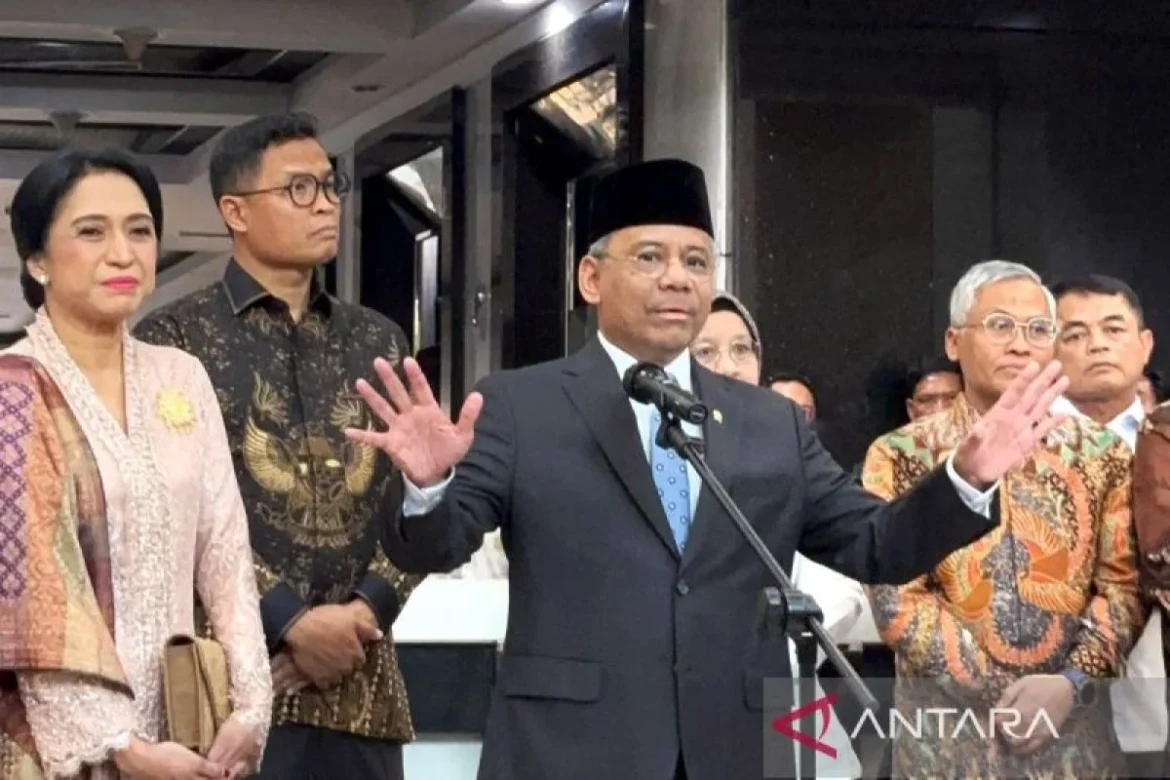
Jakarta faces a significant leadership transition within its highest economic echelons as Suahasil Nazara officially assumed office as the Minister of Finance on September 14, 2026. Appointed under the administration of President Prabowo Subianto via Presidential Decree Number 97P of 2026, Suahasil steps into the role to succeed Purbaya Yudhi Sadewa. This transition marks a pivotal moment for Indonesia’s fiscal landscape, bringing to the forefront a technocrat deeply steeped in academic rigor, extensive fiscal policy formulation, and long-standing administrative experience within the ministry itself.
The appointment of Suahasil is not merely a routine cabinet reshuffle; it represents a calculated continuity in leadership. Having served as the Deputy Minister of Finance across successive administrations—first under President Joko Widodo’s Indonesia Onward Cabinet and subsequently under President Prabowo’s Red and White Cabinet—Suahasil embodies institutional memory. As he takes the helm as the third Minister of Finance in the current presidential term, following the tenures of Sri Mulyani Indrawati and Purbaya Yudhi Sadewa, the financial markets, international investors, and domestic stakeholders are closely watching how his leadership will steer the nation’s economic engine through complex global and domestic challenges.
Educational Foundations and Academic Career
Born in Jakarta on November 23, 1970, Suahasil Nazara’s journey to the pinnacle of Indonesia’s economic governance is anchored in a robust academic foundation spanning top-tier institutions both domestically and internationally. His trajectory reflects a classic blend of theoretical economic study and practical public policy application, beginning in the halls of the Universitas Indonesia (UI).
In 1994, Suahasil earned his Bachelor of Economics degree from the Faculty of Economics at Universitas Indonesia (FEB UI). This foundational education provided him with a comprehensive understanding of macroeconomic principles tailored to developing economies. Eager to deepen his expertise, he traveled to the United States for his postgraduate studies. He enrolled at Cornell University, where he successfully completed a Master of Science degree in 1997, further refining his quantitative and analytical capabilities in economic theory.
Suahasil’s academic pursuit culminated in a doctoral degree. He attended the University of Illinois at Urbana-Champaign, where he dedicated years to advanced economic research. In 2003, he was awarded his Doctor of Philosophy (Ph.D.) in economics. This rigorous international education equipped him with advanced empirical tools, which would later prove invaluable in managing Southeast Asia’s largest economy.
Upon completing his doctorate, Suahasil returned to his alma mater to shape the next generation of Indonesian economists. He officially joined the faculty at FEB UI as a lecturer in 1999. Over the next decade and a half, his leadership within the academic community grew exponentially. He served as the Head of the Graduate Program in Economics from 2004 to 2005, followed by a tenure as the Head of the Demographic Institute at FEB UI from 2005 to 2008. His academic leadership peaked when he was appointed Chairman of the Department of Economics from 2009 to 2013. In recognition of his scholarly contributions and dedication to economic science, Universitas Indonesia bestowed upon him the title of Professor (Guru Besar) in economics in 2009.
Transition into Fiscal Policy and Technocratic Rise
While Suahasil’s roots are deeply planted in academia, his transition into public policy was seamless. His academic credentials and research focus naturally drew the attention of policymakers seeking empirical backing for national development strategies. The shift from the lecture hall to the corridors of power materialized significantly in 2015 when he was appointed as the Acting Head of the Fiscal Policy Agency (BKF) at the Ministry of Finance.
Recognizing his profound capability to navigate complex budgetary frameworks and macroeconomic forecasting, the government confirmed him as the definitive Head of the Fiscal Policy Agency a year later, a position he held until 2019. During his tenure at the BKF, Suahasil played a critical role in shaping national taxation policies, state expenditure strategies, and subsidy reforms. This period cemented his reputation as a meticulous policymaker capable of balancing growth-oriented fiscal stimuli with stringent fiscal prudence.
His high-level bureaucratic performance caught the eye of the nation’s top leadership. On October 25, 2019, President Joko Widodo appointed Suahasil as the Deputy Minister of Finance, tasking him with assisting the minister in managing the colossal task of national economic recovery, particularly during the unprecedented disruptions caused by the global COVID-19 pandemic. His institutional stability was further demonstrated when President Prabowo Subianto retained him as Deputy Minister of Finance in the Red and White Cabinet on October 21, 2024.
Chronology of Leadership and the Ministerial Succession
The leadership transition at the Ministry of Finance in September 2026 highlights the dynamic nature of President Prabowo Subianto’s economic team. The progression of finance ministers within the current administration reflects ongoing strategic adjustments to meet shifting macroeconomic realities.
- Initial Phase: At the onset of President Prabowo’s administration, the mantle of financial stewardship was initially held by Sri Mulyani Indrawati, providing continuity from the previous administration and reassuring global markets regarding Indonesia’s fiscal discipline.
- Mid-Term Adjustment: Purbaya Yudhi Sadewa subsequently assumed the role, bringing a distinct policy approach focused on accelerating domestic liquidity and funding strategic state projects.
- Current Transition: On September 14, 2026, following Purbaya’s departure, Suahasil Nazara was officially inaugurated as the Minister of Finance, bringing decades of internal ministry experience and fiscal policy mastery to the forefront of executive decision-making.
The handover ceremony from Purbaya Yudhi Sadewa to Suahasil Nazara underscored a spirit of institutional continuity. Observers noted that because Suahasil had worked intimately alongside previous ministers as a deputy, the learning curve associated with the ministerial transition would be remarkably flat, allowing the ministry to maintain uninterrupted momentum in executing the state budget (APBN).
Market Reactions and Economic Implications
The appointment of an internal technocrat with a robust academic background has elicited generally favorable responses from the economic community and financial markets. Economists and market analysts have emphasized that Suahasil’s primary immediate priority—often referred to by analysts as his principal "PR" (public relations and professional homework)—is to ensure that the government’s fiscal policies remain highly predictable, transparent, and aligned with market expectations.
In the wake of his inauguration, Suahasil firmly reiterated his unwavering commitment to safeguarding the nation’s financial health. He stressed that state finances must remain resilient amidst global geopolitical uncertainties, fluctuating commodity prices, and domestic development demands. Financial analysts have pointed out that Suahasil’s deep familiarity with the structural mechanics of the Ministry of Finance minimizes policy volatility, which is a critical factor for foreign investors evaluating Indonesian sovereign bonds and direct investments.
Furthermore, Suahasil’s leadership is expected to focus heavily on optimizing the "fiscal machine" of the Prabowo administration. This includes streamlining state expenditures to directly support core presidential priorities—such as food security, downstream mineral processing, and human capital development—without violating the legally mandated fiscal deficit ceiling of 3 percent of Gross Domestic Product (GDP).
Broader Impact on National Development
As Indonesia navigates its path toward its long-term national aspirations, the Ministry of Finance under Suahasil Nazara serves as the financial anchor. The interplay between aggressive growth targets and fiscal sustainability will test his administrative acumen. With a career that has evolved from analyzing economic theories in university classrooms to crafting the very fiscal policies that govern the nation’s treasury, Suahasil stands uniquely equipped for the challenge.
The success of his tenure will ultimately be measured by his ability to maintain investor confidence, optimize tax collection without stifling business growth, and allocate state funds efficiently to eradicate extreme poverty and boost productivity. As Suahasil Nazara takes command of the financial ministry, Indonesia enters a new chapter of fiscal governance defined by academic precision, institutional familiarity, and a steadfast dedication to national economic stability.