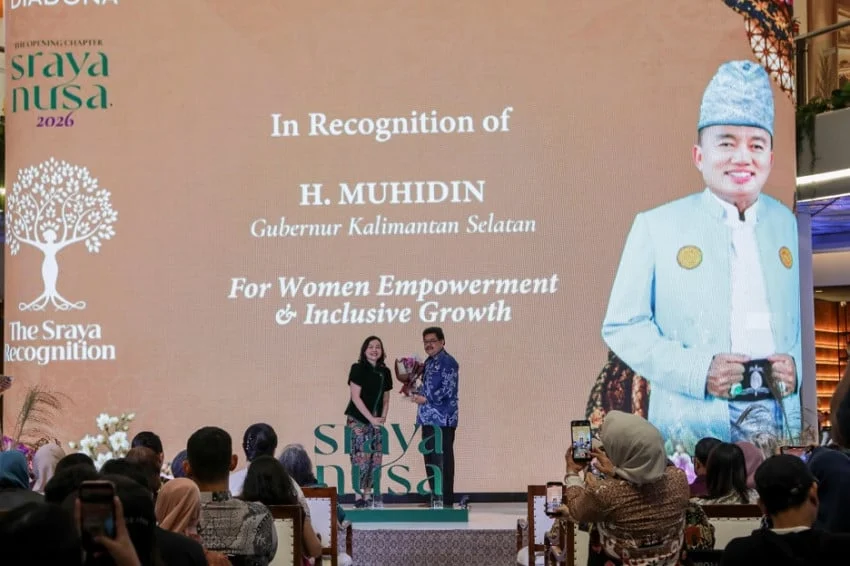
The Provincial Government of South Kalimantan has once again captured national attention for its unwavering commitment to inclusive development and gender equality. In a landmark achievement that underscores regional progress, South Kalimantan Governor H Muhidin was officially honored with The Sraya Recognition for Women Empowerment & Inclusive Growth. The prestigious accolade was presented during the grand ceremonies of the Apresiasi Perempuan Berpengaruh (APB) Sraya Nusantara 2026, held in the nation’s capital, Jakarta, on Friday, September 11, 2026.
This high-profile national recognition is specifically designed to acknowledge and celebrate male regional leaders who have demonstrated visionary leadership through impactful policy-making. These policies must actively improve the socio-economic status of women and protect vulnerable populations within their respective jurisdictions. In the context of South Kalimantan, the award reflects a comprehensive and deliberate policy framework spearheaded by Governor Muhidin. This framework meticulously integrates women empowerment, robust child protection mechanisms, the strengthening of Micro, Small, and Medium Enterprises (MSMEs), and the expansion of essential educational and basic health services into the broader blueprint of regional development.
Chronology and Event Background of APB Sraya Nusantara 2026
The path toward the Apresiasi Perempuan Berpengaruh Sraya Nusantara 2026 began months prior, following a rigorous national evaluation process conducted by policy experts, sociologists, and independent governance watchdogs. The APB Sraya Nusantara initiative serves as a premier annual platform designed to evaluate how regional autonomy translates into tangible social benefits, particularly focusing on gender mainstreaming.
As urbanization and modernization present complex socio-economic challenges across Indonesia, the 2026 edition of the awards specifically emphasized "Inclusive Growth through Grassroots Leadership." The selection committee thoroughly reviewed regional budget allocations, legislative outputs, social welfare programs, and direct community feedback from all 34 provinces and hundreds of districts across the archipelago.
On Friday, September 11, 2026, the culmination of this exhaustive review process took place in Jakarta. High-ranking government officials, civil society leaders, and international development partners gathered to witness the recognition of trailblazing leaders. While Governor Muhidin’s policy portfolio covers a vast array of infrastructural and economic achievements, it was his administration’s intersectional approach—linking economic development directly with social equity for women and children—that ultimately set South Kalimantan apart from its peers.
Strategic Pillars of South Kalimantan’s Inclusive Policy Framework
The policy architecture driving South Kalimantan’s success is built upon several interconnected pillars. Rather than treating women empowerment as a standalone sector, the provincial government has woven gender-responsive budgeting and social inclusion into economic revitalization, educational expansion, and healthcare delivery.
Economic Empowerment and MSME Growth
A cornerstone of Governor Muhidin’s administration is the revitalization of the regional economy through the empowerment of MSMEs, a sector predominantly driven by women entrepreneurs. Statistical data from the region indicates that women-led micro and small enterprises account for a significant majority of the local creative economy and domestic trade landscape.
Under the banner of the provincial motto, "Bekerja Bersama Merangkul Semua" (Working Together, Embracing Everyone), the regional government has systematically rolled out targeted financial literacy training, digital marketing workshops, and facilitated access to low-interest capital for female entrepreneurs. Furthermore, provincial initiatives in food security and creative industries have consciously prioritized female-headed households and women in rural agricultural communities, ensuring they are not left behind in the broader economic transition.
Educational Expansion and Lifelong Learning
Recognizing that sustainable empowerment begins with education, the South Kalimantan administration has placed immense emphasis on expanding educational access across both urban centers and isolated geographical pockets. Through the aggressive promotion and funding of alternative education tracks—specifically the Package A, B, and C equivalence programs—the provincial government has opened vital pathways for lifelong learning.
These programs have proven particularly transformative for women and girls in remote rural territories who may have missed out on formal schooling due to historical, economic, or geographical barriers. By providing flexible learning environments and localized tutoring centers, the province has successfully raised literacy rates and equipped women with the foundational credentials needed to participate meaningfully in the modern workforce.
Healthcare, Maternal Welfare, and Social Safety Nets
Parallel to economic and educational interventions, the provincial administration has significantly upgraded health services aimed at safeguarding the well-being of mothers and children. Enhanced maternal health monitoring, expanded vaccination drives, and targeted nutritional supplementation programs for infants have been integrated into community health centers (Puskesmas) throughout the province. These structural enhancements directly address regional health disparities, ensuring that mothers in peripheral districts receive the same standard of preventative care as those in metropolitan areas.
Infrastructure as a Catalyst for Inclusive Growth
True to the criteria of the Sraya Recognition, South Kalimantan’s development model recognizes that physical infrastructure is intrinsically linked to social inclusion. A prime example is the strategic development of major regional infrastructure projects, such as the landmark Pulau Laut Bridge project.
While initially viewed primarily as a transportation and logistics project designed to connect mainland South Kalimantan with Pulau Laut (Kotabaru Regency), the bridge serves a profound socio-economic purpose. By dismantling geographical isolation, the infrastructure dramatically reduces logistics costs, accelerates the distribution of goods, and opens up new regional markets. For women and local MSME operators in the island regions, this means unprecedented, direct access to larger consumer bases, transforming subsistence-level trading into scalable, profitable enterprises.
Pioneering Digital and Physical Protection for Women and Children
In an era where socioeconomic development must contend with the realities of the digital age, Governor Muhidin’s administration has demonstrated remarkable foresight regarding the protection of women and children from modern threats. On July 27, 2026, a milestone agreement was forged that cemented South Kalimantan’s reputation as a proactive leader in civil safety.
The Provincial Government of South Kalimantan, in a collaborative masterstroke, joined forces with the regional police force (Polda Kalsel), the Ministry of Religious Affairs, relevant regional agencies, and an impressive coalition of 21 higher education institutions. Together, these stakeholders signed a comprehensive memorandum of understanding (MoU) to establish an integrated joint forum.
This forum is dedicated entirely to the prevention and handling of violence, abuse, and cybercrimes targeting women and children. Its jurisdiction spans across traditional educational units, modern schools, and Islamic boarding schools (pondok pesantren), reflecting a holistic approach to institutional safety.
Addressing Modern Vulnerabilities: The Digital Frontier
The inclusion of cybercrime prevention within the provincial protection framework marks a critical evolution in regional governance. As educational institutions and households increasingly embrace digital technologies, women and children have become disproportionately vulnerable to online harassment, digital exploitation, and cyberbullying.
By creating specialized task forces that operate in a coordinated fashion across academic institutions, the South Kalimantan administration has established a vital safety net. This initiative moves beyond reactive law enforcement, prioritizing proactive educational campaigns designed to inoculate the younger generation against the dangers of digital abuse and the misuse of information technology.
Official Statements and Institutional Perspectives
Accepting the award on behalf of the governor, the Head of the South Kalimantan Communication and Information Office (Diskominfo), Muhamad Muslim, articulated the administration’s overarching philosophy during the gala event in Jakarta.
"Numerous priority programs initiated by Governor H Muhidin intentionally place a sharp focus on women, particularly within the critical domains of education, health, and MSME development," stated Muslim during his acceptance speech. "This prestigious recognition serves as tangible, empirical proof of our unwavering institutional commitment to fostering a development model that empowers women, entirely aligned with our guiding ethos of working together and embracing everyone."
Elaborating on the strategic vision behind the administration’s policies, Governor H Muhidin emphasized the necessity of societal education in combating emerging threats. "We harbor a clear and resolute objective: we want to provide comprehensive, forward-looking education to our younger generation regarding the dangers of physical violence, social misconduct, and the modern pitfalls associated with the misuse of digital technology," Governor Muhidin asserted in a subsequent official statement regarding the safety forum initiative.
Broader Implications and Future Outlook for Regional Development
The conferment of The Sraya Recognition for Women Empowerment & Inclusive Growth upon Governor Muhidin carries significant implications not only for South Kalimantan but for the broader national landscape of regional governance in Indonesia.
A Benchmark for Regional Autonomy
In the broader context of Indonesian decentralization, regional heads often face the temptation to prioritize high-visibility, capital-intensive infrastructure projects that offer immediate political optics while neglecting the slower, more intricate work of social human capital development. South Kalimantan’s model effectively disproves this false dichotomy. By demonstrating that infrastructural megaprojects like the Pulau Laut Bridge can be successfully harmonized with grassroots women empowerment and rigorous child protection frameworks, the province has established a replicable template for other regional governments.
Long-Term Socio-Economic Trajectory
The systematic integration of women into the formal economic apparatus through MSME support, coupled with the safeguarding of their physical and digital security, creates a powerful multiplier effect. Econometric analyses consistently show that empowering women yields higher household savings, better educational outcomes for children, and greater overall community resilience against economic shocks.
As South Kalimantan continues to roll out its strategic initiatives through the remainder of 2026 and beyond, the institutionalization of joint protection forums and inclusive economic policies ensures that the province’s growth will remain resilient, equitable, and sustainable. The Sraya Recognition thus serves not merely as a celebration of past achievements, but as a formal endorsement of a progressive governance roadmap—one that proves regional strength is ultimately measured by how effectively a society protects, empowers, and uplifts its most vulnerable members.