The socio-political landscape of Indonesia has undergone a profound transformation since the fall of the New Order regime in 1998. For over three decades, under President Suharto’s centralized administration, the Indonesian-Chinese community was largely stereotyped through a narrow lens: economically resilient yet politically marginalized. However, recent academic discourse and public forums have highlighted a decisive departure from this historical dichotomy. Today, Indonesian-Chinese citizens are increasingly active in the nation’s democratic processes, dismantling outdated prejudices and cementing their identity as integral stakeholders in the republic’s future.
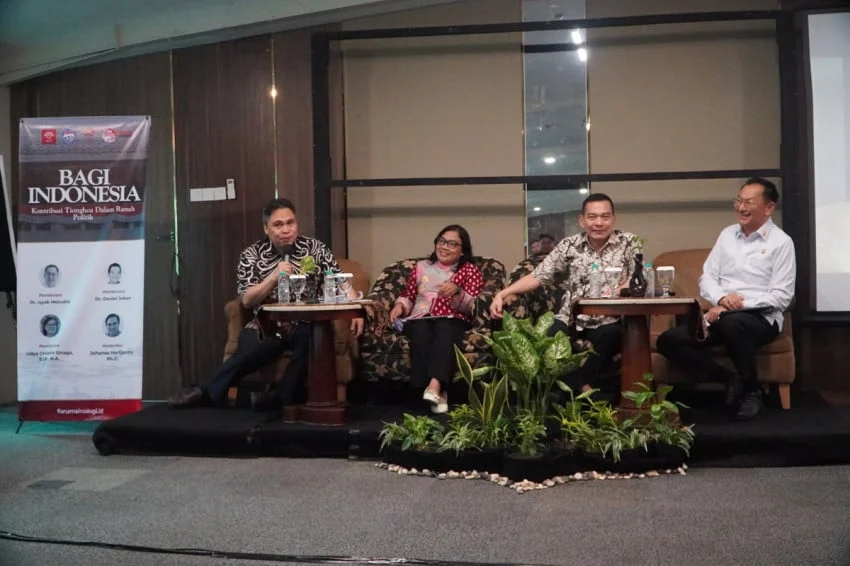
This evolving narrative took center stage during a high-profile public discussion in Jakarta titled Bagi Indonesia: Kontribusi Tionghoa dalam Ranah Politik (For Indonesia: The Contribution of the Chinese in the Political Realm). Organized collaboratively by prominent civil society organizations—including the Indonesian Chinese Association (Perhimpunan INTI), the Indonesian Chinese Youth Association (IPTI), the Indonesian Peranakan Chinese Association (Aspertina), and the Indonesia Sinology Forum (FSI)—the event brought together lawmakers, academic researchers, and policy advisors to examine the expanding role of the Indonesian-Chinese community in national governance.
The panel featured a distinguished lineup of speakers, including Dr. Isyak Meirobie, a lecturer at Podomoro University and Assistant to the Presidential Special Envoy for Communications; Dr. Daniel Johan, a member of the House of Representatives (DPR RI) from the National Awakening Party (PKB) faction; and Lidya Christin Sinaga, a political researcher from the National Research and Innovation Agency (BRIN). The session was expertly moderated by Johanes Herlijanto, providing a comprehensive platform to dissect the historical trajectory, current realities, and future implications of Indonesian-Chinese political engagement.
Historical Context: From Economic Dominance to Political Exclusion
To understand the magnitude of contemporary political participation among Indonesian-Chinese citizens, one must examine the structural constraints of the New Order era (1966–1998). During this period, state policies enforced strict assimilation while simultaneously restricting the minority group’s access to civic and political spheres. Public expressions of Chinese culture, language, and traditions were systematically suppressed under Presidential Instruction No. 14/1967.
Simultaneously, structural dynamics pushed many Indonesian-Chinese individuals toward the private sector and commerce. While a segment of the community achieved notable economic success, this wealth concentration occurred within an insulated environment, reinforcing a dichotomy where the community was viewed primarily as an economic engine devoid of political agency. International observers and domestic analysts alike frequently characterized the group as economically robust but politically vulnerable—a perception that left them exposed during periods of national crisis, most notably during the socio-political upheavals of May 1998.
The Watershed Moment of the Reform Era
The downfall of the New Order in May 1998 marked a critical turning point. The subsequent advent of the Reformasi era ushered in a constitutional and cultural overhaul that dismantled discriminatory regulations. The repeal of restrictive decrees under President Abdurrahman Wahid (Gus Dur) allowed the Indonesian-Chinese community to reclaim their cultural identity, establish media outlets, and, crucially, exercise their constitutional rights to vote and run for public office.
In the decades that followed, this newfound freedom translated into tangible political representation. Indonesian-Chinese politicians began securing seats at various levels of government—from municipal legislative bodies (DPRD) to the national parliament (DPR RI), as well as executive positions such as regents, mayors, and provincial governors. Figures such as Basuki Tjahaja Purnama (Ahok) became prominent symbols of this political awakening, demonstrating that members of the community could compete effectively in mainstream electoral politics and lead diverse constituencies.
The Rise of Inclusive Political Participation
During the Jakarta public discussion, the panelists emphasized that contemporary political engagement by Indonesian-Chinese individuals extends far beyond mere representation; it is characterized by a deeply ingrained sense of inclusivity. BRIN researcher Lidya Christin Sinaga noted that modern political actors from the community routinely build cross-cultural alliances, working hand-in-hand with various ethnic groups across the archipelago.
This inclusivity manifests in policy advocacy, grassroots community development, and nationalist platforms that prioritize broad public welfare over narrow sectarian interests. By aligning their political platforms with the broader socio-economic needs of all Indonesians, these actors demonstrate an unwavering orientation toward Indonesia as their singular homeland.
Member of DPR RI Daniel Johan echoed this sentiment, drawing from his legislative experience. He underscored that the legislative and social contributions of Indonesian-Chinese politicians are rooted in a nationalistic framework. According to Johan, the policy priorities championed by these lawmakers address systemic issues such as economic equity, educational access, and regional development, proving that their legislative compass points firmly toward national progress rather than ethnic favoritism.
Dispelling Persistent Myths Regarding National Loyalty
Despite significant democratic strides, the Indonesian-Chinese community occasionally contends with lingering, anachronistic tropes questioning their national loyalty. Panelists at the Jakarta forum roundly dismissed these notions as baseless and detached from empirical reality.
Dr. Isyak Meirobie pointed out that questioning the patriotism of Indonesian-Chinese citizens is a relic of Cold War-era paranoia and outdated state doctrines. In his analysis, the lived reality of the post-reform generation completely contradicts such skepticism. From disaster relief operations and community health initiatives to legislative contributions in parliament, Indonesian-Chinese citizens have consistently demonstrated civic responsibility and allegiance to the Red and White flag.
"The questions surrounding the loyalty of the Tionghoa community hold no analytical or factual weight," Meirobie stated during the forum. "The empirical evidence from the past two decades shows deep-rooted patriotism, active civic participation, and a shared destiny with the rest of the Indonesian population."
Implications for Indonesia’s Democratic Consolidation
The normalization and expansion of Indonesian-Chinese political participation carry profound implications for Indonesia’s broader democratic trajectory. As the world’s third-largest democracy, Indonesia’s stability hinges upon its adherence to the national motto, Bhinneka Tunggal Ika (Unity in Diversity).
When minority groups participate fully in governance, it strengthens the social contract and enhances the legitimacy of democratic institutions. Political scientists analyzing the BRIN and civil society findings suggest that the active integration of diverse ethnic groups into the political mainstream serves as an effective antidote to identity politics and sectarian polarization.
Furthermore, this dynamic fosters a more mature political culture where competence, integrity, and policy platforms supersede ethnic or religious backgrounds. As younger generations of Indonesian-Chinese citizens enter public service, civil administration, and political parties, the narrative shifts from one of "tolerance" to one of "mutual ownership" of the state.
Broader Economic and Social Spillover Effects
The synergy between economic capability and political engagement has also generated positive externalities for national development. With political representation secured, community leaders and business figures are better positioned to collaborate on public-private initiatives, philanthropic endeavors, and economic revitalization programs.
Organizations like Perhimpunan INTI and IPTI have increasingly transitioned from identity-based cultural societies into civic organizations that spearhead national disaster relief, educational scholarships, and interfaith dialogues. This evolution highlights a maturing community that leverages its resources to strengthen the social fabric of the entire nation.
Conclusion: A Shared Future for the Republic
The discourse generated by the Jakarta public forum underscores a vital truth about modern Indonesia: citizenship is defined by active contribution, constitutional alignment, and shared values, rather than ancestral heritage. The transition of the Indonesian-Chinese community from the economic periphery to the political mainstream is a testament to the resilience of Indonesia’s democratic institutions.
As empirical research from institutions like BRIN and insights from frontline lawmakers demonstrate, the political integration of the Indonesian-Chinese community is not merely a milestone for a single ethnic group, but a victory for the republic as a whole. By burying outdated prejudices and embracing a truly inclusive political ecosystem, Indonesia continues to strengthen its foundation as a pluralistic, democratic nation equipped to face the challenges of the 21st century.