
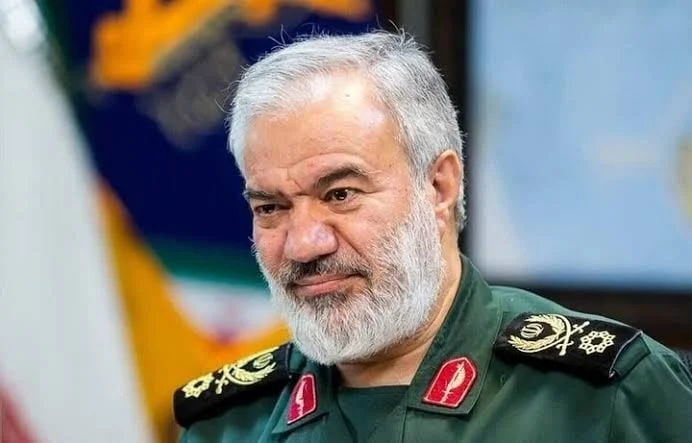
The geopolitical landscape of the Persian Gulf remains a focal point of global security, characterized by a persistent and precarious standoff between the United States and the Islamic Republic of Iran. In a recent development, Ali Fadavi, the deputy commander and head of the advisory group to the commander of the Islamic Revolutionary Guard Corps (IRGC), asserted that United States naval assets have been forced to relocate their operational footprint more than 1,000 kilometers away from Iranian maritime borders. This claim, if accurate, underscores a strategic recalibration in the region, reflecting the heightened state of readiness maintained by Iranian forces.
According to Fadavi, the IRGC’s rapid and aggressive response mechanisms have effectively compelled the U.S. Navy to maintain a substantial buffer zone. He maintained that Iran’s defensive posture acts as a deterrent, preventing American incursions into territory that Tehran considers its sovereign maritime domain. This narrative of deterrence, frequently touted by Iranian military leadership, is intended to project strength to both domestic audiences and international observers, signaling that the Islamic Republic remains unbowed by external military posturing.
Contextualizing the Maritime Standoff
The Persian Gulf is a vital artery for global energy markets, with a significant portion of the world’s crude oil supply transiting through the Strait of Hormuz. Consequently, the presence of the U.S. Fifth Fleet and its associated task forces in the region has been a permanent fixture for decades. However, the nature of this presence has evolved from routine patrol to a high-stakes game of brinkmanship.
For the United States, maintaining a presence in the region is essential for protecting freedom of navigation and supporting regional allies. For Iran, the presence of U.S. warships is viewed as an existential threat and a violation of its regional security interests. The friction between these two powers has resulted in numerous "close encounters" over the years, involving fast-attack boats, reconnaissance drones, and electronic warfare assets.
Chronology of Escalation and Drone Incidents
The recent rhetoric from IRGC leadership coincides with a history of kinetic incidents that have brought the two nations to the brink of open conflict. A pivotal moment in this timeline was the reported downing of a United States drone in the vicinity of the Strait of Hormuz.
- June 2019: The IRGC successfully shot down a U.S. RQ-4 Global Hawk, a sophisticated surveillance drone, claiming it had violated Iranian airspace near the Strait of Hormuz. The incident sparked a massive surge in regional tensions and nearly led to a retaliatory strike by the Trump administration.
- November 2026 (Reported): Reports surfaced concerning the destruction of an American MQ-1 drone over Qeshm Island. This event, as cited by Fars News Agency, highlights the continued vulnerability of unmanned aerial assets in contested airspace and the IRGC’s commitment to enforcing its air defense perimeter.
- Ongoing Deterrence: Throughout this period, Iran has utilized its domestically produced "Seyed-ol-Shohada" and "Khordad 3" air defense systems to track and intercept foreign aerial platforms, asserting that no violation of its sovereign territory will go unanswered.
Economic Warfare and Strategic Resilience
Beyond the military theater, the conflict has been deeply defined by economic measures. Ali Fadavi’s recent statements emphasize that the "maximum pressure" campaign—a series of stringent economic sanctions imposed by Washington—has failed to achieve its intended political outcomes. Despite the severe constriction of Iran’s oil exports and access to international banking systems, the Iranian government has consistently demonstrated a capacity to absorb economic shocks while pivoting toward alternative trade partners in Asia.
Analysts observe that the failure of sanctions to induce regime change or significant shifts in Iran’s regional foreign policy has led to a strategic stalemate. While the United States continues to utilize economic leverage to restrict Tehran’s ability to fund its regional proxies, the IRGC remains well-resourced, prioritizing its missile program and naval modernization as the primary pillars of its national security strategy.
Perspectives from Washington: The Diplomatic Calculus
The U.S. perspective on the standoff is nuanced, balancing the need for a robust military posture with the recognition that full-scale war would be catastrophic for global stability. Sergio de la Pena, a former deputy assistant secretary of defense for Western Hemisphere affairs, has provided critical insights into the American strategic mindset.
De la Pena noted that while the United States possesses overwhelming military superiority—encompassing air, sea, and cyber domains—kinetic engagement is not considered the optimal path forward. "The situation is inherently fluid," de la Pena explained. "The menu of options remains open, and the strategy is to manage these escalations through a combination of deterrence and diplomatic signaling. If there is a viable path toward de-escalation, Washington remains prepared to explore it."
This sentiment reflects the broader internal debate within the U.S. national security establishment. There is a palpable concern that an accidental skirmish could spiral into a regional conflagration, necessitating a careful calibration of naval movements and reconnaissance flights to avoid miscalculations.
Implications for Regional Security
The claims made by IRGC officials regarding the displacement of U.S. naval assets suggest a strategic desire to redefine the rules of engagement in the Persian Gulf. If Iranian forces believe that their defensive posture can effectively "push" U.S. forces further out to sea, it may encourage more aggressive maneuvers in the future.
Conversely, for the United States and its partners, the continued presence of naval task forces remains a non-negotiable aspect of regional policy. The implications of this are significant:
- Increased Risk of Miscalculation: With both sides operating in close proximity with highly advanced weaponry, the margin for human error or technical failure is razor-thin.
- Technological Arms Race: The focus on drones and anti-access/area-denial (A2/AD) capabilities suggests that both sides are prioritizing asymmetric warfare over traditional naval engagements.
- Regional Alliance Dynamics: Neighboring states, such as Saudi Arabia, the UAE, and Qatar, find themselves caught in the middle. The persistence of the U.S.-Iran standoff forces these nations to navigate a complex path between their reliance on U.S. security guarantees and the necessity of maintaining functional ties with Tehran to ensure regional stability.
Analytical Perspective: The "Gray Zone" Conflict
The current situation is a classic example of "gray zone" warfare—conflict that exists between peaceful competition and open war. In this environment, military assets are used for signaling rather than direct combat. The reported 1,000-kilometer withdrawal of U.S. ships, while framed by the IRGC as a victory, may also be interpreted by military analysts as a tactical shift. Moving assets further from the Iranian coastline could be a deliberate attempt to reduce the risk of provocation or to reposition forces for broader regional coverage, rather than a retreat under duress.
Furthermore, the technological sophistication of the IRGC’s air defense systems suggests that Iran has invested heavily in closing the intelligence gap. By successfully targeting drones like the MQ-1, Iran demonstrates a capability to challenge the United States’ aerial dominance, forcing the U.S. military to reconsider its reliance on unmanned platforms in high-threat environments.
Conclusion: A Precarious Future
As the situation develops, the core tension remains unresolved. The Islamic Republic of Iran shows no indication of abandoning its regional objectives or its reliance on the IRGC as the vanguard of its national security. Simultaneously, the United States remains committed to maintaining its strategic reach in the Persian Gulf, even as it weighs the costs and risks of military intervention.
The recent claims by Ali Fadavi serve as a reminder that in the theater of the Persian Gulf, perception is as important as reality. Whether the U.S. naval repositioning is a response to Iranian threats or a standard rotational adjustment, the rhetoric surrounding it underscores the ongoing battle for influence. As long as the two nations remain at an impasse, the waters of the Strait of Hormuz will continue to be a primary barometer for global peace, requiring constant diplomatic vigilance and clear communication to prevent the current cold standoff from turning into a hot conflict.
The international community continues to monitor these developments with concern, hoping that the "dynamic" nature of the situation, as described by experts like de la Pena, will eventually lean toward stabilization rather than further escalation. Until then, the IRGC and the U.S. Fifth Fleet will continue their uneasy dance, separated by both distance and ideology, in one of the world’s most critical maritime corridors.
