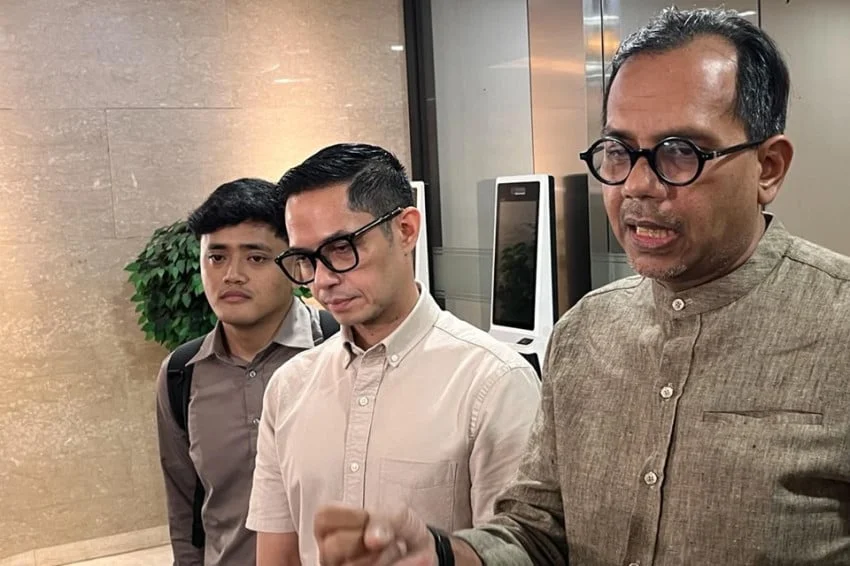
Prominent Indonesian actor Dude Harlino officially visited the Criminal Investigation Agency of the Indonesian National Police, known as Bareskrim Polri, on Thursday, July 23, 2026, to voluntarily surrender a substantial sum of money totaling Rp 5.25 billion. This amount represents the entirety of the professional fees received by Dude and his wife, fellow actress Alyssa Soebandono, during their tenure as brand ambassadors for PT Dana Syariah Indonesia (DSI). The move comes amidst a widening investigation into the financial activities and alleged irregularities of the Sharia-compliant investment firm, which has recently come under intense scrutiny by law enforcement agencies.
Accompanied by his legal representative, Haris Azhar, Dude Harlino’s arrival at the Bareskrim headquarters in Jakarta signaled a proactive approach to a complex legal situation that has entangled several high-profile public figures. The return of these funds is a significant development in the ongoing probe, highlighting the ethical and legal pressures faced by celebrities who represent financial platforms that later face allegations of fraud or mismanagement.
Voluntary Surrender and Legal Rationale
The legal team representing Dude Harlino emphasized that the return of the Rp 5.25 billion was not the result of a direct court order or a forced seizure by investigators. Instead, it was characterized as a voluntary initiative driven by the actor’s personal ethics and concern for the individuals who have suffered financial losses through PT Dana Syariah Indonesia.
Speaking to a gathered crowd of reporters at the Bareskrim building, Haris Azhar clarified the nature of the transaction. "The examination today is related to the handover of money from Dude Harlino," Azhar stated. "The amount is equivalent to the fees received for the services provided by Dude and his wife as brand ambassadors for DSI, totaling Rp 5.25 billion."
Azhar further elaborated that Dude Harlino felt a moral obligation to distance himself from the company’s financial dealings once the scale of the alleged discrepancies became public. The actor expressed deep concern for the victims—investors who had placed their trust and savings into DSI, often influenced by the wholesome and religious image projected by the brand’s high-profile ambassadors. By returning the honorarium, Dude aims to ensure that these funds can potentially be used as part of a restitution pool for those impacted by the company’s collapse.
Background: The Rise and Fall of PT Dana Syariah Indonesia
PT Dana Syariah Indonesia emerged several years ago as a promising player in Indonesia’s burgeoning financial technology (fintech) sector. Marketing itself as a Sharia-compliant peer-to-peer (P2P) lending and investment platform, it specifically targeted the Muslim middle class, offering investment opportunities in property and business ventures that adhered to Islamic principles.
The inclusion of Dude Harlino and Alyssa Soebandono as brand ambassadors was a strategic move by the company to build credibility. Known for their pious public personas and stable family life, the couple provided DSI with a level of trust that few other celebrities could offer. For several years, the partnership appeared successful, with DSI reporting significant growth in its user base and managed funds.
However, the tide turned in late 2025 when investors began reporting difficulties in withdrawing their funds and receiving promised returns. What started as "technical glitches" soon evolved into a systemic failure of the platform. Investigations by the Financial Services Authority (OJK) and subsequently Bareskrim Polri revealed potential mismanagement, lack of liquidity, and allegations that funds were being diverted to unauthorized projects. By the time the police stepped in, the estimated losses incurred by thousands of investors across Indonesia had reached hundreds of billions of rupiah.
The Chronology of Legal Involvement
The involvement of Dude Harlino in the police investigation has followed a structured timeline, typical of cases involving high-profile witnesses in financial crime probes:
- Late 2025 – Early 2026: Public complaints against PT Dana Syariah Indonesia spike. Bareskrim Polri opens an official investigation into allegations of embezzlement and violations of the Information and Electronic Transactions (ITE) Law.
- March 2026: Investigators begin auditing the financial records of DSI, identifying significant payments made to various marketing agencies and celebrity influencers.
- May 2026: Dude Harlino and Alyssa Soebandono receive their first summons for questioning as witnesses. The police aim to determine whether the ambassadors were aware of the company’s internal financial state or if they played any role in the management beyond their promotional duties.
- June 2026: During initial questioning, Dude Harlino expresses his shock at the allegations and pledges full cooperation with the authorities. He provides documentation regarding his contract and the payments received.
- July 23, 2026: Following internal discussions and legal counsel, Dude Harlino returns to Bareskrim to officially hand over the Rp 5.25 billion in fees, citing empathy for the victims and a desire to maintain his integrity.
Legal Implications for Brand Ambassadors in Indonesia
The case of Dude Harlino and PT DSI brings to the forefront a recurring issue in the Indonesian legal system: the liability of celebrities who endorse fraudulent investment schemes. Under the Law on the Prevention and Eradication of the Crime of Money Laundering (TPPU), individuals who receive proceeds from a crime can, in some circumstances, be held liable if they knew or "should have suspected" that the money originated from illegal activities.
In recent years, Bareskrim has taken a firm stance on this issue. Following the high-profile "Crazy Rich" cases involving binary options and Ponzi schemes (such as the DNA Pro and Binomo cases), the police have consistently encouraged public figures to return fees earned from companies under investigation. While returning the money does not automatically grant immunity from prosecution, it is viewed as a significant act of good faith that often prevents the individual from being named as a suspect in money laundering.
For Dude Harlino, the decision to return over five billion rupiah serves as a protective legal measure. It demonstrates that he did not intend to profit from the misfortune of others and that his involvement with DSI was strictly a professional engagement based on the information available to him at the time of the contract.
Reactions from Victims and the Public
The response to Dude Harlino’s move has been largely positive, though it has also sparked a broader debate about the responsibilities of influencers.
A representative for the "DSI Victims Communications Forum," an organization representing over 500 affected investors, expressed cautious optimism. "We appreciate Mr. Dude’s willingness to return the money. While five billion is only a small fraction of the total losses, it sets a moral precedent. We hope other influencers who took money from DSI will follow suit so that the funds can eventually be returned to the people who lost their life savings," the representative stated.
On social media, the reaction was mixed. Many fans praised Dude Harlino for his "gentlemanly" and "Islamic" response to the crisis, reinforcing his image as a man of principle. Conversely, some critics argued that celebrities should perform more rigorous due diligence before lending their faces to financial products, suggesting that their endorsement is what led many to trust the platform in the first place.
The Role of the Financial Services Authority (OJK)
The DSI scandal has also placed the OJK under the spotlight. Critics argue that the regulatory body should have detected the irregularities in DSI’s operations much earlier. In response to the growing number of fintech-related crimes, the OJK has recently updated its regulations regarding the use of "finfluencers" and brand ambassadors for financial products.
The new guidelines require celebrities to verify that the company they are promoting holds a valid and active license for the specific services being advertised. Furthermore, ambassadors are now encouraged to include disclaimers in their promotions, highlighting the risks associated with investments. The Dude Harlino case is expected to accelerate the enforcement of these regulations, as the government seeks to protect the public from increasingly sophisticated financial scams.
Broader Impact on the Entertainment Industry
The surrender of such a large sum of money is likely to have a "chilling effect" on the celebrity endorsement market in Indonesia. Talent agencies and managers are reportedly becoming more cautious, requiring comprehensive audits of potential corporate clients before signing brand ambassador deals.
"The era of just taking a paycheck for a photoshoot is over," says a prominent Jakarta-based talent manager. "Cases like Dude Harlino’s show that your entire reputation, and a significant amount of your earnings, can be at risk if the company you represent fails the legal test. We are now hiring third-party financial auditors to vet any fintech or investment firms that want to work with our talent."
Conclusion: A Step Toward Justice
As Bareskrim Polri continues its investigation into PT Dana Syariah Indonesia, the Rp 5.25 billion returned by Dude Harlino will be held as evidence and potentially liquidated into a compensation fund for victims, pending a court ruling. The police have indicated that further summonses may be issued for other public figures associated with the company as they work to trace the flow of funds.
For Dude Harlino, the move represents a difficult but necessary step to clear his name and uphold the values he has publicly championed throughout his career. While the legal process for PT DSI is far from over, the actor’s proactive stance provides a rare example of accountability in the often-opaque world of celebrity endorsements and financial speculation. The case remains a stark reminder of the potential consequences when the worlds of high-stakes finance and mass-media stardom collide, leaving thousands of ordinary citizens caught in the middle.