
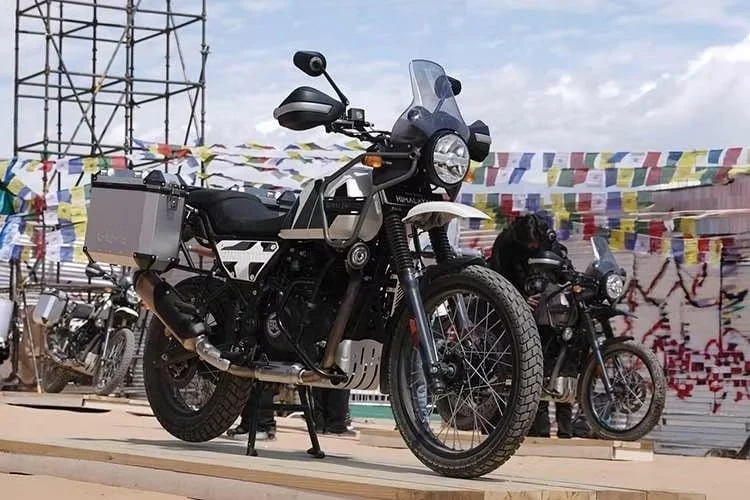
The global adventure motorcycle segment is witnessing a strategic shift as heritage manufacturers balance modern technological advancements with the timeless appeal of mechanical simplicity. Royal Enfield, a dominant player in the mid-size motorcycle market, has officially announced the launch of the Royal Enfield Himalayan 440 for the 2026 model year. Rather than discarding a decade of goodwill built by its predecessor, the company has elected to honor the tenth anniversary of the Himalayan lineup by breathing new life into the architecture that started it all.
At its core, the new Himalayan 440 is an evolution of the beloved Himalayan 411. It retains the rugged, no-nonsense silhouette and mechanical familiarity that won over expedition riders across the globe, while seamlessly integrating the updated 440cc engine platform derived from the upcoming Scram 440. Furthermore, the motorcycle incorporates modern connectivity features such as Royal Enfield’s proprietary Tripper navigation system. By positioning the Himalayan 440 alongside the contemporary, liquid-cooled Himalayan 450, the manufacturer is executing a dual-track strategy designed to cater to distinct segments of the adventure-touring community—those who demand cutting-edge performance and those who prioritize mechanical purity, ease of maintenance, and accessible adventure touring.
Chronology and Evolution: A Decade of Himalayan Heritage
To understand the significance of the 2026 Himalayan 440, one must examine the trajectory of Royal Enfield’s adventure portfolio over the past ten years. When the original Himalayan 411 made its debut, it carved out a unique niche in the global market. While other manufacturers focused on increasingly complex, high-horsepower, and expensive adventure flagships, Royal Enfield introduced a motorcycle that was lightweight, approachable, and capable of handling unforgiving terrain without intimidating the rider.
Over the years, the Himalayan 411 became a staple for independent travelers, overland expeditions, and everyday commuters in developing and developed markets alike. However, tightening global emissions regulations and a consumer demand for higher cruising speeds prompted the development of the completely redesigned, liquid-cooled Himalayan 450. Launched to critical acclaim, the 450 shifted the brand into a more modern technological bracket.
Despite the commercial success of the newer flagship, a vocal segment of the motorcycle community continued to voice an affinity for the air-cooled simplicity, robust steel frames, and classic ergonomics of the original 411 platform. Recognizing this enduring loyalty, Royal Enfield’s engineering division conceptualized a bridge between the past and the present. The culmination of this effort is the Himalayan 440, arriving just in time to mark a decade of the Himalayan lineage. By utilizing the displacement-bumping 440cc architecture, the brand has revitalized the legacy platform, ensuring it meets modern performance standards while preserving the soul of the original expedition machine.
Engineering and Technical Specifications
Beneath its familiar aesthetic, the 2026 Royal Enfield Himalayan 440 introduces a series of mechanical enhancements designed to elevate its capability both on and off the tarmac. The motorcycle is constructed around a robust semi-double-cradle frame, engineered to absorb the severe impacts associated with off-road riding while maintaining structural rigidity during highway cruising.
Suspension duties are handled by a traditional telescopic fork setup at the front and a linkage-type monoshock at the rear. However, compared to its sibling, the Scram 440, Royal Enfield has substantially increased the suspension travel on the Himalayan 440 to better suit genuine adventure-touring demands. The front suspension offers an impressive 200mm of wheel travel, while the rear monoshock provides 180mm. For context, the Scram 440 features 190mm of front travel and 180mm at the rear, underscoring the Himalayan’s dedicated focus on rough-terrain absorption and ground clearance.
Ground clearance is a critical metric for any adventure motorcycle, and the Himalayan 440 delivers with a generous 220mm clearance height, surpassing the 200mm found on the Scram 440. This elevated stance allows the machine to clear substantial obstacles, rocks, and deep ruts without compromising the integrity of the engine casing or exhaust system.
True to its adventure credentials, the motorcycle rolls on wire-spoke wheels, utilizing a traditional 21-inch front wheel paired with a 17-inch rear wheel. This combination remains the gold standard for off-road enthusiasts, as it allows riders to choose from a vast array of heavy-duty, knobby adventure tires designed to conquer mud, sand, gravel, and rock.
Stopping power has also received a comprehensive upgrade. The braking system consists of a large 300mm front disc brake and a 240mm rear disc brake. In a technical brief accompanying the launch, Royal Enfield emphasized that the brake calipers have been redesigned and upgraded with larger pistons. This modification significantly enhances initial bite, overall braking performance, and thermal management during prolonged descents or heavy-load touring.
Safety and control are further bolstered by a dual-channel Anti-lock Braking System (ABS). Crucially for off-road riders, the system allows the rear ABS to be completely deactivated. Disengaging the rear ABS enables riders to lock the rear wheel intentionally, facilitating controlled slides, sharper cornering maneuvers on loose surfaces, and superior management of descents on steep, unpaved gradients.
Technological Integration: The Tripper Navigation System
While the mechanical heart and chassis of the Himalayan 440 lean heavily into traditional values, the cockpit brings the motorcycle into the modern era of connected riding. The integration of Royal Enfield’s Tripper navigation pod represents a pragmatic approach to rider technology.
Developed in partnership with Google, the Tripper system is a dedicated, turn-by-turn navigation display that pairs seamlessly with the rider’s smartphone via the Royal Enfield app. Rather than incorporating a distracting, full-color tablet display that might detract from the analog charm of the machine, the minimalist circular pod provides clear, intuitive directional arrows and distance indicators. This ensures that riders can navigate unfamiliar territory without the visual clutter often found on contemporary high-end adventure motorcycles, maintaining the clean, expedition-ready ethos of the Himalayan line.
Market Positioning and Commercial Strategy
The introduction of the Royal Enfield Himalayan 440 for the 2026 model year is a calculated commercial maneuver. By offering the Himalayan 440 alongside the more technologically advanced Himalayan 450, Royal Enfield is effectively segmenting its adventure portfolio into two distinct tiers.
The Himalayan 450 caters to riders seeking modern liquid-cooled performance, higher horsepower outputs, ride-by-wire throttle modes, and a comprehensive TFT infotainment display. It competes directly in the fiercely contested sub-500cc adventure class against sophisticated rivals from European and Japanese manufacturers.
Conversely, the Himalayan 440 targets a demographic that values mechanical transparency, field-repairability, and a lower cost of ownership. In many developing markets and remote regions where electronic diagnostic tools are scarce, the simpler air-cooled platform of the 440 is viewed as a distinct advantage. Furthermore, riders who prefer a classic aesthetic without compromising on fundamental touring capabilities will find the new model an attractive proposition.
Industry analysts note that this dual-model strategy minimizes the risk of alienating traditionalists while capturing market share from riders who might find the Himalayan 450 too complex or expensive. Dealership networks have reported that customer pre-orders for the Himalayan 440 opened immediately following the official announcement, indicating robust underlying demand for the platform.
Broader Industry Implications and Analysis
The release of the Royal Enfield Himalayan 440 carries several important implications for the mid-size motorcycle segment. First, it demonstrates a growing industry trend where manufacturers recognize that progress does not always necessitate the abandonment of heritage platforms. As motorcycle prices climb globally due to stricter emissions regulations and advanced safety electronics, the ability to refresh a proven, cost-effective architecture provides a vital economic buffer for consumers.
Second, the platform sharing between the Scram 440 and the Himalayan 440 highlights Royal Enfield’s efficient modular manufacturing strategy. By leveraging the 440cc engine across multiple models, the company optimizes research and development expenditures, streamlines supply chain logistics, and passes manufacturing cost savings onto the end consumer.
Finally, the focus on practical off-road enhancements—such as increased suspension travel, higher ground clearance, and switchable rear ABS—reinforces Royal Enfield’s commitment to authentic adventure riding. Rather than building a crossover designed primarily for urban commuting with pseudo-adventure styling, the Himalayan 440 remains fundamentally engineered for exploration.
As the first units prepare to roll onto showroom floors, the 2026 Royal Enfield Himalayan 440 stands as a testament to the endurance of classic design principles. By successfully marrying a trusted legacy chassis with an upgraded 440cc engine and essential modern connectivity, Royal Enfield has ensured that the spirit of the original Himalayan will continue to inspire a new generation of overlanders and adventure enthusiasts for years to come.
