The night sky over Senayan in Central Jakarta bore witness to a monumental event in contemporary live music history as American musical icon Kanye West, widely known as Ye, delivered a breathtaking and visually arresting performance at the Stadion Utama Gelora Bung Karno (SUGBK). Tens of thousands of enthusiastic spectators packed the iconic Indonesian venue on Saturday evening, October 24, 2026, to witness a concert experience that transcended traditional musical performances, merging avant-garde architecture, high-definition digital artistry, and theatrical production on an unprecedented scale.
The centerpiece of the entire production, which immediately captured the attention of the massive audience and media personnel from the iNews Media Group (IMG) stationed at the venue, was a colossal 360-degree dome stage. Erected majestically in the center of the stadium’s lush green turf, the structure served as the absolute gravitational center of the evening’s visual and auditory journey. This architectural marvel redefined concert staging standards in Southeast Asia, offering every single attendee in the sold-out stadium an uninhibited, immersive view of the performance.
Architectural Innovation and Immersive Visual Engineering
The defining technical achievement of the evening was the massive semicircular dome structure integrated seamlessly with state-of-the-art, high-resolution projection mapping technology. Rather than relying on traditional LED video walls flanking a standard rectangular stage, the production team utilized the curved surface of the dome as a dynamic, living canvas that continuously shifted the environmental context of the stadium.
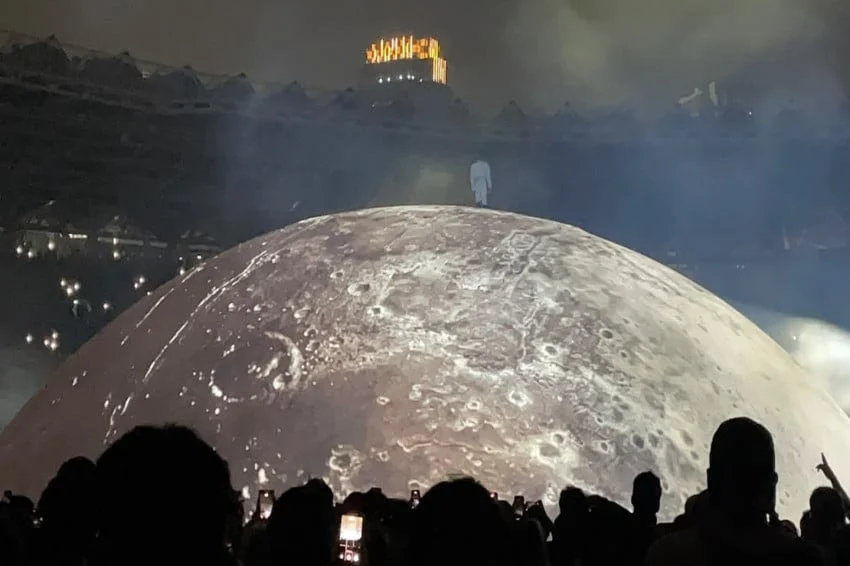
In the early moments of the set, the dome transformed into a hyper-realistic projection of planet Earth. Spectators were treated to a mesmerizing view of sprawling continents and deep blue oceans, rendered with astonishing clarity that made the massive stadium feel intimately connected to the cosmos. As the set progressed, a magical and seamless visual transition occurred across the curved surface of the structure. The terrestrial blue hues dissolved, replaced by an impeccably detailed simulation of the lunar surface. Every crater, ridge, and silver-gray shadow of the Moon was projected onto the dome with startling realism, effectively transporting the tens of thousands of fans from the heart of Jakarta into deep space.
At the very pinnacle of this lunar structure—standing triumphantly at the zenith of the dome—stood Kanye West himself. Clad in his signature oversized, minimalist streetwear ensemble, the artist cut a striking, solitary silhouette against the celestial backdrop. This staging created a profoundly dramatic visual illusion, positioning the musician not merely as a performer on a stage, but as a central celestial body commanding the surrounding universe. The synchronization between his towering physical placement, the immersive audio engineering, and the shifting planetary projections created an unforgettable sensory spectacle that sent the crowd into a state of ecstatic jubilation.
Chronology and Event Background
The path to Kanye West’s triumphant return to Southeast Asia had been the subject of intense speculation and rigorous planning for months leading up to the October 2026 date. Promoters and local authorities worked closely behind the scenes to secure the necessary permits and oversee the complex logistical requirements of assembling the custom 360-degree dome stage inside Indonesia’s premier sporting arena.
Preparation for the event began weeks prior, requiring heavy equipment transport, specialized rigging crews, and extensive acoustic testing to ensure that the open-air bowl of SUGBK could handle the demanding frequency ranges of Ye’s avant-garde production catalog. By Friday afternoon, the final structural integrity checks of the dome stage were completed, setting the stage for Saturday’s historic event.
Gates officially opened to the public in the late afternoon, drawing a massive, diverse demographic of music enthusiasts, fashion aficionados, and international travelers who had flown into Jakarta specifically for the concert. Security protocols were heavily enforced by local law enforcement and private security details, ensuring a smooth entry process for the tens of thousands of ticket holders. By 8:00 PM local time, the stadium stands and the festival-style floor zones were entirely packed to capacity. The atmosphere shifted from anticipatory murmurs to a deafening roar as the house lights dimmed, signaling the activation of the projection mapping system and the dramatic entrance of the artist atop the towering dome.
Supporting Data and Production Logistics
Stadion Utama Gelora Bung Karno, historically renowned for hosting monumental political gatherings, international association football matches, and massive pop music acts, underwent a specialized operational transformation to accommodate Kanye West’s unique technical rider. The 360-degree dome stage required a reinforced sub-floor construction built directly over the pitch protection system to prevent long-term damage to the turf.
The technical specifications of the production included:
- Over 50 high-output laser projectors calibrated to wrap seamless imagery around the entire circumference of the dome.
- A multi-directional, surround-sound acoustic array designed to overcome the natural delay issues often associated with open-air stadium concerts of this magnitude.
- A dedicated logistics crew of over 300 international and local staging technicians working around the clock during the build-up phase.
- A peak attendance figure estimated at approximately 65,000 spectators, making it one of the largest ticketed single-artist events held at SUGBK in recent years.
The choice of Jakarta as a primary stop on this international routing highlights the growing economic and cultural significance of the Indonesian capital within the global touring circuit. Major international promoters have increasingly recognized the high demand for western avant-garde hip-hop and electronic productions in the region, paving the way for larger investments in cutting-edge stage technology previously reserved exclusively for North American and European markets.
Official Responses and Stakeholder Reactions
In the wake of the concert, representatives from local tourism boards, event promotion agencies, and municipal authorities expressed immense satisfaction with the operational success and economic fallout of the event.
Local hospitality and tourism stakeholders noted a significant surge in hotel occupancy rates across Central and South Jakarta over the weekend, driven by regional tourists traveling from neighboring countries such as Malaysia, Singapore, and the Philippines. Restaurants, transport services, and retail centers in proximity to the Gelora Bung Karno complex similarly reported substantial increases in consumer activity.
Event organizers emphasized that the successful execution of such a complex, technology-heavy production proves Jakarta’s infrastructural readiness to host world-class entertainment spectacles. Despite the logistical hurdles of managing a crowd of tens of thousands of people around a non-traditional central stage layout, municipal police and security coordinators confirmed that the event concluded without major security incidents or public safety disruptions.
Broader Impact and Industry Implications
Kanye West’s performance at SUGBK is expected to leave a lasting imprint on the live entertainment landscape in Indonesia and the wider Southeast Asian region. By successfully deploying a complex 360-degree dome stage—a format that challenges traditional front-facing concert paradigms—the production has raised the bar for what audiences and artists alike expect from stadium-scale concerts.
From an artistic perspective, the seamless integration of real-time environmental projection mapping with minimalist, theatrical performance art demonstrates a continuing evolution in how contemporary musicians present their work live. Rather than relying on standard pyrotechnics and conventional pop choreography, the concert prioritized conceptual storytelling, utilizing scale, architecture, and visual astronomy to translate abstract themes into tangible audience experiences.
Furthermore, the commercial success of the event serves as a strong indicator of market resilience and consumer appetite for high-ticket, premium international entertainment experiences within Indonesia. As global touring networks continue to expand their geographic footprints beyond traditional Western strongholds, events of this caliber underscore Jakarta’s growing status as an essential hub for major cultural milestones. The echoes of Saturday night’s performance—both the visual brilliance of the lunar dome and the collective energy of tens of thousands of voices echoing through Senayan—will undoubtedly resonate within the regional music industry for years to come.