
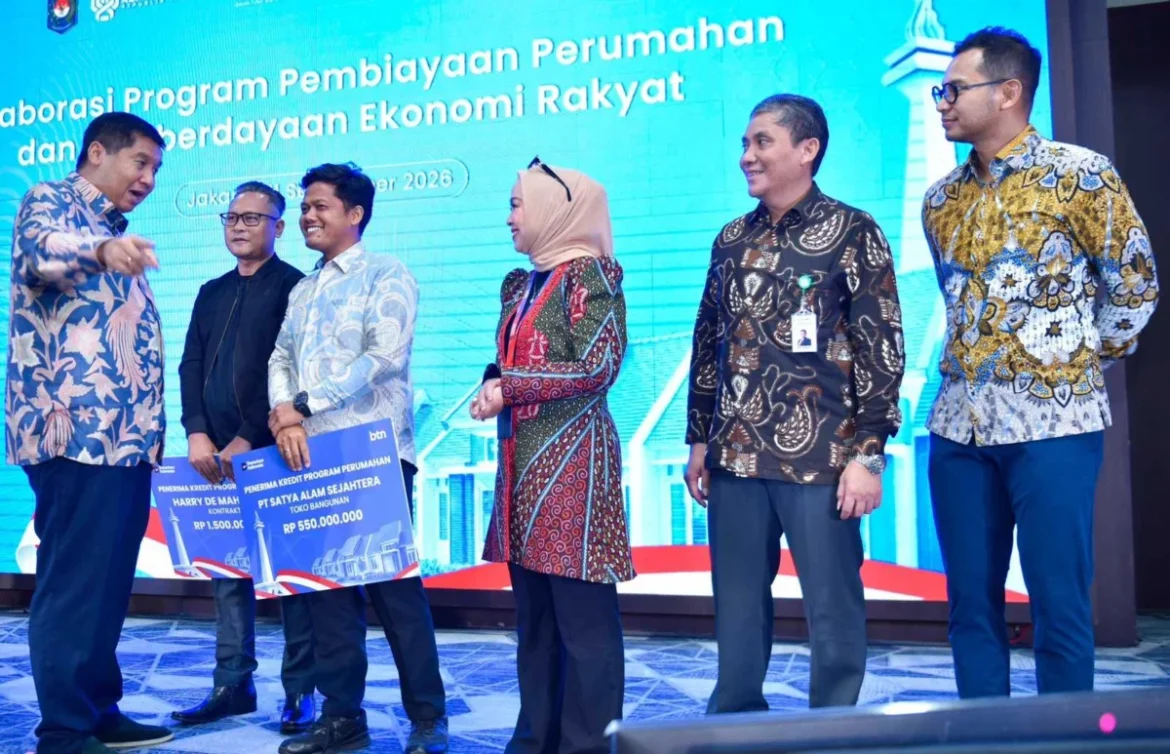
PT Bank Tabungan Negara (Persero) Tbk (BTN) has solidified its strategic position as a primary catalyst in Indonesia’s housing sector by achieving a cumulative disbursement of Rp7.4 trillion through the government’s Housing Program Credit (Kredit Program Perumahan – KPP). This milestone reflects the bank’s active engagement in expanding financial inclusion, bolstering residential infrastructure supply, and empowering productive-sector communities to stimulate grassroots economic growth. The ongoing execution of the KPP framework underscores a concerted effort by state financial institutions and housing authorities to bridge the country’s persistent housing backlog while concurrently nurturing micro, small, and medium enterprises (MSMEs) embedded within the broader property ecosystem.

The comprehensive rollout of the initiative comprises two core pillars designed to address structural needs across the housing market: the KPP Supply mechanism and the KPP Demand scheme. Since the inception of the program, BTN has channeled Rp5.4 trillion toward the supply side—focusing on developers, contractors, and building material merchants—and allocated Rp2.0 trillion toward the demand side, extending credit lines to individual entrepreneurs and working-class families seeking to acquire, construct, or renovate properties that double as commercial spaces.
Strategic Architecture of KPP Supply and Demand
During a dedicated socialization event held at Menara BTN in Jakarta, Corporate Banking Director Helmy Afrisa elaborated on the dual-pronged philosophy governing the financial institution’s strategy. According to Helmy, the distinct strength of the KPP framework lies in its capacity to simultaneously stimulate macro-level property development and micro-level household productivity.

"Through KPP Supply and KPP Demand, BTN is actively endeavoring to broaden financing access throughout the entire housing ecosystem. Our objective is to ensure this program not only accelerates the physical provision of residential units but also elevates the operational productivity of business operators, thereby serving as a tangible engine for grassroots economic mobility," Helmy stated.
Under the operational guidelines of the supply-side financing, accredited property developers, licensed contractors, and regional building material suppliers are eligible for credit facilities carrying maximum ceilings of up to Rp5 billion. This liquidity injection is engineered to alleviate capital constraints that frequently hinder small-scale contractors and local developers from scaling their operations or executing high-volume affordable housing projects.

Conversely, the demand-side intervention targets individual MSME operators, offering tailored financing solutions with ceilings reaching up to Rp500 million. This specific allocation is purposefully tailored to empower self-employed merchants and small business owners to secure functional living spaces that integrate residential utility with commercial enterprise, thereby maximizing household income-generation potential.
Market Response and Regional Absorption Rates
Initial market reception toward the housing credit program has exceeded preliminary institutional projections. BTN data indicates that regional demand remains exceptionally robust, particularly within the Jakarta metropolitan area and its surrounding satellite cities (Jabodetabek). In this key economic corridor alone, the bank has registered 353 distinct financing expressions of interest with an aggregate valuation of approximately Rp424.94 billion.

A granular breakdown of this regional interest highlights the balanced nature of the demand: 57 prospective clients have submitted applications for KPP Supply facilities amounting to an estimated Rp288.97 billion, while 296 applicants have sought KPP Demand financing valued at roughly Rp135.97 billion.
"The sheer volume of interest demonstrates that financing requirements originate from multiple touchpoints across the economy. We are committed to intensifying our collaborative frameworks with governmental bodies, real estate developers, building supply merchants, and local entrepreneurs to ensure that the tangible benefits of KPP permeate deeper into the social fabric," Helmy added.

This systemic integration aligns with BTN’s overarching institutional vision to transform housing from a mere social welfare commodity into a productive economic asset. By enabling families to leverage residential properties as collateral or workspace extensions, the financial institution seeks to institutionalize sustainable pathways out of economic vulnerability.
Government Commendation and National Quota Adjustments
The sustained momentum of the program has earned formal praise from Minister of Housing and Settlement Areas (PKP) Maruarar Sirait. Speaking on the broader socio-economic implications of the initiative, Maruarar lauded the systemic design of the credit program, noting its capacity to serve as a vital stepping stone for micro-enterprises operating within the construction and property supply chains to elevate their commercial standing.

"The benefits delivered by this program are extraordinary. On the supply side, the subsidized interest rate structure provides critical fiscal relief. It is our fervent hope that, in alignment with its foundational goals, participating MSMEs—spanning contractors, developers, and hardware storefronts—will successfully scale up their operations," Maruarar remarked.
Reflecting the high velocity of capital absorption nationwide, the central government has responded to market demand by scaling up the national allocation limit for the program. The total available national quota for KPP was officially adjusted upward from an initial Rp36 trillion to a robust Rp50 trillion. In assessing institutional performance, the Minister explicitly highlighted BTN’s leading role in driving supply-side execution.

"The program is relatively young and has yet to complete its first full operational year, yet the market response has proven overwhelmingly positive. Absorption rates have soared, which necessitated raising the national ceiling to Rp50 trillion. Notably, in terms of supply-side execution, BTN stands out as the highest performer," the Minister affirmed.
Despite these early successes, government oversight emphasizes that quantitative disbursement metrics alone do not define ultimate victory. The true benchmark of the program’s efficacy, according to policy architects, will be measured by structural enterprise transformation over the coming decade.

"We will only truly celebrate our success if, ten or fifteen years from now, the MSMEs we engage with today look back and testify that while they began as modest operators, the initial institutional support allowed them to evolve into major, highly successful corporate entities," Maruarar emphasized.
Macroeconomic Multiplier Effects and 2026 Targets
The Ministry of PKP continues to underscore the potent multiplier effects inherent to the residential construction sector. Industry analyses consistently demonstrate that housing development triggers secondary economic activity across dozens of related sub-sectors, ranging from heavy manufacturing and logistics to localized retail, professional services, and raw material extraction.

"The housing ecosystem is truly expansive. Property developers, general contractors, material vendors, and micro-entrepreneurs must maintain a cohesive front if we are to successfully drive macroeconomic resilience," Maruarar noted.
To sustain this growth trajectory, the Ministry has issued a decisive challenge to BTN leadership to accelerate structural execution. Statistical tracking reveals that between January and September 9, 2026, BTN successfully channeled approximately Rp5.25 trillion in KPP financing, advancing toward the institution’s internal annual target of Rp10 trillion for the 2026 fiscal year.

"The targets are ambitious, and the expectations held by the public are substantial. Consequently, our execution must match that scale—we must approach this mandate with expansive operational capacity, resolute dedication, and a steadfast commitment to the welfare of the Indonesian republic and its citizens," Maruarar concluded.
As BTN navigates the remainder of the fiscal year, institutional efforts remain concentrated on streamlining digital application procedures, expanding regional distribution channels, and deepening risk-mitigated partnerships with localized SME networks. Through these synchronized measures, the stakeholder coalition aims to entrench KPP as a permanent cornerstone of Indonesia’s national strategy for equitable infrastructure distribution and inclusive economic development.
