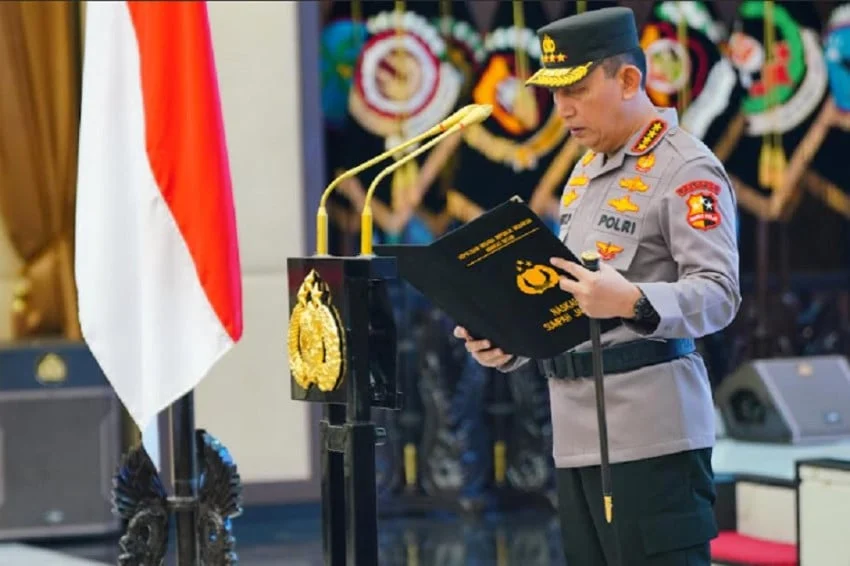
In a strategic move to reinforce internal oversight and organizational integrity, the Chief of the Indonesian National Police (Kapolri), General Listyo Sigit Prabowo, has officially reassigned three high-ranking Brigadier Generals (Brigjen Pol) to the Inspectorate General (Itwasum) of the National Police. This transition, formalized on June 25, 2026, is part of a massive personnel reshuffle involving 1,121 officers across various ranks. The reassignment of these one-star generals underscores the police force’s commitment to strengthening its internal auditing and supervisory mechanisms, ensuring that the institution maintains its standards of professionalism and public accountability.
The Inspectorate General, known locally as Itwasum (Inspektorat Pengawasan Umum), serves as the backbone of internal discipline and operational auditing within the Indonesian National Police (Polri). By placing experienced generals into these roles, General Sigit aims to enhance the "supervision of the supervisors," a critical component in the ongoing "Polri Presisi" (Predictive, Responsibility, Transparency, and Fairness) transformation program. The three generals—Brigjen Pol Imam Thobroni, Brigjen Pol Herukoco, and Brigjen Pol Eddy Hermanto—bring decades of field and administrative experience to their new oversight responsibilities.
Strategic Breakdown of the Appointments
The reshuffle at the Itwasum level involves both lateral movements and promotions designed to optimize the department’s auditing capabilities. The specific assignments are as follows:
-
Brigjen Pol Imam Thobroni: Formerly serving as the Deputy Chief of the Maluku Regional Police (Wakapolda Maluku), Brigjen Pol Imam Thobroni has been appointed as the Auditor Kepolisian Utama TK I at Itwasum Polri. Moving from a high-stakes regional command in Eastern Indonesia to a central auditing role suggests a strategic intent to utilize his field experience in evaluating regional police performance.
-
Brigjen Pol Herukoco: Previously serving as the Regional Inspector (Irwil) III of Itwasum Polri, Brigjen Pol Herukoco has been transitioned to the position of Auditor Kepolisian Utama TK I at Itwasum Polri. This move represents a deepening of his involvement in the high-level auditing processes within the same department, ensuring continuity in the oversight of police operations.
-
Brigjen Pol Eddy Hermanto: Formerly the Auditor Kepolisian Utama TK II at Itwasum Polri, Brigjen Pol Eddy Hermanto has been promoted to the position of Regional Inspector (Irwil) III of Itwasum Polri. This promotion places him in a leadership role overseeing inspections across specific regional jurisdictions, succeeding Brigjen Pol Herukoco in that capacity.
These shifts indicate a structured rotation within the Itwasum hierarchy, where officers with proven track records in auditing and regional management are placed in positions that demand rigorous scrutiny of police conduct and financial management.
The Scale of the June 2026 Mutation Wave
The reassignment of these three generals is only a small fraction of a much larger administrative overhaul. On June 25, 2026, the National Police Headquarters released seven separate Telegram Letters (Surat Telegram), which together detailed the movement of 1,121 personnel. This scale of mutation is one of the largest in recent years, affecting High-Ranking Officers (Pati) and Middle-Ranking Officers (Pamen) alike.
The distribution of these mutations across the seven Telegram Letters is as follows:
- ST/1335/VI/KEP./2026: 74 personnel
- ST/1336/VI/KEP./2026: 359 personnel
- ST/1337/VI/KEP./2026: 65 personnel
- ST/1338/VI/KEP./2026: 174 personnel
- ST/1339/VI/KEP./2026: 150 personnel
- ST/1340/VI/KEP./2026: 104 personnel
- ST/1341/VI/KEP./2026: 195 personnel
This comprehensive reshuffle covers a wide array of departments, including the Legal Division (Divkum), the Educational and Training Institute (Lemdiklat), and various Regional Police Commands (Polda) across the archipelago. The sheer volume of transitions highlights an effort to refresh the leadership ranks and prevent stagnation within specific units.
Official Statements and Organizational Philosophy
Brigadier General Pol Trunoyudo Wisnu Andiko, the Head of the Public Information Bureau (Karo Penmas) of the National Police Public Relations Division, addressed the media regarding the motivations behind this large-scale mutation. He emphasized that such movements are a standard procedural element in the life of the organization.
"Mutations and job promotions are part of the organizational dynamics aimed at increasing professionalism, leadership capacity, and the effectiveness of the National Police’s duties in providing service, protection, and guidance to the community," Trunoyudo stated on July 22, 2026.
He further explained that the selection process for these positions is rigorous, involving an evaluation of the officers’ performance history, integrity, and suitability for the new challenges they will face. In the case of the Itwasum appointments, the focus is squarely on maintaining the "cleanliness" of the institution. As the National Police faces increasing public scrutiny in an era of digital transparency, the role of the Inspectorate General has become more pivotal than ever.
The Role of Itwasum in Modern Policing
To understand the significance of these appointments, one must look at the function of the Inspectorate General for General Supervision. Itwasum is responsible for assisting the Kapolri in conducting internal supervision, which includes monitoring, auditing, and evaluating the use of the police budget, the implementation of operational procedures, and the conduct of personnel.
The "Auditor Kepolisian Utama" (Main Police Auditor) positions assigned to Brigjen Pol Imam Thobroni and Brigjen Pol Herukoco are high-level roles that involve scrutinizing complex financial reports and operational outcomes. These auditors ensure that the billions of rupiahs allocated to the police force are used effectively and that regional commands are adhering to the national policy directives set by the Kapolri.
By promoting Brigjen Pol Eddy Hermanto to Irwil III, the Kapolri is ensuring that the regional inspection branch is led by someone who has already spent time within the auditing framework. The Irwil (Regional Inspector) serves as the "eyes and ears" of the central headquarters in the provinces, conducting routine and special inspections to root out corruption, mismanagement, or negligence.
Background and Chronology of the Decision
The decision-making process for a mutation wave of this size typically begins months in advance through the Council for High-Level Rank and Position Assignments (Wanjakti). This council, composed of the highest-ranking officers in the force, reviews the career trajectories of thousands of personnel.
The timing of this specific mutation—June 2026—aligns with the mid-year performance review cycle. Historically, the Indonesian National Police uses the mid-year and end-of-year periods to facilitate the retirement of senior officers and the subsequent promotion of younger, high-performing officers. This ensures a continuous "regeneration" of the leadership core.
Furthermore, the transition of Brigjen Pol Imam Thobroni from the Maluku region is particularly noteworthy. Maluku is a geographically challenging region with a complex security landscape. Successfully serving as Wakapolda there is often seen as a prerequisite for more senior administrative roles in Jakarta, as it demonstrates an officer’s ability to manage diverse communities and maintain stability in volatile environments.
Implications for Public Trust and Institutional Reform
The appointment of these three generals to Itwasum is a clear signal to the public that internal reform remains a top priority for General Listyo Sigit Prabowo. In recent years, the Indonesian National Police has worked tirelessly to improve its public image following several high-profile internal scandals. A robust and active Inspectorate General is the primary tool for preventing such incidents.
From a policy perspective, strengthening Itwasum serves three main purposes:
- Anti-Corruption Measures: By placing experienced generals in auditing roles, the force increases its capacity to detect and prevent the misuse of state funds.
- Standardization of Service: Itwasum ensures that a citizen receiving police services in Papua receives the same quality of protection and legal certainty as a citizen in Jakarta.
- Leadership Accountability: When high-ranking officers know they are being audited by peers of equal or higher rank and experience, it fosters a culture of accountability that trickles down to the lowest levels of the precinct (Polsek).
Analysis of the "Pecah Bintang" Phenomenon
While the three generals mentioned are already one-star officers, this mutation wave also includes several "Pecah Bintang" (breaking the star) moments—promotions where Colonels (Kombes Pol) are promoted to Brigadier General. This is a crucial aspect of police morale. The 1,121-personnel reshuffle creates a "domino effect" where the movement of a Brigadier General to Itwasum opens up a Deputy Chief position in a regional command, which is then filled by a senior Colonel, who in turn leaves a vacancy for a junior officer.
This career ladder is essential for maintaining the motivation of the middle-ranking officers. By moving 1,121 people at once, the Kapolri is effectively refreshing the energy of the entire organization, placing new leaders in positions where they can implement fresh ideas while adhering to the core mission of the force.
Future Outlook for the Appointees
As Brigjen Pol Imam Thobroni, Brigjen Pol Herukoco, and Brigjen Pol Eddy Hermanto assume their new roles at Itwasum, they face a challenging landscape. The year 2026 is expected to bring new complexities in cybercrime, regional security, and the ongoing modernization of police equipment. Their oversight will be vital in ensuring that the National Police remains an agile and ethical force.
The success of these appointments will be measured by the transparency of the police force in the coming months and the efficiency with which internal complaints are handled. Under the leadership of General Listyo Sigit Prabowo, the focus remains on building a "Presisi" police force that is not only feared by criminals but loved and trusted by the people of Indonesia.
In conclusion, the June 25, 2026, mutation is more than just a routine administrative exercise; it is a strategic realignment of the National Police’s top brass. By fortifying the Inspectorate General with seasoned leaders, the Kapolri is reinforcing the walls of integrity within the institution, ensuring that the Indonesian National Police is prepared to meet the demands of a modern, democratic society.