
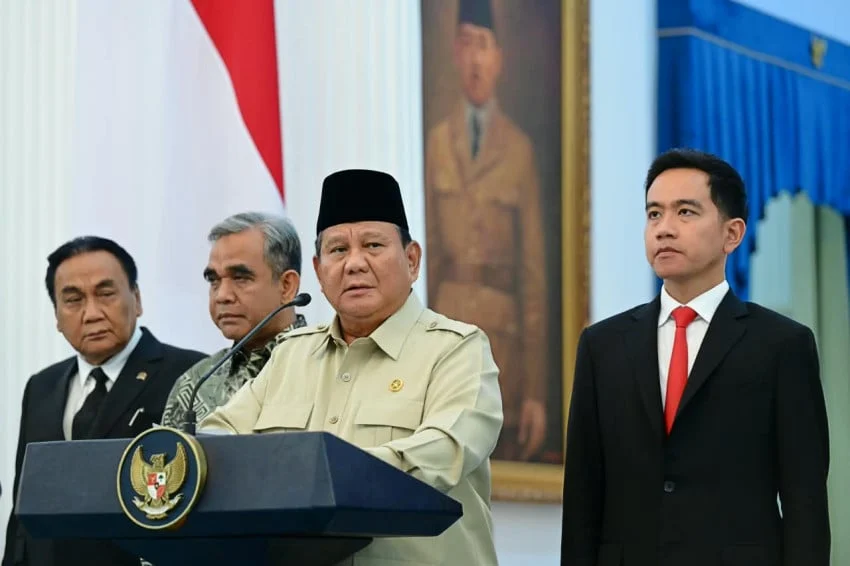
The political landscape of Indonesia enters a critical juncture today as President Prabowo Subianto prepares to officially submit two candidates for the vice-presidency to the People’s Consultative Assembly (MPR RI). This high-stakes development follows the unexpected and consequential resignation of Gibran Rakabuming Raka from the nation’s second-highest office. The submission of the dual candidates sets off a rapid constitutional mechanism governed by Indonesian law, triggering extensive procedural adjustments within the legislature and drawing intense scrutiny from political observers, legal experts, and the general public alike.
According to confirmation provided by Johan Rosihan, a member of Working Group III (Pokja III) of the MPR RI Verification Team, the official presidential communication containing the two names is expected to arrive at the legislative complex by the afternoon or evening of Monday, November 23, 2026. The move comes amid a flurry of legislative activity designed to accommodate the urgent constitutional vacancy while ensuring strict adherence to the regulatory frameworks governing executive successions in Indonesia.
Chronology of Events and the Resignation of Gibran Rakabuming Raka
The sequence of events leading up to today’s submission began with the sudden resignation of Vice President Gibran Rakabuming Raka, a development that shocked domestic political circles and created an immediate executive vacuum. While the exact reasons surrounding the resignation have been the subject of intensive media coverage and public debate, the constitutional reality necessitated an immediate response from the state apparatus.
Under the 1945 Constitution of the Republic of Indonesia, a vacancy in the vice-presidency must be filled through a specific mechanism wherein the President proposes two candidates to the MPR. The assembly then convenes in a plenary session to debate, select, and inaugurate the new vice president.
Initially, the leadership of the MPR outlined an aggressive timeline, scheduling the formal selection and subsequent inauguration of the new vice president for December 9, 2026. To meet this ambitious target, the MPR imposed a strict deadline, requiring President Prabowo to submit his two nominated candidates no later than November 25, 2026. By submitting the names on November 23, the executive branch has successfully complied with the assembly’s timeline, keeping the transition process on schedule.
Legislative Adjustments and the Role of the MPR Joint Meeting
To formally receive and process the presidential communication, the MPR RI has scheduled a series of high-level internal meetings for today. A Joint Meeting (Rapat Gabungan, or Ragab) is officially slated for 11:00 AM Western Indonesia Time (WIB). The primary agenda of this morning session is to discuss and approve adjustments to the schedule of the upcoming Plenary Session.
Speaking to journalists ahead of the proceedings, Johan Rosihan elaborated on the anticipated schedule. "God willing, the information that has reached us indicates precisely that. Therefore, there are two Joint Meetings scheduled for today," Johan stated on Monday. He added that the afternoon and evening sessions will be entirely dedicated to formally receiving the official presidential letter concerning the vice-presidential candidates.
Despite the initial push to finalize the selection by December 9, the assembly has faced growing internal pressure and external advice to recalibrate its timeline. Several legal scholars and legislators have suggested that the MPR should alter the schedule for the plenary selection session to a date past December 9. Proponents of this delay argue that extending the timeline is essential to ensure full compliance with the Law on the People’s Consultative Assembly, House of Representatives, Regional Representative Council, and Regional House of Representatives (UU MD3), as well as the internal Rules of Procedure (Tatib) of the MPR. These regulations dictate specific cooling-off periods, review phases, and consultative mechanisms that cannot be rushed without risking procedural flaws.
Constitutional Framework and Statutory Guidelines
The replacement of an Indonesian vice president mid-term is a rare and delicate constitutional procedure. Article 8, Paragraph 2 of the 1945 Constitution stipulates that in the event of a vacancy in the vice-presidency, the President shall nominate two candidates within a period of sixty days to the MPR, which must then elect a replacement within sixty days of the vacancy occurring.
The involvement of the MPR—a bicameral body consisting of the House of Representatives (DPR) and the Regional Representative Council (DPD)—underscores the gravity of the decision. Unlike cabinet appointments, which fall under the exclusive purview of the executive, the selection of a vice president requires legislative ratification, reflecting the representative will of the Indonesian populace.
As the names of the two candidates are set to be unveiled, political analysts have pointed out the immense weight resting on President Prabowo’s shoulders. The chosen candidates must not only command the confidence of the President to ensure effective governance and policy execution but also possess the legislative appeal necessary to secure a majority vote within the MPR.
Implications for the National Political Landscape
The introduction of two new candidates into the legislative pipeline is expected to reshape political alliances within the governing coalition and the broader parliament. With Gibran’s departure, the political equilibrium established during the 2024 presidential election has shifted, prompting various political parties to reposition themselves.
The identity of the two candidates remains one of the most closely guarded secrets in Jakarta, with speculation running high across media outlets and political parlays. Observers are evaluating whether the President will opt for figures with strong technocratic backgrounds to bolster economic policy implementation, or political stalwarts capable of maintaining legislative harmony and coalition stability.
Furthermore, the decision regarding the final timeline—whether to proceed with the December 9 vote or to push the schedule back in accordance with recommendations concerning UU MD3—will serve as a test of institutional maturity. Legal experts emphasize that adhering strictly to procedural legitimacy is paramount to prevent any future legal challenges to the legitimacy of the incoming vice president.
As the clock ticks toward the 11:00 AM Joint Meeting, all eyes are fixed on the parliamentary complex in Senayan. The formal receipt of the President’s letter later today will mark the official commencement of the selection race, setting the stage for what promises to be a consequential weeks-long legislative deliberation that will define the remainder of the current administration’s term.
