
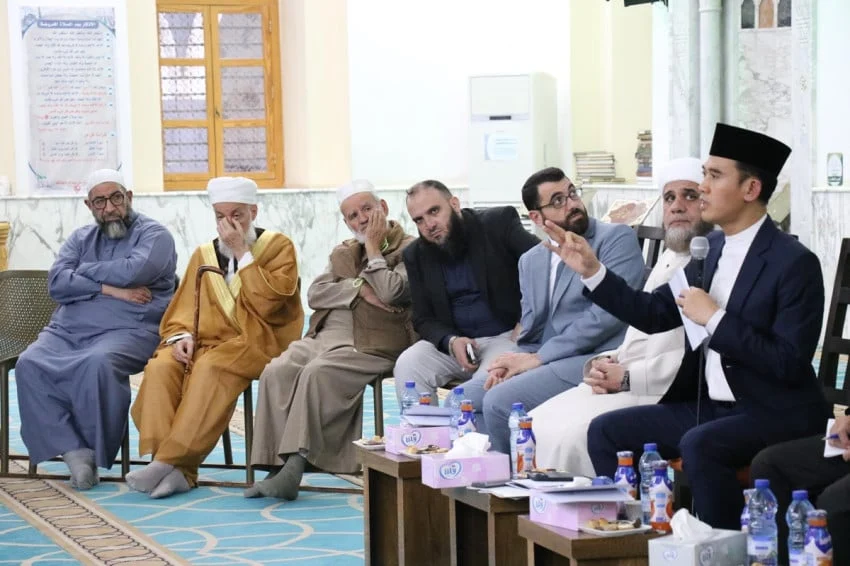
The intersection of faith and governance remains one of the most critical discussions in the contemporary Muslim world, shaping how nations navigate pluralism, stability, and modernization. Against this backdrop, Professor K.H. Asrorun Niam Sholeh, the Head of Fatwa for the Indonesian Ulema Council (MUI), delivered a comprehensive and strategic address on the relationship between religion and the state. Speaking before an audience of hundreds of prominent Syrian scholars, religious leaders, and academics at the historic Jami’ Khalid bin Walid in the province of Homs, Syria, Professor Niam presented Indonesia’s Pancasila-based model as a successful, harmonious paradigm of symbiotic interaction.
The symposium, held on Thursday, October 29, 2026, drew significant attention from regional intellectuals as Syria continues its long-term process of societal reconstruction, institutional stabilization, and reconciliation. Professor Niam’s intervention offered a comparative perspective rooted in Southeast Asia’s largest Muslim-majority democracy, illustrating how religious values and national governance can reinforce one another without sacrificing pluralism or civil liberties.
Chronological Context of the International Academic Engagement
The high-profile gathering in Homs is part of a broader framework of ongoing bilateral and intellectual exchanges between Indonesian Islamic institutions and their counterparts across the Middle East. Over the past decade, the Indonesian Ulema Council has actively engaged in international forums to share Indonesia’s unique socio-political trajectory—often summarized by the national motto Bhinneka Tunggal Ika (Unity in Diversity).
The journey to the Jami’ Khalid bin Walid symposium involved a series of diplomatic and academic preparations, beginning with preliminary roundtable discussions in Damascus involving Indonesian delegates and Syrian religious authorities. The October 29 event served as the intellectual pinnacle of this diplomatic mission, aiming to foster cross-cultural dialogue on religious moderation (wasathiyah Islam), social cohesion, and the prevention of radical extremism. By choosing Homs—a city deeply impacted by historical conflict and subsequent revitalization—the organizers sought to anchor the conversation in the tangible realities of societal rebuilding and the vital need for ethical governance.
Three Paradigms of State and Religion
In his detailed presentation to the Syrian scholarly community, Professor Niam categorized the global spectrum of state-religion dynamics into three distinct theoretical paradigms: the integralistik (integralist), the sekularistik (secularist), and the simbiotik (symbiotic) models.
Under the integralistic paradigm, religion and the state are fused into a single, unified entity where religious law serves directly as the supreme law of the land, leaving little formal distinction between civic institutions and religious authorities. Conversely, the secularistic paradigm mandates a strict separation, often pushing religion entirely out of the public sphere and into the private domain, restricting the state from engaging with or endorsing religious values.
Indonesia, however, occupies the third space: the symbiotic model. According to the MUI Fatwa Head, this model acknowledges that religion and the state are distinct yet mutually dependent entities. Religion infuses statecraft with moral, ethical, and spiritual values, guiding policymakers toward justice and public welfare (maslahah). Meanwhile, the state provides the structural framework, security, and institutional support necessary for citizens to practice their faiths freely and maintain public order.
"The experience of Indonesia proves that the relationship between religion and the state is dynamic and mutually reinforcing," Professor Niam stated during his address. "Change is an immutable law of nature (sunnatullah), and religion is present to ensure that every social transformation leads toward public welfare and universal peace."
The Indonesian Model: Pancasila and Mitsaq Wathani
Expanding upon the mechanics of Indonesia’s symbiotic model, Professor Niam—who also serves as a Professor of Islamic Jurisprudence (Fiqh) at UIN Syarif Hidayatullah Jakarta—explained the foundational pillars of the Unitary State of the Republic of Indonesia (NKRI). He emphasized that Indonesia is built upon the dual foundation of Pancasila (the five national principles) and the 1945 Constitution (UUD 1945), which together function as a Mitsaq Wathani, or a grand national consensus.
This social contract transcends sectarian divisions, bridging the aspirations of the Muslim majority with the rights of various ethnic, cultural, and religious minorities. Within this framework, state regulations actively absorb the substance of Islamic legal principles and fatwas when addressing contemporary social, economic, and moral issues, provided they align with constitutional harmony. Concurrently, religious fatwas and institutional teachings continuously respond to national challenges, fostering civic responsibility, anti-corruption campaigns, and national development.
This ideological equilibrium was formally solidified during the historic 2006 Ijtima Ulama (National Consensus of Ulema) of the Indonesian Ulema Council’s Fatwa Commissions. That convention issued a definitive religious decree establishing the NKRI as the final and legitimate form of the Indonesian state. Consequently, mainstream Indonesian Islamic organizations view defending the territorial integrity and ideological foundation of the nation as a core religious obligation, effectively immunizing the populace against transnational separatist movements and religious extremism.
International Reception and Regional Implications
The reception of Professor Niam’s discourse among Syrian academics and religious scholars was overwhelmingly positive, sparking rigorous panel discussions regarding the adaptability of the Indonesian model to other post-conflict or transitioning societies in the Middle East. Syrian intellectuals noted that while historical contexts differ significantly between Southeast Asia and the Levant, the core principles of religious moderation, mutual accommodation, and inclusive citizenship remain universally applicable.
Observers point out that international outreach by Indonesian religious bodies like the MUI serves a dual purpose. Externally, it projects Indonesia as a global beacon of moderate Islam, countering narratives of sectarian violence. Internally, it reinforces domestic stability by validating the constitutional compromise that has kept the diverse archipelago united since its independence in 1945.
Furthermore, analysts suggest that dialogues of this nature carry profound policy implications. As nations across the globe grapple with the resurgence of identity politics, religious polarization, and governance crises, the Indonesian template offers a practical case study in how a majority-Muslim nation can successfully embrace democratic governance, constitutionalism, and national pluralism without compromising its religious identity.
Broader Impact and Future Outlook
The symposium at Jami’ Khalid bin Walid concluded with a joint commitment from Indonesian and Syrian religious leaders to enhance academic cooperation, student exchanges, and joint research initiatives focused on countering extremism and promoting the values of wasathiyah.
As Professor Niam and the Indonesian delegation returned to Jakarta, the echoes of the Homs symposium underscored the growing influence of Indonesian Islamic thought on the global stage. By articulating a clear, balanced, and historically tested theory of state-religion relations, the MUI has not only reaffirmed its domestic mandate of safeguarding religious harmony but has also offered a valuable intellectual blueprint for international partners navigating the delicate balance between faith and governance in the twenty-first century.
