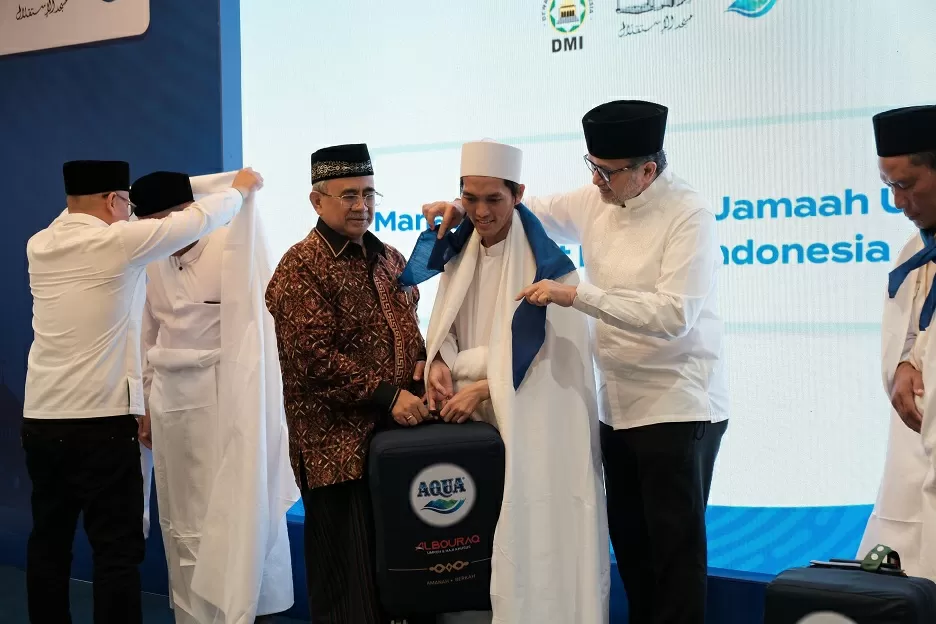
JAKARTA — In a continuing effort to honor the tireless dedication of community religious workers, Danone AQUA, in strategic partnership with the Indonesian Mosque Council (Dewan Masjid Indonesia – DMI) and the Istiqlal Mosque Management Board (Badan Pengelola Masjid Istiqlal – BPMI), has officially dispatched a new cohort of 27 marbot (mosque caretakers) and mosque administrators to perform the holy Umrah pilgrimage in Saudi Arabia.
This initiative, now entering its third consecutive year of implementation, marks a significant milestone in corporate-religious collaboration. Since its inception, the program has successfully enabled a total of 70 mosque caretakers and administrators from diverse regions across the Indonesian archipelago to visit the holy cities of Mecca and Medina—privileges that often remain financially out of reach for individuals working in these roles.
The send-off ceremony highlights a growing recognition of the vital, yet frequently overlooked, contributions made by grassroots religious workers who maintain the physical infrastructure and spiritual vitality of Indonesia’s hundreds of thousands of houses of worship.
Background and Context of the Initiative
According to data from the Ministry of Religious Affairs’ Mosque Information System (SIMAS), Indonesia is home to more than 710,000 registered mosques and musalas (prayer rooms). Beyond serving strictly as spaces for daily ritual prayers, these institutions function as dynamic centers for community learning, economic empowerment, and the strengthening of social solidarity.
However, the day-to-day operations of these facilities rely heavily on the quiet, steadfast dedication of marbot and local administrators. These individuals manage facility cleanliness, ensure acoustic and spatial comfort, coordinate religious study circles, and maintain safety protocols. Operating largely behind the scenes, their work forms the essential foundation that keeps community spaces functioning.
Recognizing this imbalance between heavy societal responsibility and modest financial compensation, AQUA, DMI, and BPMI established this collaborative pilgrimage program three years ago. The initiative was designed not only as a spiritual reward, but as a formal expression of institutional gratitude toward those who dedicate their lives to serving congregations.
Official Statements and Stakeholder Perspectives
Speaking at the departure event, KH Bukhori Sail Al-Tahiri, Head of the Worship Implementation Division at BPMI, emphasized the profound societal inspiration provided by mosque caretakers.
"The dedication of marbot and mosque administrators is an inspiration that we must all emulate," KH Bukhori stated. "Through their sincerity, we are reminded that there is immense blessing in every effort we make to compete in bringing goodness to the community."
He praised the synergy between private sector entities like AQUA and religious organizations, noting that shared objectives regarding community welfare can yield tangible, uplifting results.
Secretary-General of DMI, Rahmat Hidayat, echoed these sentiments, highlighting the organization’s broader mandate to increase the self-reliance and societal impact of local mosques.
"We see that paying attention to marbot and mosque administrators is not only important as a form of appreciation, but also as part of efforts to maintain the sustainability of the mosque’s role as a space for service, guidance, and community empowerment," Rahmat remarked. He underscored that partnerships with corporate entities allow religious councils to execute concrete programs that directly touch the lives of frontline workers.
From the corporate standpoint, Danone Indonesia General Secretary Director Agung Laksamana stressed that fostering community resilience requires continuous, genuine cross-sector collaboration.
"We believe that community empowerment requires sincere and sustainable collaboration," Agung explained. "AQUA is committed to continuing to walk alongside various partners, including religious organizations, mosque institutions, and local communities, in presenting initiatives that strengthen the social role of mosques and provide broader benefits for the people of Indonesia."
Participant Testimonies and Practical Preparation
For many participants, the journey represents the fulfillment of a lifelong dream. Abdul Muaz, a mosque administrator and pilgrimage participant representing the West Java region from Bogor, expressed profound gratitude upon his departure.
Muaz noted that the logistical planning managed by the organizing bodies ensured a seamless transition from daily responsibilities to international travel. From telecommunications provisions to daily necessities, comprehensive preparations allowed the delegates to travel with peace of mind.
"With all this support, we can depart with a calm heart and focus more intensely on worshiping in the Holy Land," Muaz said.
The meticulous coordination aims to alleviate any administrative or financial anxieties for the participants, ensuring that their time abroad is dedicated entirely to spiritual reflection and recovery from years of physical labor.
Beyond Pilgrimage: A Multi-Year Collaborative Ecosystem
While the annual Umrah dispatch captures public attention, the alliance between AQUA, DMI, and BPMI extends far beyond seasonal religious tourism. The strategic partnership encompasses long-term social, economic, and environmental frameworks tailored to the needs of the Islamic community infrastructure in Indonesia.
Key focus areas of this broader collaboration include:
- Community Economic Development: Programs designed to foster financial independence among congregants through micro-enterprises and local market integration centered around mosques.
- Green and Healthy Mosques (Masjid Hijau dan Sehat): Environmental initiatives promoting waste management, energy efficiency, clean water access, and sanitary infrastructure within mosque complexes.
- Capacity Building: Training workshops for administrators to enhance organizational governance, transparency, and public service delivery at the neighborhood level.
Furthermore, AQUA maintains active partnerships with other major Islamic organizations in Indonesia, including Nahdlatul Ulama (PBNU), Muhammadiyah (PP Muhammadiyah), and various Islamic boarding school (pesantren) networks nationwide. These institutional linkages are designed to scale up sustainable social and environmental interventions across diverse demographic landscapes.
Socio-Economic Implications and Future Outlook
Sociological analysts observing the program point out that corporate social responsibility (CSR) initiatives targeting grassroots religious workers address a critical gap in social safety nets. While national labor laws cover formal corporate employees, informal religious infrastructure workers—who often depend on voluntary donations (infaq and sadaqah) and modest stipends—frequently fall outside institutional welfare systems.
By providing high-value non-monetary rewards such as international travel, health programs, and structural upgrades, corporate-NGO partnerships help elevate the social standing of essential community workers. This recognition not only boosts individual morale but also encourages younger generations to view community service within religious institutions as a respected and valued career path.
Organizers have confirmed their intention to sustain and potentially expand the scope of the Umrah program in coming years, contingent upon continued institutional alignment and measurable positive feedback from participating communities.
As the current cohort of 27 caretakers begins their spiritual journey in Saudi Arabia, stakeholders hope the initiative will continue to inspire widespread acts of corporate philanthropy and community care across Indonesia.