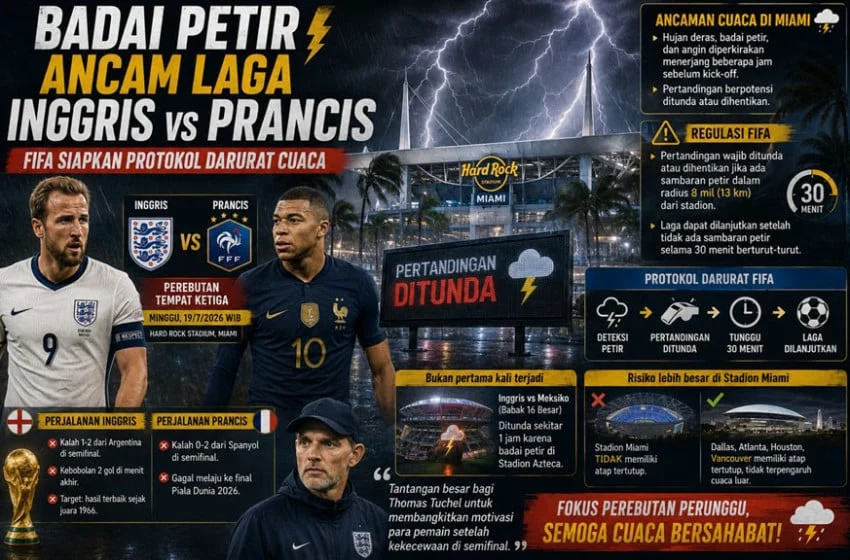
The highly anticipated FIFA World Cup 2026 third-place playoff match between England and France, scheduled to determine the tournament’s third and fourth-place finishers, faces a significant threat from severe weather conditions. Forecasters are predicting a potent storm system, complete with thunderstorms and heavy rain, to sweep across Miami, Florida, in the hours leading up to the scheduled kick-off on Sunday, July 19, 2026 (WIB). This meteorological outlook has prompted FIFA to activate its emergency protocols to ensure the safety of players, staff, and spectators, and to maintain the integrity of the competition.
Looming Storm System Casts Shadow Over Miami Stadium
Miami, a vibrant hub for international sports and entertainment, is bracing for a potentially disruptive weather event. Meteorological models indicate that the region could experience a significant deluge of rain accompanied by frequent lightning strikes and strong winds several hours before the England-France clash is slated to begin. While weather forecasts are inherently dynamic and subject to change, the current projections have raised concerns among tournament organizers and footballing authorities. The potential for such adverse weather conditions at the Miami International Stadium, a venue known for its open-air design, adds another layer of complexity to the situation. Unlike stadiums with retractable roofs, the Miami venue offers less protection from the elements, making it more susceptible to weather-related delays or interruptions.
FIFA’s Contingency Plans: Safety and Fair Play as Top Priorities
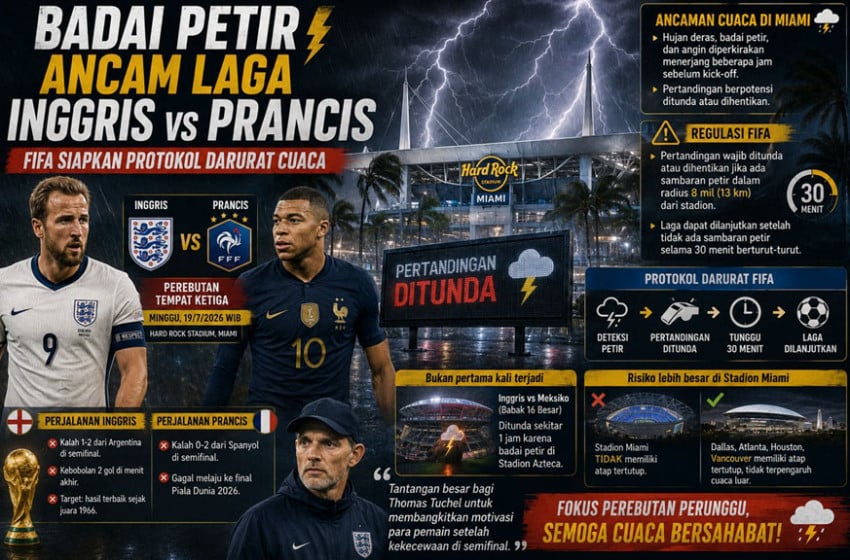
In response to the potential threat, FIFA has confirmed that it has comprehensive emergency procedures in place. These protocols are designed to address situations where extreme weather conditions could compromise the safety of the match or its participants. According to regulations stipulated by the sport’s governing body, a match must be suspended or postponed if lightning is detected within an eight-mile (approximately 13-kilometer) radius of the stadium. The game can only resume after a continuous 30-minute period free from any lightning strikes. This stringent rule underscores FIFA’s commitment to player safety, as lightning poses a direct and immediate danger to individuals on the field of play.
This is not the first instance of inclement weather impacting the FIFA World Cup 2026. Throughout the tournament, several matches have experienced delays or interruptions due to severe weather events. These occurrences have highlighted the unpredictable nature of climate and its potential to disrupt even the most meticulously planned sporting spectacles.
A Pattern of Weather Disruptions in World Cup 2026
The 2026 edition of the FIFA World Cup has, in several instances, been a testament to the challenges posed by extreme weather. The tournament, spanning across North America, has encountered a diverse range of climatic conditions, from the intense heat in some host cities to the unexpected downpours in others. One notable incident occurred during the Round of 16, where a match involving England and Mexico had to be delayed for approximately an hour due to a severe thunderstorm near the Estadio Azteca. This delay, though ultimately brief, disrupted the flow of the game and tested the resilience of both teams and the tournament organizers.
The potential for weather-related disruptions is particularly pronounced in Miami. The Miami International Stadium, while a state-of-the-art facility, lacks a fully enclosed roof. This design choice, common in many open-air stadiums, prioritizes a more traditional football atmosphere but leaves it vulnerable to the full force of atmospheric disturbances. The presence of strong winds can also affect ball trajectory and player performance, while heavy rain can render the pitch waterlogged, making play extremely difficult and increasing the risk of injuries.
Background: The Third-Place Playoff and its Significance
The third-place playoff match, while not carrying the ultimate prize of the World Cup trophy, holds considerable significance for the competing nations. It offers a final opportunity for teams to end their tournament campaign on a positive note, secure bragging rights, and provide their fans with a concluding spectacle. For England and France, two of football’s traditional powerhouses, this match represents a chance to salvage pride after falling short in the semi-final stages.
England, with their rich footballing history, would be eager to secure a podium finish, validating their efforts throughout the tournament. Similarly, France, a nation that has enjoyed considerable success in recent World Cups, would view a third-place finish as a respectable outcome. The intensity and competitive spirit typically displayed in matches between these two European giants are usually a guarantee of an exciting contest. However, the looming threat of thunderstorms could significantly alter the dynamic of this highly anticipated encounter.
Strategic Considerations and Potential Impact on Teams
The potential for a weather delay or even a postponed match introduces a significant element of uncertainty for both England and France. Teams often have carefully structured pre-match routines, including warm-ups, tactical briefings, and rest periods, all meticulously planned to optimize performance. A sudden suspension or postponement can disrupt these routines, potentially affecting player concentration and physical readiness.
From a tactical perspective, heavy rain and strong winds can neutralize the strengths of technically gifted teams. Short, intricate passing gameplays might become impractical, forcing teams to adopt a more direct approach. Goalkeepers and defenders could face challenges with slippery balls and unpredictable bounces. Coaches might need to make rapid tactical adjustments based on the prevailing weather conditions, potentially favoring players who are more adept at playing in adverse weather.
Furthermore, the psychological impact of a prolonged delay can be considerable. Players might experience a drop in adrenaline, making it harder to re-engage with the intensity of the match upon resumption. The anticipation and anxiety associated with waiting for the all-clear can also affect mental fortitude.
FIFA’s Regulatory Framework: A Precedent for Safety
FIFA’s commitment to player safety is enshrined in its comprehensive rulebook. The specific protocol regarding lightning is a critical component of these regulations. The eight-mile radius for lightning detection is a standard safety measure employed across various outdoor sports globally. The 30-minute waiting period after the last detected strike is a precautionary measure to ensure that the storm system has moved sufficiently far away from the venue to mitigate any residual risk.
This approach is not unique to the World Cup 2026. Similar protocols have been implemented in previous FIFA tournaments and in major football leagues around the world. The governing body consistently reviews and updates its safety regulations based on scientific advice and lessons learned from past events. The experience of weather-related disruptions in this tournament will likely lead to further refinements in how such situations are managed in future competitions.
The Broader Implications: Climate Change and Sporting Events
The increasing frequency and intensity of extreme weather events globally have brought climate change into sharp focus. Sporting organizations, including FIFA, are increasingly aware of the potential impact of climate change on their events. Hosting international tournaments in regions prone to extreme weather requires robust planning and adaptation strategies.
The disruptions seen at the World Cup 2026 serve as a stark reminder of the interconnectedness between global climate and major sporting events. As weather patterns become more volatile, organizers will need to continue investing in advanced meteorological forecasting, developing flexible scheduling options, and potentially considering venues with greater resilience to extreme weather. The long-term sustainability of outdoor sporting events may hinge on adapting to a changing climate.
Looking Ahead: Uncertainty and Resilience
As Sunday approaches, all eyes will be on the weather forecast for Miami. While the prospect of a thunderstorm looms, the final decision on whether to delay or postpone the match will be made by match officials in consultation with FIFA, based on real-time weather data and safety assessments. Fans and players alike will be hoping for clear skies, allowing England and France to contest the third-place playoff in the spirit of fair competition.
Regardless of the weather’s intervention, the FIFA World Cup 2026 has already provided a captivating spectacle, and this final match, though potentially affected by the elements, will still mark the conclusion of another memorable tournament. The resilience of the sport, its organizers, and its participants in the face of unexpected challenges will be a testament to the enduring appeal of football. The contingency plans in place demonstrate a proactive approach to ensuring that safety remains paramount, even when the skies threaten to disrupt the beautiful game.