
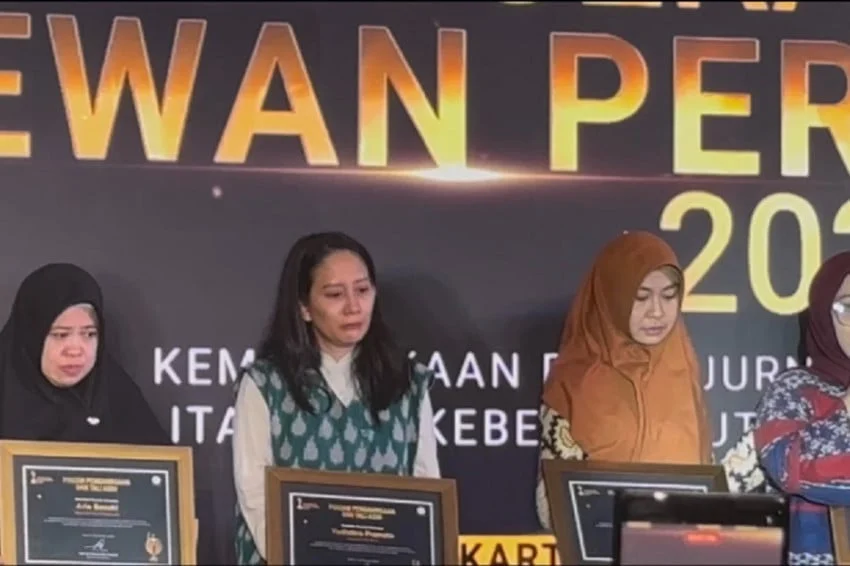
The Press Council of Indonesia hosted a deeply poignant and solemn ceremony during the climax of the 2026 Press Council Awards, extending formal recognition and financial assistance, known locally as tali asih, to the families of journalists who have made the ultimate sacrifice in the line of duty. Held on the evening of Wednesday, October 28, 2026, the event in Jakarta became a focal point of national emotion as five wives of photojournalists—who mysteriously vanished while on assignment in the turbulent waters surrounding Mount Anak Krakatau—took the stage to receive honors on behalf of their missing husbands.
The atmosphere inside the auditorium quickly shifted from celebratory to heavy with grief as the names of the five photojournalists were called. For the grieving spouses, the moment served as a bittersweet acknowledgment of their husbands’ unwavering dedication to the journalistic profession, juxtaposed against the agonizing reality of their prolonged absence. Among those visibly overwhelmed by emotion was Rodiyah Nasution, the wife of iNews photojournalist Yudistiro Pranoto, widely known as Yudis. Throughout the ceremony, she struggled to maintain composure, repeatedly wiping away tears with a tissue as fellow attendees and officials looked on with shared sorrow and solidarity.
The tragedy surrounding the disappearance of the reporting crew has remained one of the most haunting chapters in the recent history of Indonesian journalism. The hazards of covering maritime and volcanic disasters were starkly underscored by the incident, prompting renewed national conversations regarding press safety, the inherent dangers faced by field reporters, and the psychological and financial vulnerabilities confronting the families left behind when tragedy strikes in remote environments.
Chronology of the Disappearance and Search Operations
The sequence of events leading up to the historic recognition by the Press Council began months prior, during a high-stakes reporting mission. The team of photojournalists and their crew had set out to document the geological activities and maritime conditions around Mount Anak Krakatau—a volatile volcanic island situated in the Sunda Strait between the islands of Java and Sumatra. Known for its unpredictable eruptions and treacherous surrounding currents, the area has long posed significant risks to navigation and scientific exploration alike.
During the height of their expedition, communication with the reporting vessel abruptly ceased. Initial concerns escalated into a full-scale emergency as scheduled check-ins passed without contact. Search and rescue (SAR) operations were immediately mobilized, involving multiple agencies, including the National Search and Rescue Agency (Basarnas), maritime police, and naval units, alongside voluntary assistance from local fishing communities and media organizations.
Despite extensive sweeps across vast expanses of the Sunda Strait, initial efforts yielded few tangible clues, save for scattered debris believed to be associated with the vessel. Over the ensuing weeks and months, the search perimeter expanded significantly, driven by shifting ocean currents and maritime winds. Recent operational updates from rescue coordinators noted that SAR teams had even extended their sweeps into distant maritime zones, such as the waters surrounding Enggano Island, following reports from crew members and maritime workers regarding potential debris and drifting objects linked to the missing vessel.
Despite these tireless efforts, the exact fate of the journalists and the boat’s crew remains officially unconfirmed, keeping families in a prolonged state of limbo as rescue and recovery operations continue to adapt to new leads.

Institutional Responses and Support for Grieving Families
In the wake of the disaster, press freedom organizations, media houses, and regulatory bodies have faced mounting pressure to address the welfare of families affected by occupational hazards in journalism. The decision by the Press Council to honor the five missing photojournalists and provide financial support to their spouses represents a critical institutional step toward fulfilling the duty of care owed to media workers operating in high-risk environments.
During the presentation ceremony, Maha Eka Swasta, the Chairman of the Commission for Information and Communication at the Press Council, delivered a compassionate address acknowledging the profound sacrifice made by the journalists. Expressing deep condolences on behalf of the broader press community, Swasta emphasized the resilience required of the families enduring such prolonged uncertainty. He voiced hope that the five wives would be granted continued strength, fortitude, and resilience as they navigate the complex emotional and practical challenges of supporting their households in the absence of their partners.
"The work of a journalist often takes them to the very edges of safety to bring the truth and vital visual documentation to the public," remarks from industry advocates noted following the event. "When the worst happens, the media ecosystem has a moral obligation to ensure that the families who bear the true cost of this dedication are never forgotten."
Broader Implications for Press Safety and Occupational Standards in Indonesia
The tragedy at Mount Anak Krakatau has triggered a comprehensive re-evaluation of safety protocols across Indonesian media organizations, particularly for reporters dispatched to remote, disaster-prone, or geographically hostile locations. Media unions and press advocacy groups have increasingly called for mandatory risk assessments, standardized safety gear, comprehensive life and health insurance coverage, and rigorous adherence to maritime safety regulations before any reporting team is cleared for deployment.
Historically, freelance and staff photojournalists alike have frequently operated under immense pressure to secure compelling visuals, occasionally bypassing stringent safety measures in competitive media landscapes. Industry analysts suggest that the ongoing case of the missing Krakatau journalists will likely serve as a watershed moment for legislative and institutional reforms regarding occupational safety in journalism. Stakeholders are urging media companies to establish dedicated emergency response funds and psychological support systems designed specifically to assist families dealing with long-term trauma, missing-person investigations, and financial displacement.
Furthermore, the involvement of the Press Council in providing direct financial and moral support highlights a growing recognition that institutional accountability extends beyond posthumous honors. By institutionalizing frameworks for survivor assistance, regulatory bodies aim to set a precedent that safeguards the dignity and welfare of media workers and their dependents.
As search operations in distant waters continue to follow intermittent leads, the collective memory of the five photojournalists remains alive within Indonesia’s newsrooms. The poignant scenes at the Anugerah Dewan Pers 2026 serve as both a solemn tribute to those lost while pursuing the truth and a persistent reminder of the steep human price paid to document the forces of nature and history.
