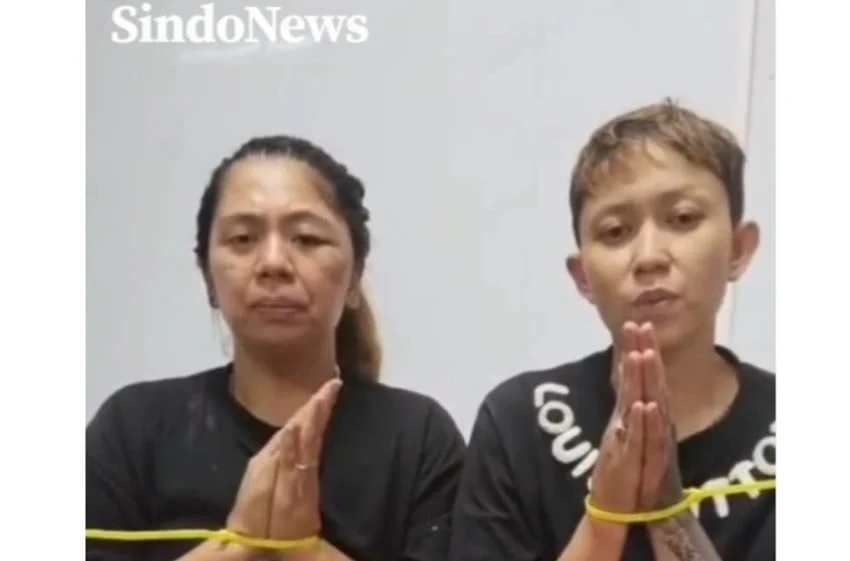
A distressing video circulating widely on social media platforms depicts two Indonesian women, identified as WNI (Warga Negara Indonesia), allegedly held captive, shackled, and subjected to torture within Myanmar. The harrowing footage has brought to light their desperate plea for help, claiming they are victims of a sophisticated human trafficking scheme culminating in an extortion demand of up to IDR 220 million (approximately USD 14,000) from their families back in Indonesia. This incident underscores the escalating crisis of online scam syndicates operating from volatile border regions, particularly in Southeast Asia, preying on vulnerable individuals with false promises of lucrative employment.
The Viral Appeal and Immediate Aftermath
The viral video, which surfaced recently, shows the two women in apparent distress, their wrists visibly bound by handcuffs, as they recount their ordeal. Their testimony includes allegations of severe physical and psychological abuse, intended to coerce their families into paying the substantial ransom. The immediate public outcry following the video’s dissemination pressured Indonesian authorities to swiftly acknowledge and address the grave situation. Brigjen Pol Dr. Untung Widyatmoko, Secretary of NCB Interpol Indonesia, confirmed that his agency is actively monitoring the alleged captivity and has initiated communication with security authorities in Myanmar. This rapid official response highlights the urgency and severity with which the Indonesian government views the safety and well-being of its citizens abroad, especially when human rights violations and criminal extortion are involved.
However, the path to their liberation is fraught with significant challenges. Dr. Widyatmoko indicated that details regarding rescue efforts could not be disclosed, primarily due to the perilous location where the women are believed to be held. They are suspected to be situated in the Myawaddy region, an area notorious for its instability and status as a conflict zone. This particular strip of land along the Thai-Myanmar border is not under the control of the official Myanmar military junta but is instead dominated by the Karen National Union (KNU), an ethnic armed organization. This complex geopolitical landscape complicates any direct intervention by foreign governments or even the official Myanmar state apparatus, as diplomatic and security protocols are severely constrained in areas controlled by non-state actors.
Myawaddy: A Hotbed for Scams and Human Trafficking
The Myawaddy region, and specifically its controversial "new city" development known as Shwe Kokko, has gained infamy as a primary hub for international online scam syndicates and a nexus for human trafficking. These operations, often referred to as "crypto scam factories" or "pig butchering scams," lure individuals from various Southeast Asian countries, including Indonesia, Malaysia, Thailand, the Philippines, and even further afield, with enticing but fraudulent job offers. Victims are typically promised high-paying positions in IT, customer service, or online marketing, only to find themselves trapped in compounds, forced to engage in illicit online scamming activities targeting unsuspecting individuals globally. Refusal to comply often leads to severe punishment, including physical abuse, torture, sexual assault, and forced labor, culminating in demands for ransom payments from their families for their release.
The Indonesian women in question are reportedly working for one such "scamming company" located within this rebel-held territory. This detail aligns with a disturbing pattern observed across the region, where economic vulnerabilities post-pandemic, coupled with a lack of awareness about sophisticated online recruitment scams, render many susceptible to these criminal enterprises. The operational model of these syndicates thrives on exploiting desperation, leveraging the relative lawlessness of conflict zones to maintain their compounds and enforce control over their captive workforce.
The Lure and the Trap: A Chronology of Deception (Inferred)
While the specific chronology of the two Indonesian women’s journey remains undisclosed, their predicament fits a well-established pattern of human trafficking into these scam hubs:
- Online Recruitment: Victims are typically contacted through social media platforms or online job portals with attractive offers for positions in countries like Thailand, Cambodia, Laos, or Myanmar. These advertisements often promise high salaries, easy visas, and luxurious living conditions, far exceeding typical local wages.
- Travel Facilitation: Traffickers arrange travel, often through irregular channels or by exploiting legitimate travel routes, guiding the victims across borders. Many victims may initially believe they are heading to a legitimate job in Thailand or another neighboring country, only to be secretly transported across the border into Myanmar’s special economic zones or conflict areas like Myawaddy.
- Arrival and Realization: Upon arrival at the designated compound, usually heavily guarded and isolated, the victims’ passports and phones are confiscated. They are then informed of the true nature of their "job" – to defraud people online, often through romance scams, investment scams, or cryptocurrency scams.
- Forced Labor and Indoctrination: Refusal to participate or failure to meet scamming quotas results in severe penalties. Victims are subjected to psychological manipulation, intimidation, and physical violence. They are often forced to work long hours, with little food or rest, under constant surveillance.
- Extortion and Ransom: When victims or their families attempt to seek help or escape, the syndicates demand exorbitant "release fees" or "repayment for travel costs and training," effectively holding them for ransom. The IDR 220 million demand in this case is consistent with such tactics.
- Desperate Plea: As a last resort, some victims manage to secretly communicate with their families or record videos, hoping to draw public and governmental attention to their plight, as seen in the viral video.
This inferred chronology highlights the systematic nature of these criminal operations, from recruitment to enslavement and extortion.
Indonesian Government’s Response and Diplomatic Challenges
The Indonesian Ministry of Foreign Affairs (Kemlu) and the Indonesian Embassy in Yangon typically spearhead efforts to assist WNI in distress. However, cases in Myawaddy present unique and formidable challenges. Unlike regions under the Myanmar military’s control, where consular access might be negotiated through official channels, Myawaddy’s governance by the KNU means that standard diplomatic procedures are often ineffective. Any intervention requires delicate negotiations, often involving unofficial intermediaries or direct engagement with the KNU, which can be politically sensitive and dangerous.
The Indonesian government has historically dealt with similar cases, with previous successful repatriations of WNI trapped in scam compounds in Cambodia, Laos, and other parts of Myanmar. These efforts usually involve intense coordination between multiple agencies, including Kemlu, the National Police (through Interpol), the Agency for the Protection of Indonesian Migrant Workers (BP2MI), and sometimes even collaboration with international organizations and NGOs specializing in anti-human trafficking efforts. However, the ongoing civil unrest in Myanmar post-2021 coup further complicates these operations, diverting resources and attention from the official Myanmar government, and empowering non-state actors like the KNU.
A Regional Epidemic: Broader Context of Human Trafficking in Southeast Asia
The plight of these two Indonesian women is not an isolated incident but rather a grim symptom of a widespread human trafficking crisis engulfing Southeast Asia. Reports from the United Nations Office on Drugs and Crime (UNODC) and various human rights organizations indicate a dramatic surge in online scam operations, particularly since the COVID-19 pandemic. Economic downturns and increased digital dependency created a fertile ground for these syndicates to flourish.
Thousands of individuals from across Asia, and increasingly from other continents, have been lured into these illicit operations. Estimates suggest that tens of thousands are currently trapped in various scam compounds across Myanmar, Cambodia, Laos, and even parts of Thailand. The victims often face a double-edged sword: forced to commit crimes against others, while simultaneously being victims themselves of severe human rights abuses. This transnational criminal phenomenon generates billions of dollars annually, fueling corruption and empowering organized crime networks.
Data from BP2MI reveals a consistent rise in reports of Indonesian citizens falling victim to such scams. Many returnees recount horrific experiences, detailing prolonged periods of captivity, physical beatings, electrocution, sexual abuse, and threats against their families. The psychological trauma endured by these victims often lasts long after their rescue, highlighting the profound and lasting impact of these criminal enterprises.
The Geopolitical Quagmire of Myawaddy
Myawaddy’s strategic location, bordering Thailand, makes it an ideal smuggling route and a haven for illicit activities. The region’s control by the KNU is a legacy of Myanmar’s long-standing civil war. While the KNU has historically fought for greater autonomy, its control over certain areas, including Myawaddy, has inadvertently created pockets of de facto lawlessness where criminal enterprises can operate with relative impunity. The group’s relationship with various business entities and its governance structures in these areas are complex, often involving a mix of legitimate commerce and tolerance of illicit activities that generate revenue for the armed group.
The presence of these scam compounds in KNU-controlled territory means that rescue operations cannot simply rely on coordination with the Myanmar junta, which has limited to no effective control. Any intervention would require delicate diplomatic maneuvering, possibly involving the Thai authorities as a transit point, and direct or indirect negotiations with the KNU. This geopolitical complexity adds layers of difficulty and risk to any attempts at rescue and repatriation.
International Efforts and Future Prospects
Combating this pervasive issue requires a multi-pronged approach involving international cooperation, enhanced intelligence sharing, and public awareness campaigns. Organizations like the International Organization for Migration (IOM) and UNODC are actively working with regional governments to identify victims, dismantle trafficking networks, and provide assistance to survivors. However, the scale of the problem and the adaptability of these criminal syndicates often outpace current response mechanisms.
For Indonesia, the incident serves as another stark reminder of the urgent need to strengthen preventive measures. This includes more robust public education campaigns warning citizens about the dangers of suspicious overseas job offers, improving pre-departure orientation for migrant workers, and enhancing collaboration with destination countries to monitor labor practices. Furthermore, regional cooperation through ASEAN frameworks is crucial to develop a coordinated strategy to address human trafficking and online scamming, which are transnational crimes requiring transnational solutions.
Warning and Prevention
The most effective tool against falling victim to these schemes remains public awareness. Potential migrant workers and job seekers are strongly advised to:
- Verify Job Offers: Always cross-reference job offers with official government channels, such as the Ministry of Manpower and the Agency for the Protection of Indonesian Migrant Workers (BP2MI).
- Check Employer Credibility: Thoroughly research the company offering employment. Be wary of offers that seem too good to be true, promise exceptionally high salaries for minimal qualifications, or require immediate payment for travel or visa processing.
- Use Official Channels: Only use official, government-sanctioned channels for overseas employment.
- Beware of Social Media Scams: Exercise extreme caution with job offers encountered solely through social media platforms, especially from unknown recruiters or profiles.
- Secure Documents: Never surrender passports or personal identification documents to unverified individuals or employers.
The harrowing situation of these two Indonesian women in Myawaddy is a critical reminder of the ongoing human cost of transnational organized crime. While diplomatic and security efforts are underway, the complexities of the region and the entrenched nature of these syndicates mean that their rescue will be a testament to perseverance and intricate international cooperation. Their plight serves as a desperate call to action for stronger protective measures and a more coordinated global response to combat the scourge of human trafficking and online exploitation.