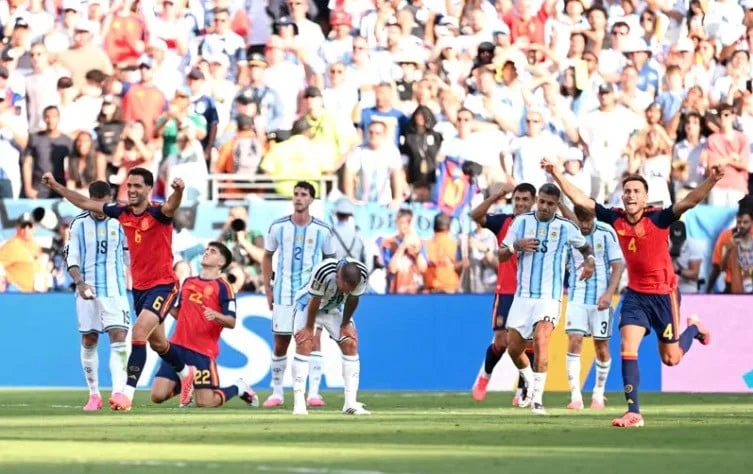
Spain has officially reclaimed its throne at the pinnacle of global football after securing a hard-fought 1-0 victory over Argentina in the final of the 2026 FIFA World Cup. Held at the MetLife Stadium in East Rutherford, New Jersey, on Monday, July 20, 2026, the match concluded with a dramatic extra-time goal from Ferran Torres, ending a 16-year wait for the Spanish nation to hoist the most prestigious trophy in sports. This victory marks a significant milestone for La Furia Roja, who navigated the expanded 48-team tournament with tactical precision and defensive resilience. The triumph not only adds a second star to the Spanish jersey but also signals the culmination of a generational shift that has successfully integrated veteran leadership with the exuberance of youth.
The Final Showdown: A Tactical Chess Match
The final was billed as a clash of philosophies: the reigning champions Argentina, led by an aging but still influential Lionel Messi, against a rejuvenated Spanish side that had transitioned from the "tiki-taka" era into a more direct and physically imposing unit. From the opening whistle, the intensity was palpable. Argentina utilized a compact mid-block, looking to exploit the pace of Julian Alvarez on the counter-attack, while Spain controlled the tempo through Rodri and Pedri in the midfield.
Throughout the 90 minutes of regulation time, both sides had opportunities to break the deadlock. Spain’s Unai Simon produced a world-class save in the 74th minute to deny a curling effort from Messi, while at the other end, Emiliano Martinez stood tall against a powerful strike from Lamine Yamal. As the match moved into extra time, the physical toll of the expanded tournament format became evident. It was in the 106th minute that the breakthrough finally arrived. A sweeping move involving Nico Williams on the left wing resulted in a low cross that found Ferran Torres, who had come on as a second-half substitute. Torres’ clinical finish into the bottom corner sent the Spanish supporters into a frenzy and ultimately decided the fate of the trophy.
Chronology of Spain’s Path to Glory
Spain’s journey to the MetLife Stadium was a testament to their consistency and adaptability. In the first-ever 48-team World Cup, the road to the final required playing eight matches instead of the traditional seven.
- Group Stage: Spain dominated their group, which included South Korea, Ivory Coast, and Scotland. They finished top with seven points, scoring six goals and conceding none.
- Round of 32: In the newly introduced knockout round, Spain faced a resilient Ecuadorian side. A lone goal from Alvaro Morata was enough to see them through.
- Round of 16: A tactical masterclass saw Spain dismantle Denmark 3-0, with goals from Lamine Yamal, Pedri, and Gavi.
- Quarter-finals: Perhaps their toughest test before the final, Spain faced hosts USA in Los Angeles. The match went to penalties after a 1-1 draw, where Unai Simon emerged as the hero, saving two spot-kicks.
- Semi-finals: Spain met old rivals France in a highly anticipated European heavyweight clash. A 2-1 victory, secured by a late header from Aymeric Laporte, booked their ticket to New Jersey.
- The Final: The 1-0 victory over Argentina solidified their status as the world’s best.
10 Interesting Facts Behind the Triumph
The statistical data provided by Opta and FIFA High-Performance Tech reveals several historic achievements associated with Spain’s victory.
1. The Best Defensive Record in History
Spain’s victory was built on an impenetrable defensive foundation. Throughout their eight matches in the 2026 tournament, La Furia Roja conceded only one goal (against the USA in the quarter-finals). This sets a new record for the fewest goals conceded by a World Cup-winning team, surpassing the previous record of two goals held by France (1998), Italy (2006), and Spain themselves in 2010.
2. Joining the Elite Multi-Title Club
With this victory, Spain has secured its second World Cup title, following their 2010 triumph in South Africa. They now join an elite group of nations with multiple titles, becoming the seventh country to achieve this feat. They follow in the footsteps of Brazil (5), Germany (4), Italy (4), Argentina (3), Uruguay (2), and France (2).
3. Ferran Torres and the "Gotze" Legacy
Ferran Torres’ 106th-minute winner etched his name into the history books. He became only the second substitute in World Cup history to score the winning goal in a final. The first was Germany’s Mario Götze, who famously scored the winner against Argentina in the 2014 final in Rio de Janeiro.
4. The Youth Revolution
The 2026 Spanish squad featured the youngest average age of any finalist in the 21st century. Led by the 19-year-old sensation Lamine Yamal and the 23-year-old Pedri, the team demonstrated that tactical maturity is not solely the domain of veteran players. Yamal also became the youngest player to ever start and win a World Cup final.
5. Master of Possession and Efficiency
While Spain maintained their trademark high possession (averaging 64% per game), they showed a significant increase in efficiency. In 2026, Spain averaged 14.5 shots per game, with 42% hitting the target, a marked improvement from their 2022 campaign where they struggled to convert dominance into goals.
6. Unai Simon’s Clean Sheet Record
Goalkeeper Unai Simon kept seven clean sheets in eight matches, the most by any goalkeeper in a single World Cup edition. His performance in the final was his 15th career clean sheet in major international tournaments, cementing his legacy as one of Spain’s greatest shot-stoppers.
7. Rodri: The Engine Room
Midfielder Rodri covered more ground than any other player in the tournament, clocking a total of 92.4 kilometers over eight matches. His pass completion rate remained at a staggering 94.2%, illustrating his role as the tactical heartbeat of Luis de la Fuente’s side.
8. First Title in North America
This victory represents Spain’s first World Cup win on the American continent. Their previous win in 2010 occurred in Africa, while their best previous finishes in the Americas were fourth place in Brazil (1950) and a quarter-final exit in the USA (1994).
9. Managerial Success for Luis de la Fuente
Luis de la Fuente became the first manager to win the UEFA European Championship (2024) and the FIFA World Cup (2026) in consecutive cycles with Spain. His ability to transition players from the U-21 levels to the senior stage has been cited as the primary reason for Spain’s sustained success.
10. Breaking the "Defending Finalist" Curse
In defeating Argentina, Spain ensured that for the fourth time in the last six editions, the defending champion or finalist from the previous tournament failed to secure the trophy in the subsequent final. Argentina was attempting to become the first team since Brazil (1962) to defend their title successfully.
Official Reactions and Statements
In the aftermath of the final, the emotions were high as players and coaching staff reflected on the achievement.
Luis de la Fuente, the Spanish head coach, emphasized the collective effort during the post-match press conference. "This victory belongs to the players who believed in a system that demands both intelligence and physical sacrifice. We knew Argentina would be our greatest challenge, but this group has a mental fortitude that is rare. We have honored the style of Spanish football while adding the grit necessary to win on the world stage," De la Fuente stated.
Match-winner Ferran Torres expressed his disbelief at the moment of the goal. "I saw the space, and I knew Nico [Williams] would find me. When the ball hit the net, I didn’t know how to react. To score the winning goal in a World Cup final is what you dream of as a child. This is for all of Spain."
On the opposing side, Argentina manager Lionel Scaloni was gracious in defeat. "Spain played a perfect game defensively. We had our chances, but at this level, if you don’t take them, you are punished. I am proud of my players and what we have achieved over these years. Today was Spain’s day."
Broader Impact and Implications
Spain’s victory in 2026 has profound implications for the future of international football. Firstly, it validates the Spanish youth development system (La Masia and others), which continues to produce technically gifted players capable of competing at the highest level. The success of Lamine Yamal and Gavi suggests that Spain will remain a dominant force for at least the next decade.
Furthermore, the 2026 World Cup was a logistical test for FIFA, given the expansion to 48 teams and three host nations. Spain’s ability to maintain high performance despite the increased travel and additional matches suggests that top-tier European squads have adapted their sports science and recovery protocols to meet the demands of a more grueling schedule.
For Argentina, the loss likely marks the end of the "Messi Era" on the international stage. While the Albiceleste remains a powerhouse, the focus will now shift to a new generation. For the global audience, the 2026 final provided a fitting conclusion to a tournament that celebrated the diversity of football, with North American venues providing a spectacular backdrop for Spain’s historic second star.
As the celebrations continue in Madrid and across the Iberian Peninsula, the 2026 World Cup will be remembered as the tournament where Spain perfected the balance between art and efficiency, proving that a solid defense is indeed the foundation of a world-champion team.