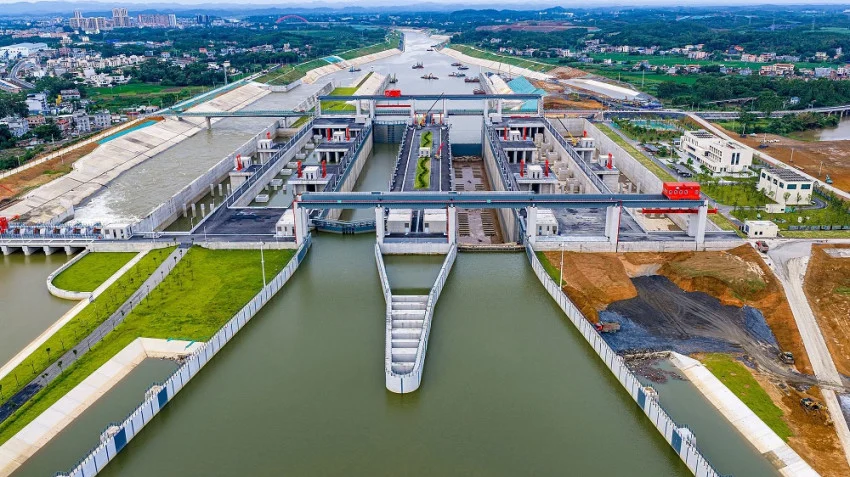
Beijing has officially inaugurated the Pinglu Canal, marking a monumental milestone in modern engineering and international trade logistics. As the first river-to-sea modern canal constructed in the history of the People’s Republic of China, this ambitious mega-project is designed to fundamentally reshape maritime connectivity between China’s landlocked southern and southwestern regions and the booming economies of Southeast Asia. Located entirely within the Guangxi Zhuang Autonomous Region—which shares a land border with Vietnam and opens directly onto the South China Sea—the canal serves as a strategic economic corridor aimed at reducing transit times, lowering logistical expenditures, and tightening supply chain integration between Beijing and the Association of Southeast Asian Nations (ASEAN).
The realization of the Pinglu Canal is not merely a regional infrastructure upgrade; it represents a core component of China’s broader geopolitical and economic strategy, most notably the Belt and Road Initiative championed by President Xi Jinping. By engineering a navigable waterway that bridges inland river systems with international maritime routes, Beijing seeks to future-proof its export-driven economy against rising logistical costs and regional bottlenecks, cementing its commercial dominance across the Indo-Pacific.
Geographical Scope and Engineering Overview
The newly opened Pinglu Canal spans an impressive 134 kilometers (approximately 83 miles), establishing a direct, high-capacity waterborne highway that connects the Xijiang River—a primary tributary of the Pearl River system—to the Beibu Gulf. The Beibu Gulf, forming the northwestern arm of the broader Gulf of Tonkin, acts as a vital maritime vestibule situated between southern China and northern Vietnam.
From an engineering standpoint, the project is designed to accommodate vessels with capacities of up to 5,000 tons. This capability allows large commercial barges to bypass traditional, more circuitous river routes and complex overland transport systems. By cutting directly through the topography of Guangxi, the waterway links deep inland production hubs in southwestern provinces such as Yunnan and Guizhou directly to international shipping lanes.
The canal is a centerpiece of the New International Land-Sea Trade Corridor. This overarching logistics framework integrates various transport networks—including highways, railways, and deep-water ports—to connect western and southwestern China with global markets. Rather than operating in isolation, the canal functions as a critical hydraulic artery that feeds cargo from urban and industrial centers like Chongqing, Chengdu, Guiyang, and Kunming directly to the ports of the Beibu Gulf, facilitating seamless transshipment to Southeast Asia, Europe, Africa, and beyond.
Chronology and Development Timeline
The path to completing the Pinglu Canal reflects decades of logistical planning and a compressed execution timeline driven by modern engineering prowess and substantial state backing.
Initial conceptualizations of a direct river-to-sea route in southern Guangxi date back to early regional development blueprints, though difficult terrain, financial constraints, and technological limitations kept the project on the drawing board for decades. The modern iteration of the project gained serious momentum in the late 2010s as Beijing sought to optimize domestic supply chains and enhance trade flows with ASEAN nations under the framework of the Belt and Road Initiative.
By the early 2020s, official feasibility studies were concluded, and environmental as well as structural assessments were fast-tracked by both provincial and national authorities. Construction officially commenced following comprehensive planning approvals, with the central government and local Guangxi authorities committing an estimated 72.7 billion yuan—equivalent to roughly 10.8 billion US dollars—to the venture.
Throughout the construction phase, thousands of engineers, laborers, and logistics specialists worked across multiple sections of the canal, overcoming significant topographical challenges, managing complex water-level engineering requirements, and constructing advanced lock systems to handle elevation changes between the river systems and the coastal gulf. The culmination of these efforts arrived on a historic Wednesday, when the first modern river-to-sea canal officially opened for navigation, transitioning from an ambitious blueprint to a fully operational commercial artery.
Economic Data and Logistical Cost Reductions
The primary commercial justification for the Pinglu Canal lies in its dramatic potential to compress distances and lower operating expenditures for manufacturing and agricultural sectors across southern and southwestern China.
According to data compiled and released by local authorities in Guangxi, the canal cuts the shipping distance between inland southwestern China and Southeast Asian markets by approximately 560 kilometers (350 miles). This substantial reduction in nautical mileage translates directly into a projected decrease in overall logistical costs ranging between 18 and 30 percent.
Quantifying these savings, Zhang Zhiwen, the deputy secretary-general of the Guangxi regional government, estimated that transportation costs alone will decline by more than 5 billion yuan annually, representing roughly 700 million US dollars in direct savings for enterprises utilizing the corridor. These efficiencies are expected to significantly enhance the profit margins of manufacturers operating in China’s interior, making their goods more competitive in international export markets.
Furthermore, the integration of 5,000-ton vessel capabilities means that bulk commodities, heavy machinery, agricultural products, and manufactured goods can be transported in much larger volumes per voyage than previously possible via smaller river craft or congested overland rail and highway networks.
Official Responses and Stakeholder Perspectives
Regional and national officials have lauded the completion of the Pinglu Canal as a transformative development for domestic and international commerce.
Lu Xinning, vice-chairperson of the Guangxi Zhuang Autonomous Region, emphasized that the project delivers tangible, real-world advantages to the business community. In official statements regarding the inauguration, Lu highlighted that the canal will function as a vital catalyst for lowering operational overheads for enterprises, thereby stimulating both domestic trade within China’s provinces and international commerce with neighboring ASEAN states.
From the perspective of regional economic planners, the canal resolves a long-standing geographic disadvantage. Historically, southwestern provinces like Yunnan and Guizhou relied heavily on lengthy river detours or expensive overland trucking to reach coastal export terminals, rendering their supply chains vulnerable to congestion, high fuel costs, and capacity limits. By establishing a direct, state-of-the-art water route to the Beibu Gulf, regional governments anticipate a surge in foreign investment, industrial relocation to inland zones, and enhanced integration with global supply chains.
International trade analysts observing the development note that the project aligns seamlessly with Beijing’s broader economic transition toward high-end manufacturing, regional economic integration, and the diversification of trade routes away from overly congested eastern coastal hubs like Shanghai and Shenzhen.
Strategic Implications and Broader Geopolitical Impact
The opening of the Pinglu Canal carries profound implications that extend far beyond the immediate economic metrics of cost reduction and distance savings.
From a geopolitical standpoint, the infrastructure project reinforces China’s economic footprint in Southeast Asia. ASEAN has remained one of China’s most crucial trading partners, and efficient supply chain corridors facilitate deeper bilateral economic interdependence. By smoothing the flow of raw materials and finished goods between interior Chinese provinces and Southeast Asian markets, Beijing further solidifies its position as the central node in Asian regional trade networks.
Moreover, the canal serves as a physical manifestation of the Belt and Road Initiative’s domestic-international nexus. While much of the international discourse surrounding the BRI focuses on overseas investments—such as railways in Southeast Asia, ports in South Asia, and energy grids in Africa—the Pinglu Canal demonstrates how domestic mega-projects are intentionally engineered to plug directly into international corridors, creating a continuous, unbroken logistical pipeline from China’s interior to the wider world.
Environmental and ecological considerations have also been a focal point of the project’s execution. Planners and environmental agencies incorporated advanced watershed management, ecological protection zones, and modern water-saving technologies into the canal’s construction to mitigate potential disruptions to local river ecosystems and marine habitats in the Beibu Gulf. While massive engineering projects of this scale invariably invite environmental scrutiny, authorities have maintained that sustainable development practices were prioritized to balance commercial utility with ecological preservation.
Ultimately, the Pinglu Canal stands as a testament to modern hydraulic engineering and strategic economic planning. By bridging the Xijiang River with the Beibu Gulf, China has successfully unlocked a new maritime gateway that promises to redefine trade dynamics, accelerate regional development, and chart a more efficient course for the future of international logistics in Asia.