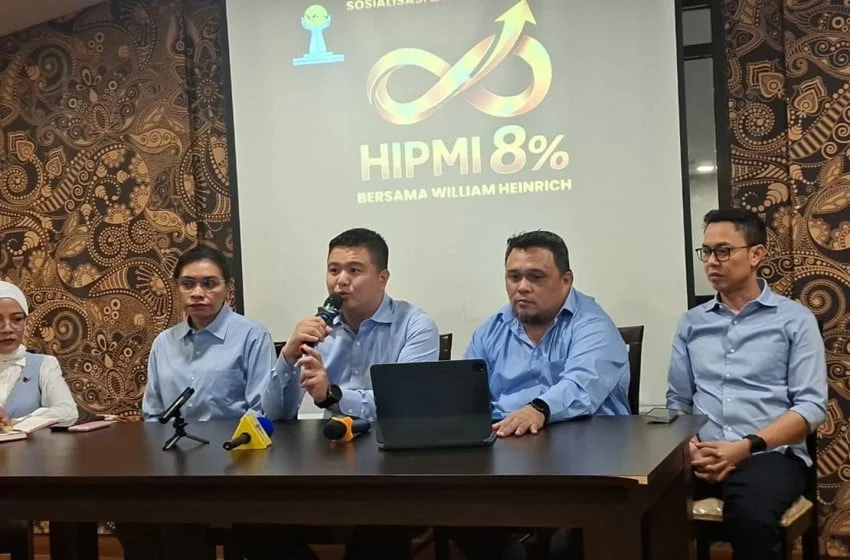
JAKARTA – William Heinrich, a candidate for the General Chairperson of the Central Executive Board (BPP) of the Indonesian Young Entrepreneurs Association (HIPMI), expressed strong optimism that a robust collaboration between the government and the business community will be the pivotal element in achieving the nation’s "Golden Indonesia" vision. Heinrich articulated this perspective during a press conference held at SCBD, South Jakarta, on Wednesday, April 15, 2026.
The press conference served as a platform for Heinrich to introduce his strategic initiative, dubbed "HIPMI 8%." This program is presented as a tangible contribution aimed at strengthening the national economy, aligning with the policy direction advocated by President-elect Prabowo Subianto. In his detailed presentation, Heinrich underscored the urgent necessity of achieving an 8% economic growth rate, positing it as a critical benchmark for Indonesia to successfully navigate and escape the "middle-income trap."
He emphasized the imperative of maximizing the current demographic bonus, a period characterized by a large, working-age population. Heinrich asserted that this demographic dividend can only be fully leveraged through a synergistic partnership between the state and the private sector, with a particular focus on empowering young entrepreneurs. He highlighted the limitations of the government’s fiscal capacity, suggesting that this necessitates a more substantial role and contribution from the real economy.
The "HIPMI 8%" Initiative: A Strategic Framework for Growth
The "HIPMI 8%" initiative, as presented by William Heinrich, is more than just a target; it represents a comprehensive framework designed to stimulate economic dynamism. The proposed 8% economic growth rate is not arbitrary but is informed by global economic trends and Indonesia’s specific development trajectory. Historical data indicates that economies transitioning from middle-income to high-income status often require sustained periods of high growth, typically exceeding 7-8%, to bridge the gap. Countries like South Korea and Taiwan in the latter half of the 20th century are often cited as examples where sustained high growth, coupled with strategic industrial policies and entrepreneurial dynamism, facilitated their ascent.
Heinrich’s proposal implicitly acknowledges that Indonesia, despite its considerable progress, remains susceptible to the middle-income trap – a phenomenon where a country’s economic growth stagnates after reaching a certain level of development, often due to challenges in moving up the value chain, increasing productivity, and fostering innovation. Achieving 8% growth is seen as a crucial step in overcoming these hurdles and ensuring Indonesia’s trajectory towards becoming a developed nation by 2045, the centenary of its independence.
The emphasis on the demographic bonus is another cornerstone of Heinrich’s strategy. Indonesia is currently experiencing a "demographic dividend," with a substantial proportion of its population in the productive age group. This presents a unique opportunity for accelerated economic development, provided that this large workforce is well-educated, skilled, and productively employed. Without effective strategies to harness this potential, the demographic bonus could instead become a demographic burden, characterized by high unemployment and social instability. Heinrich’s call for synergy with the private sector is therefore a direct response to this challenge, recognizing that the government alone cannot create the necessary jobs and economic opportunities for millions of young Indonesians entering the workforce each year.
Government-Entrepreneur Synergy: Addressing Fiscal Constraints
William Heinrich’s assertion that the government’s fiscal limitations demand a greater role from the private sector is a pragmatic observation. Indonesia’s national budget, while substantial, faces competing demands from various sectors, including infrastructure development, social welfare programs, education, and healthcare. Relying solely on government spending to drive an ambitious 8% growth rate would place an unsustainable burden on public finances.
The private sector, particularly a vibrant and innovative entrepreneurial community, can act as a powerful engine for economic growth through investment, job creation, and innovation. Heinrich’s "HIPMI 8%" initiative seeks to foster an environment where entrepreneurs are empowered and incentivized to invest, expand their businesses, and contribute to the national economy. This could involve a range of policy measures, such as:
- Streamlining Regulations: Reducing bureaucratic hurdles and simplifying licensing procedures to make it easier for businesses to operate and grow.
- Improving Access to Finance: Facilitating access to affordable capital for small and medium-sized enterprises (SMEs) and startups, which are often the backbone of job creation.
- Incentivizing Investment: Offering tax incentives and other forms of support for businesses that invest in key sectors, create jobs, and adopt new technologies.
- Promoting Innovation and R&D: Encouraging investment in research and development to foster innovation and help Indonesian businesses move up the global value chain.
The collaboration envisioned by Heinrich extends beyond mere financial investment. It implies a partnership in policy formulation, where entrepreneurs provide valuable insights and feedback to inform government economic strategies. This co-creation process can lead to more effective and targeted policies that address the real needs of the business community and the economy.
Context of the HIPMI Leadership Race
The press conference by William Heinrich takes place against the backdrop of the upcoming leadership elections for BPP HIPMI. HIPMI, as an organization representing young entrepreneurs, plays a significant role in advocating for the interests of its members and contributing to national economic development discourse. The selection of its next leader is therefore a matter of considerable interest, as the new chairperson will have the mandate to shape the organization’s agenda and its engagement with the government and other stakeholders.
Heinrich’s proactive approach, by presenting a clear strategic vision and initiative like "HIPMI 8%" well in advance of the election, signals his ambition and preparedness to lead. His focus on a collaborative model and a specific economic growth target suggests a departure from purely reactive advocacy towards a more proactive, solution-oriented approach. Other candidates for the leadership position will likely need to articulate their own distinct visions and strategies to resonate with HIPMI members and the broader business community.
The timing of his announcement also aligns with the broader national political landscape, particularly the transition and policy agenda of the incoming Prabowo Subianto administration. By explicitly linking his "HIPMI 8%" initiative to the President-elect’s policy direction, Heinrich seeks to position himself and HIPMI as key partners in realizing the national development agenda. This strategic alignment could enhance his credibility and influence should he be elected to lead HIPMI.
Supporting Data and Economic Indicators
To underscore the urgency and feasibility of his proposal, Heinrich’s advocacy for an 8% economic growth rate can be contextualized with relevant economic data and projections:
- Historical Growth Trends: Indonesia’s economic growth has averaged around 5% in recent years, with fluctuations due to global economic conditions. Achieving a sustained 8% growth would represent a significant acceleration, requiring a concerted effort from all economic actors. For instance, between 2004 and 2007, Indonesia experienced a period of growth above 6%, demonstrating the potential for higher growth rates.
- Demographic Dividend Projections: The Indonesian workforce is projected to peak in the coming years. The National Development Planning Agency (Bappenas) has highlighted the importance of job creation to absorb this growing labor force. Without sufficient job opportunities, the demographic dividend could turn into a demographic curse.
- Middle-Income Trap Benchmarks: Many East Asian economies that successfully transitioned to high-income status achieved this through sustained growth rates of 7-8% for extended periods, often accompanied by significant structural reforms and industrial upgrading.
- Investment Needs: To achieve higher growth rates, Indonesia requires substantial increases in investment, both domestic and foreign. The Investment Coordinating Board (BKPM) regularly reports on investment realization, and there is a continuous need to attract more capital into productive sectors.
Heinrich’s "HIPMI 8%" proposal implicitly calls for policies that can attract and channel investment effectively, coupled with measures to enhance productivity and competitiveness across various industries.
Potential Reactions and Broader Implications
William Heinrich’s optimistic outlook and strategic proposal are likely to elicit varied responses from different stakeholders:
- Government: The incoming administration, led by President-elect Prabowo Subianto, is expected to welcome initiatives that align with its economic agenda. The emphasis on private sector involvement and achieving high growth rates resonates with stated policy goals. Officials may look to engage with HIPMI and Heinrich’s initiative to explore concrete implementation mechanisms.
- Business Community: Other business organizations and individual entrepreneurs may view Heinrich’s proposal positively, seeing it as a potential catalyst for growth and a voice for their concerns. However, there may also be questions regarding the specific details of the "HIPMI 8%" plan and how it will be implemented in practice.
- Economic Analysts: Economists will likely analyze the feasibility of an 8% growth target, considering the prevailing global economic conditions, domestic structural challenges, and the potential impact of proposed policies. They might offer insights into the necessary reforms and investments required to achieve such an ambitious goal.
- HIPMI Members: The ultimate success of Heinrich’s proposal will depend on its reception among the members of HIPMI. His ability to articulate a compelling vision and demonstrate its practical benefits will be crucial in securing their support, especially in the context of the leadership race.
The broader implications of Heinrich’s proposal are significant. If successfully implemented, a sustained period of 8% economic growth, driven by government-entrepreneur collaboration and a maximized demographic dividend, could accelerate Indonesia’s journey towards becoming a developed nation. This would translate into higher living standards, increased employment opportunities, and a stronger global economic standing. Conversely, failure to achieve such growth could prolong Indonesia’s stay in the middle-income trap, with potential long-term consequences for social stability and national development.
Heinrich’s call for synergy underscores a fundamental truth in modern economic development: no single entity, be it the government or the private sector, can achieve ambitious national goals in isolation. The path to "Golden Indonesia" is paved with shared responsibility, strategic partnerships, and a collective commitment to innovation and progress. The "HIPMI 8%" initiative, if translated into actionable policies and embraced by all stakeholders, could indeed be a significant stride towards that vision.