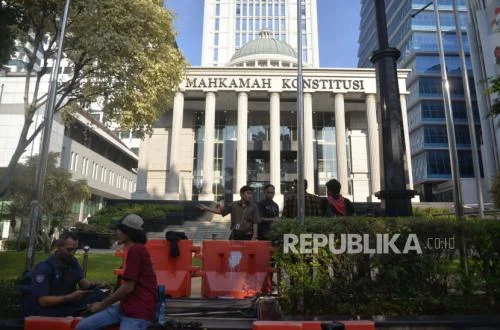
Jakarta, Indonesia – A dramatic scene unfolded at the Constitutional Court (MK) in Jakarta on Wednesday, May 29, 2024, as family members of a witness, identified as Sulaiman, reportedly associated with the Democratic Party, erupted in protest. The incident, occurring amidst ongoing hearings for the 2024 Legislative Election Dispute (PHPU Pileg), saw a woman claiming to be Sulaiman’s sister vehemently accuse authorities of coercion and injustice, alleging that her brother had been incommunicado since May 24, 2024, after being picked up from home without proper communication or agreement. The confrontation highlighted underlying tensions and sensitivities surrounding the integrity of the electoral process and the treatment of witnesses in high-profile legal battles in Indonesia.
The Dramatic Confrontation: A Sister’s Allegations
The incident, which transpired in the vicinity of Building I of the Constitutional Court, began as Sulaiman was escorted into the premises alongside a legal representative from the Democratic Party. Dressed entirely in black and with his face obscured by a mask, Sulaiman’s appearance immediately drew attention. Moments later, a man and a woman from outside the building began shouting, demanding to see him. The woman, clad in a yellow shirt and a black headscarf, identified herself as Sulaiman’s sister and forcefully articulated her distress. "I am his sister! Do you know that? Everything is unfair! There is coercion!" she exclaimed, her voice laced with anguish and frustration.
Her attempts to gain entry into the building were thwarted by security personnel. Following the initial outburst, she and two other individuals were approached by a Constitutional Court official, who inquired about their forceful entry attempts. The sister reiterated her primary concern: her brother, Sulaiman, had been picked up from their home on Friday, May 24, 2024, and had been unreachable ever since. "There was no agreement. The plan was for (Sulaiman) to be taken out of the house, he said goodbye, and until now, there has been no news," she stated, emphasizing the sudden and unexplained disappearance that had left her family deeply worried. This lack of communication, coupled with her brother’s masked appearance, fueled her allegations of unfairness and coercion, casting a shadow over the proceedings.
Sulaiman’s Role in the PHPU Pileg Case
Sulaiman was slated to appear as a witness for the Democratic Party in the Legislative Election Dispute case number 196-01-14-22/PHPU/DPR-DPRD-XXII/2024. In this particular case, the General Election Commission (KPU) serves as the respondent, while the National Mandate Party (PAN) is listed as the related party. The specific details of Sulaiman’s testimony were not immediately disclosed, but his presence as a witness suggests his potential knowledge or involvement in electoral processes relevant to the Democratic Party’s challenge in the legislative elections. The context of legislative election disputes often involves intricate details regarding vote counts, administrative procedures, and allegations of fraud or irregularities at various levels of the electoral hierarchy. Witnesses play a crucial role in providing firsthand accounts and evidence to substantiate the claims made by petitioners.
Context: Indonesia’s 2024 Elections and the Constitutional Court
The dramatic incident surrounding Sulaiman occurs against the backdrop of Indonesia’s highly anticipated and contentious 2024 General Elections. The elections, held on February 14, 2024, encompassed both presidential and legislative races, marking a significant democratic exercise in the world’s third-largest democracy. Following the elections, the Constitutional Court became the focal point for resolving disputes arising from the results.
The Pivotal Role of the Constitutional Court
The Constitutional Court (Mahkamah Konstitusi or MK) in Indonesia holds immense power and responsibility, particularly as the ultimate arbiter of election disputes. Established in 2003, the MK is tasked with safeguarding the constitution, reviewing laws, and resolving disputes concerning the authority of state institutions. Crucially, it serves as the final and binding judicial body for adjudicating PHPU cases, ensuring electoral integrity and upholding democratic principles. Its decisions are final and cannot be appealed, making its role indispensable in maintaining stability and legitimacy in the country’s democratic framework. The court’s pronouncements are often highly anticipated and can shape the political landscape for years to come.
The PHPU Pilpres 2024 Verdict (April 22)
Earlier, on Monday, April 22, 2024, the Constitutional Court had delivered its highly anticipated verdict on the Presidential Election Dispute (PHPU Pilpres) for the 2024 elections. This particular case involved challenges to the results that declared Prabowo Subianto and Gibran Rakabuming Raka as the winners. The petitions, filed by the losing presidential candidates Anies Baswedan-Muhaimin Iskandar and Ganjar Pranowo-Mahfud MD, alleged various irregularities, including ethical violations by the election commission, misuse of state resources, and structural, systematic, and massive fraud. The court’s decision on April 22 upheld the election results, rejecting the petitions and solidifying Prabowo-Gibran’s victory. The announcement of this verdict was a major event, marked by heightened security and intense public scrutiny, symbolizing the resolution of the top-tier electoral contest. The atmosphere around the MK on that day was one of profound anticipation, a stark contrast to the agitated scene involving Sulaiman’s family a month later, yet both underscore the court’s critical role in the nation’s democratic process.
The Intricacies of PHPU Pileg Cases
While the presidential election dispute garners significant national attention, the legislative election disputes (PHPU Pileg) are equally complex and numerous. These cases involve challenges from various political parties and individual candidates at different levels—DPR (national parliament), DPD (regional representatives council), and provincial and district/city DPRD (regional legislative councils). The sheer volume of these cases often runs into hundreds, each requiring meticulous examination of vote counts, electoral procedures, and evidence of alleged violations. The legal proceedings for PHPU Pileg cases are exhaustive, involving the presentation of witnesses, expert testimonies, and documentary evidence from petitioners, respondents (KPU), and related parties (other political parties or candidates whose interests might be affected). The outcomes of these cases can significantly alter the composition of legislative bodies across the archipelago, impacting political representation and local governance. The case involving Sulaiman falls into this category, highlighting the granular level at which the Constitutional Court ensures electoral fairness.
Allegations of Coercion and Lack of Communication
The family’s allegations surrounding Sulaiman’s "disappearance" and claims of coercion are deeply troubling within the context of legal proceedings. The assertion that Sulaiman was taken from home on May 24 and subsequently became incommunicado for five days, without his family being able to reach him, raises serious questions about his welfare and the circumstances under which he was brought to the Constitutional Court. The sister’s desperate plea, "Tidak ada perjanjian. Rencana (Sulaiman) dibawa keluar rumah, pamitan, dan sampai sekarang tidak ada kabarnya," paints a picture of a family left in the dark, fearing for their loved one’s safety and autonomy.
Legal Implications of Witness Handling
In any judicial process, the voluntary and uncoerced testimony of witnesses is paramount. Legal frameworks in democratic nations typically include provisions to ensure that witnesses are protected from intimidation, undue influence, or forced participation. If the family’s claims are substantiated, they could point to potential breaches of legal ethics, procedural fairness, and even human rights. The act of bringing a witness to court without proper communication with their family, especially when they are allegedly incommunicado, can undermine public trust in the legal system and raise doubts about the credibility of the testimony itself. Such situations often prompt investigations by judicial oversight bodies or law enforcement agencies to ascertain the facts and ensure that all legal protocols are adhered to.
Witness Protection and Procedural Integrity
Indonesia, like many countries, has provisions for witness protection, particularly in sensitive cases where there might be threats or intimidation. However, the application and effectiveness of these measures can vary. The incident at the MK underscores the critical importance of robust witness protection mechanisms and transparent procedural integrity.
Legal Safeguards for Witnesses
Under Indonesian law, witnesses are generally afforded rights, including the right to legal counsel, protection from intimidation, and the right to provide testimony freely. The Law on Witness and Victim Protection (UU Perlindungan Saksi dan Korban) aims to provide a legal framework for safeguarding individuals who come forward to assist in legal proceedings. However, the practical implementation of these safeguards, particularly in politically charged environments like election disputes, can be challenging. The alleged incommunicado status of Sulaiman and his masked appearance, as observed by his family, could be interpreted in various ways – from a legitimate security measure to a potential indicator of undue pressure. Clarification from relevant parties is crucial to dispel any concerns.
The Importance of Voluntary Testimony
The bedrock of a fair trial rests on the principle that all testimony, especially from witnesses, must be given voluntarily and without any form of coercion or undue influence. Any suspicion of a witness being compelled or manipulated to testify could invalidate their statements and jeopardize the entire case. The Democratic Party, as the party presenting Sulaiman as a witness, would typically be responsible for ensuring that their witnesses are willing and properly prepared, and that all ethical guidelines for engaging witnesses are followed. The Constitutional Court, as the presiding judicial body, is also obligated to ensure that all evidence, including witness testimony, is obtained through legitimate and ethical means.
Reactions and Calls for Clarity
The incident at the Constitutional Court is likely to trigger a range of reactions from various stakeholders, necessitating clear and prompt responses to maintain public confidence in the electoral justice system.
Constitutional Court’s Stance (Inferred)
While no immediate official statement from the Constitutional Court was reported at the time of the incident, it is highly probable that the court would address the matter. In such situations, the MK typically reaffirms its commitment to upholding fair and transparent legal proceedings. They might issue a statement clarifying their security protocols, the procedures for handling witnesses within their premises, and potentially initiate an internal inquiry into the circumstances surrounding Sulaiman’s presence and the family’s allegations. The court would likely emphasize that all parties, including witnesses, are treated according to legal norms and that any allegations of coercion would be taken seriously.
Political Party’s Response: The Democratic Party (Inferred)
The Democratic Party, as the party that brought Sulaiman as a witness, would likely face pressure to provide an explanation. They would be expected to clarify the nature of their relationship with Sulaiman, the process by which he was engaged as a witness, and to refute any allegations of coercion. A spokesperson for the Democratic Party might issue a statement asserting that Sulaiman is a willing witness, that all proper legal procedures were followed, and that his security and well-being are a priority. They might also explain the reasons for his masked appearance, if it was indeed a measure taken for his protection or privacy.
Legal Experts and Civil Society Concerns (Inferred)
Legal experts and civil society organizations advocating for human rights and electoral integrity would undoubtedly voice their concerns. They would likely call for a thorough and independent investigation into the family’s claims. Emphasis would be placed on ensuring witness protection, upholding the principle of voluntary testimony, and maintaining the transparency and fairness of the judicial process. Organizations like the Indonesian Legal Aid Foundation (LBH) or the Association for Elections and Democracy (Perludem) would likely monitor the situation closely, advocating for accountability and adherence to democratic principles. They might also highlight the broader implications for public trust if such allegations are not adequately addressed.
Broader Impact on Public Trust and Electoral Transparency
Incidents such as the family’s outburst at the Constitutional Court, especially when involving allegations of coercion and incommunicado status of a witness, can have significant repercussions for public trust in Indonesia’s democratic institutions and the overall transparency of its electoral processes.
Upholding the Rule of Law
The rule of law dictates that all individuals, regardless of their role in legal proceedings, are entitled to due process and protection of their rights. If allegations of coercion or improper handling of witnesses are not addressed transparently and effectively, it can erode confidence in the justice system. The Constitutional Court’s ability to maintain its credibility as an impartial arbiter depends heavily on its commitment to upholding these fundamental principles, not only in its verdicts but also in the conduct of its proceedings. Any perceived deviation from ethical or legal standards in witness management can invite criticism and undermine the legitimacy of the entire electoral dispute resolution mechanism.
Maintaining Confidence in Democratic Institutions
Indonesia has made significant strides in consolidating its democracy since the reformasi era. However, public confidence in institutions like the KPU and the Constitutional Court remains crucial for the health of its democratic system. Episodes that suggest irregularities in witness treatment or a lack of transparency can fuel skepticism and mistrust among the populace. This is particularly sensitive in a post-election period where political tensions are often high. Ensuring that all aspects of the electoral dispute resolution process are conducted with utmost integrity and accountability is essential to reinforce public faith in the democratic process and the institutions tasked with safeguarding it. The ultimate goal is to reassure citizens that their electoral choices are respected and that disputes are resolved fairly and justly.
Conclusion: Awaiting Further Developments
The emotional outburst by Sulaiman’s family at the Constitutional Court has introduced an unexpected and unsettling element into the ongoing PHPU Pileg proceedings. Beyond the immediate legal implications for the Democratic Party’s case, the incident has ignited broader discussions about witness rights, procedural transparency, and the integrity of the electoral dispute resolution mechanism in Indonesia. As the Constitutional Court continues its work in adjudicating numerous legislative election challenges, the handling of this particular incident and the clarity provided by the involved parties will be critical. The public, legal observers, and civil society will undoubtedly be watching closely for further developments, seeking assurance that justice is not only served but is also seen to be served, in every aspect of Indonesia’s democratic journey. The resolution of this specific contention will serve as a vital test of the system’s commitment to fairness and the protection of all individuals involved in its most sensitive judicial processes.