
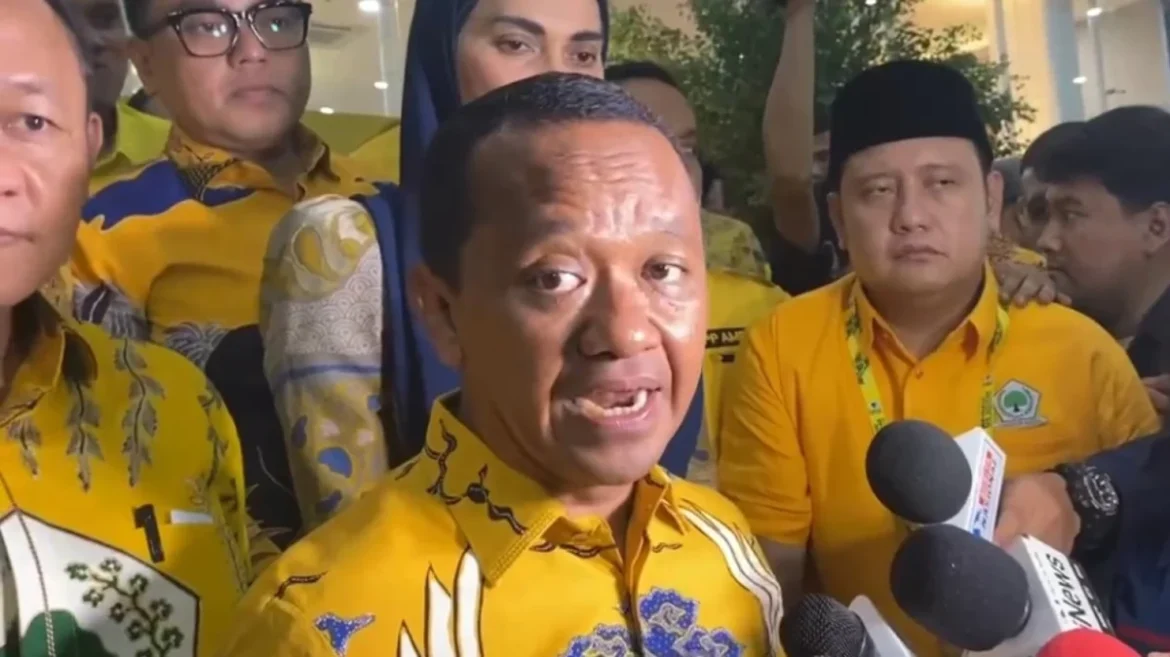
Jakarta, VIVA – The Chairman of the Golkar Party, Bahlil Lahadalia, has issued a robust call to all party cadres to fortify internal consolidation and maintain an unyielding sense of solidarity. Speaking at the party’s 61st anniversary celebration, Bahlil emphatically cautioned against any "additional movements" that could undermine the party’s cohesion, emphasizing the critical role of unity in securing Golkar’s enduring political influence. The event, a significant milestone for one of Indonesia’s most storied political institutions, took place on Monday, October 20, 2025, at the Golkar Central Leadership Council (DPP) office in Slipi, West Jakarta. His remarks, delivered to a gathering of party loyalists and officials, underscored a strategic imperative for collective action and disciplined adherence to party lines.
Bahlil’s address, delivered with directness and conviction, highlighted the delicate balance between internal discourse and disruptive actions. "If you cannot contribute to solidity, at the very least, do not create additional movements. I know, we all know. It’s not that I am unaware; I know," Bahlil stated, his words carrying an implicit warning to those who might consider dissenting or factional activities. The initial ambiguity surrounding the term "additional movements" prompted immediate journalistic inquiry, to which Bahlil provided a clarifying explanation, reframing the concept within a positive and constructive framework. He elaborated that the "additional movements" he encouraged were those "constructive and productive for the advancement of the Golkar Party going forward, towards a better direction." This clarification sought to distinguish between healthy internal debate and divisive maneuvers, emphasizing the party’s openness to progressive ideas while simultaneously guarding against fragmentation.
A Milestone Celebration and a Strategic Imperative
The 61st anniversary celebration of the Golkar Party served as more than just a commemorative event; it was a platform for strategic messaging and a reaffirmation of the party’s foundational principles. For a party with a history spanning over six decades, marked by periods of immense power and significant transitions, internal unity remains a perennial concern. Golkar, established in 1964, has historically been a dominant force in Indonesian politics, playing a pivotal role in the nation’s development and governance across various administrations. Its longevity is attributed to its broad-based appeal, organizational strength, and adaptability, but also to its ability to manage internal dissent and maintain a cohesive front.
The timing of Bahlil’s remarks is particularly noteworthy. While the last general elections (presidential and legislative) would have been held in early 2024, October 2025 places the party in a period of consolidation following national political contests and likely preparing for regional elections (Pilkada) or even laying groundwork for future national contests. In this context, ensuring internal harmony is paramount for any major political party seeking to maintain or expand its influence. Post-election periods often expose fissures within parties as various factions jockey for positions, influence, or leadership succession. Bahlil’s proactive stance aims to preempt such internal strife, channeling energy towards collective goals rather than individual or factional ambitions.
Bahlil Lahadalia: A Profile in Leadership

Bahlil Lahadalia’s leadership of the Golkar Party is a relatively recent development in the party’s long history, marking a new era. His rise within the party and national politics has been swift and impactful. Beyond his role as party chairman, Bahlil holds a significant position in the executive branch as a minister. The original article, specifically referring to him as "Menteri ESDM" (Minister of Energy and Mineral Resources) in October 2025, places him at the helm of a critical portfolio that directly impacts national development and economic strategy. This dual role—leading a major political party and holding a key ministerial position—accords him considerable influence and responsibility.
His background as a successful entrepreneur before entering politics has often been highlighted, contributing to his image as a pragmatic and results-oriented leader. This experience likely shapes his approach to party management, where efficiency, strategic planning, and measurable outcomes are prioritized. His call for "constructive and productive" movements aligns with a leadership style focused on tangible progress rather than ideological purism or internecine power struggles. Such a leader would naturally view internal discord as a drain on resources and a distraction from the party’s broader objectives.
The Peril and Promise of "Dinamika"
A central theme in Bahlil’s address was the concept of "dinamika" (dynamics) within the party. He acknowledged that Golkar, being a party born from diverse functional groups and encompassing a wide spectrum of ideologies and interests, is inherently prone to internal dynamics. Crucially, he framed these dynamics not as weaknesses but as potential assets. "Now, for our administration, Golkar’s cohesiveness is extraordinary, even though we know that Golkar was born from various functional groups, dynamics will certainly occur, and those dynamics are an asset, an asset for the party," he articulated.
This perspective is insightful. In many political organizations, internal differences are often suppressed, leading to resentment and eventual fragmentation. Bahlil’s approach suggests a recognition that a healthy party allows for debate and diverse viewpoints. However, the caveat lies in the management of these dynamics. He stressed that while dynamism is a sign of a living, evolving party, it "must be well-managed." Uncontrolled or destructive dynamics can quickly devolve into factionalism, undermining collective action and public trust. The challenge for Golkar, under Bahlil’s leadership, is to harness these diverse energies into a unified force, channeling potential conflicts into constructive policy debates or strategic innovations.
Golkar’s Enduring Relevance and Future Prospects
Golkar’s trajectory over the past decades illustrates its remarkable resilience. Despite significant political upheavals, including the fall of the New Order regime with which it was historically associated, the party has consistently reinvented itself, adapted to democratic reforms, and remained a formidable electoral contender. In recent general elections (assuming 2024 elections were concluded), Golkar typically secures a significant share of the national vote, often placing among the top three parties. Its broad network, spanning from national to grassroots levels, and its appeal to various segments of society – from business elites to rural communities – contribute to its consistent performance.

This enduring relevance makes internal unity even more critical. A fragmented Golkar would not only weaken its own electoral prospects but could also destabilize broader political coalitions and governance structures. As a party that often serves as a kingmaker or a crucial coalition partner, its internal strength directly impacts national political stability. The call for solidarity, therefore, is not merely an internal party matter; it has broader implications for Indonesia’s political landscape.
Looking ahead, the party faces various challenges and opportunities. These include adapting to evolving voter demographics, responding to new social and economic issues, and preparing for upcoming electoral cycles. The 61st anniversary speech by Bahlil Lahadalia can be seen as a strategic move to position Golkar for these future challenges. By emphasizing unity and constructive engagement, he aims to ensure that the party remains a cohesive and influential force in Indonesian politics.
Analysis of Implications and Broader Context
Bahlil’s strong admonition against disruptive "additional movements" suggests an awareness of potential internal jostling, perhaps related to leadership aspirations, policy disagreements, or strategic directions post-general election. Large parties like Golkar, with numerous influential figures and diverse factions, are always susceptible to internal power struggles. A chairman’s call for unity is often a pre-emptive measure to assert authority and consolidate support, especially if there are nascent challenges to leadership or strategic decisions.
Political observers would likely interpret Bahlil’s statement as a clear signal from the party leadership that internal cohesion is non-negotiable. It reinforces the expectation that any internal debates or disagreements should occur within established party mechanisms and ultimately align with the collective good, as defined by the party’s central command. This type of messaging is common in well-established political parties, particularly those with a hierarchical structure and a strong sense of institutional identity.
Furthermore, the emphasis on "constructive and productive" movements reflects a desire to channel the party’s internal energy towards tangible outcomes that benefit Golkar’s public image and electoral performance. This could include developing innovative policy platforms, strengthening grassroots outreach, or enhancing internal training and capacity building. By framing internal dynamism as an asset, Bahlil is attempting to foster an environment where diverse ideas can flourish, but only if they contribute positively to the party’s overall mission.
In conclusion, Chairman Bahlil Lahadalia’s address at Golkar’s 61st anniversary celebration was a pivotal moment for the party. His unequivocal call for internal consolidation and solidarity, coupled with a nuanced explanation of constructive dynamism, serves as a clear directive for all cadres. It underscores the leadership’s commitment to maintaining Golkar’s strength and influence in the evolving Indonesian political landscape. As the party navigates future electoral cycles and continues to play a significant role in national governance, its ability to heed this call for unity will undoubtedly be a crucial determinant of its sustained success and relevance. The imperative to "build a solid consolidation" is not just a slogan but a strategic foundation for Golkar’s trajectory in the years to come.