The Pertamina Foundation has strategically utilized the momentum of National Children’s Day (Hari Anak Nasional or HAN) 2026 to instill sustainable living habits in early childhood through a series of comprehensive educational activities. Centered on the theme "Me and My Parents Care for the Earth," the initiative took place at two of the foundation’s fostered kindergartens, TK Bumi Patra I in Pondok Ranji and TK Bumi Patra II in Cempaka Putih. By integrating parents into the learning process, the program aims to build a foundational character of environmental awareness in the younger generation, ultimately supporting Indonesia’s broader transition toward a sustainable green economy and a more environmentally conscious society.
The event, held on Friday, July 24, 2026, involved 75 students and 77 parents, creating a collaborative learning environment where theoretical knowledge was immediately translated into practical, everyday actions. This initiative reflects a growing recognition among educational and corporate entities that environmental literacy must begin in the formative years to ensure long-term behavioral changes.
A Strategic Approach to Early Environmental Literacy
The "Me and My Parents Care for the Earth" program was designed to move beyond traditional classroom instruction. Operation Director of Pertamina Foundation, Gusman Adiwardhana, emphasized during a press briefing that National Children’s Day serves as a critical entry point for shaping the mindset of the nation’s future leaders. He noted that the involvement of parents is not merely incidental but a core component of the program’s success.
"National Children’s Day is the right momentum for us to instill concern for the environment from an early age," Adiwardhana stated. "Through the theme ‘Me and My Parents Care for the Earth,’ we want children and parents to learn and practice environmentally friendly habits together directly, rather than just absorbing theory. This synergy ensures that the lessons learned at school are reinforced within the home environment, creating a consistent lifestyle for the child."
The foundation’s approach aligns with global educational trends that emphasize "active learning" and "modeling." By having parents participate in waste sorting and energy conservation drills alongside their children, the program establishes a social proof mechanism where children see environmental care as a standard family value rather than a chore.
Chronology of the "Little Earth Heroes" Activities
The activities were structured under the conceptual framework of "Pahlawan Cilik Penyelamat Bumi" (Little Earth-Saving Heroes). The day began with synchronized environmental-themed gymnastics, designed to engage the children physically and create a positive, energetic atmosphere. This was followed by a series of interactive modules:
- Comprehensive Waste Management Education: Students were introduced to the differences between organic, inorganic, and hazardous (B3) waste. To make this complex topic accessible, the foundation utilized a "waste sorting relay race," where children had to identify and place various items into the correct bins. This gamified approach helped demystify waste management and turned a civic duty into a fun, competitive challenge.
- The "Guardians of the Earth" Puppet Show: Recognizing that storytelling is one of the most effective ways to communicate values to preschoolers, the event featured a puppet performance titled "Pahlawan Penjaga Bumi." The narrative focused on the consequences of pollution and the power of small individual actions, such as picking up litter or saving water, to save the planet.
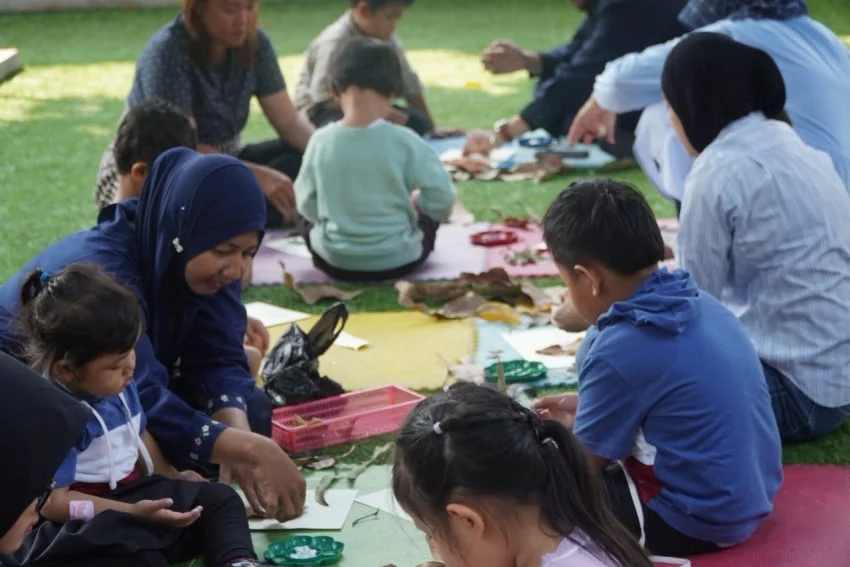
- Creative Upcycling and Nature Art: In a bid to foster appreciation for natural materials, participants engaged in a creative session where they transformed dried leaves into artwork. Children created depictions of butterflies, ships, and trains, learning that "waste" from nature can be a source of beauty and creativity rather than something to be discarded.
- The SAMUSAPO Program (One Student One Tree): The highlight of the event was the sustainability commitment through the SAMUSAPO initiative. Children and parents participated in the maintenance of watermelon trees and the watering of plants brought from their respective homes. This program is designed to be ongoing, encouraging students to take long-term responsibility for a living organism.
The Significance of Parental Involvement in Environmental Education
Psychological research into early childhood development suggests that children between the ages of three and six are in a peak stage for habit formation. During this period, they primarily learn through imitation. By mandating parental participation, the Pertamina Foundation addresses the "disconnect" that often occurs when children learn progressive values at school that are not practiced at home.
The 77 parents involved in the HAN 2026 activities were not just observers; they were active participants in the energy and water conservation workshops. They were encouraged to commit to using tumblers and reusable bags, reducing single-use plastics within their households, and opting for public transportation when feasible. This holistic approach recognizes that a child cannot be an environmental hero in isolation; they require an ecosystem of support.
Supporting Data: The Urgency of Environmental Education in Indonesia
The Pertamina Foundation’s initiative comes at a time when Indonesia faces significant environmental challenges. According to data from the Ministry of Environment and Forestry (KLHK), Indonesia generated approximately 68.5 million tons of waste in recent years, with plastic waste accounting for a substantial portion. Furthermore, a significant percentage of household waste remains unsorted at the source, complicating recycling efforts and overwhelming landfills.
By targeting the "Alpha Generation" (those born between 2010 and 2025), the foundation is investing in a demographic that will reach adulthood as Indonesia nears its "Golden Indonesia 2045" vision. Educating this cohort on the principles of a circular economy and resource efficiency is vital for the country’s economic resilience.
Moreover, studies on early childhood education (ECE) indicate that children who engage with nature and environmental conservation early on are more likely to pursue science-based careers and demonstrate higher levels of civic engagement in adulthood. The Pertamina Foundation’s focus on its fostered schools (TK Bumi Patra) serves as a pilot model that could potentially be scaled across other educational institutions under the Pertamina umbrella or shared as a best practice with the Ministry of Education.
Integration with National Goals and the Green Economy
The HAN 2026 activities are not isolated CSR events but are integrated into a larger strategy for human resource development. Indonesia has committed to achieving Net Zero Emissions by 2060 or sooner. Reaching this target requires more than just technological shifts in the energy sector; it requires a fundamental cultural shift in how the population consumes resources.
Gusman Adiwardhana noted that the Pertamina Foundation is committed to managing its fostered schools with an orientation toward both academic excellence and environmental character building. "This is part of our long-term commitment. We believe that a green economy cannot be achieved without ‘green people.’ By building this character now, we are preparing the human resources who will drive sustainable industries in the future," he explained.
The focus on "B3 waste" (hazardous and toxic materials) is particularly noteworthy. As electronic waste and chemical household products become more common, teaching even the youngest citizens to recognize and safely handle these materials is a critical public health and environmental safety measure.
Broader Impact and Future Implications
The success of the "Me and My Parents Care for the Earth" program suggests a growing appetite for experiential environmental education. For the 75 students involved, the transition from "student" to "Little Earth Hero" provides a sense of agency and purpose.
Looking forward, the implications of such programs are twofold. First, there is the immediate reduction in environmental footprint within the school and the families involved. The adoption of tumblers and waste sorting at TK Bumi Patra I and II serves as a direct intervention in waste production. Second, there is the "ripple effect." Children often become "environmental ambassadors" within their extended families, reminding grandparents or siblings to turn off lights or avoid plastic bags.
As Pertamina Foundation continues to monitor the SAMUSAPO program, the data gathered on plant survival and student engagement will likely inform future curriculum developments. The foundation’s emphasis on "sustainable schools" sets a benchmark for other corporate entities in Indonesia, demonstrating that CSR in education should move beyond infrastructure (building schools) toward content and character development.
In conclusion, the National Children’s Day 2026 celebration by the Pertamina Foundation serves as a blueprint for how corporate social responsibility can intersect with national holidays to produce meaningful social change. By empowering children and parents to act as partners in environmental preservation, the foundation is planting the seeds for a more sustainable and ecologically literate Indonesia. The journey from a "Little Earth Hero" in a Pondok Ranji kindergarten to a leader in a green economy is a long one, but the foundation laid during these formative celebrations is an essential first step.