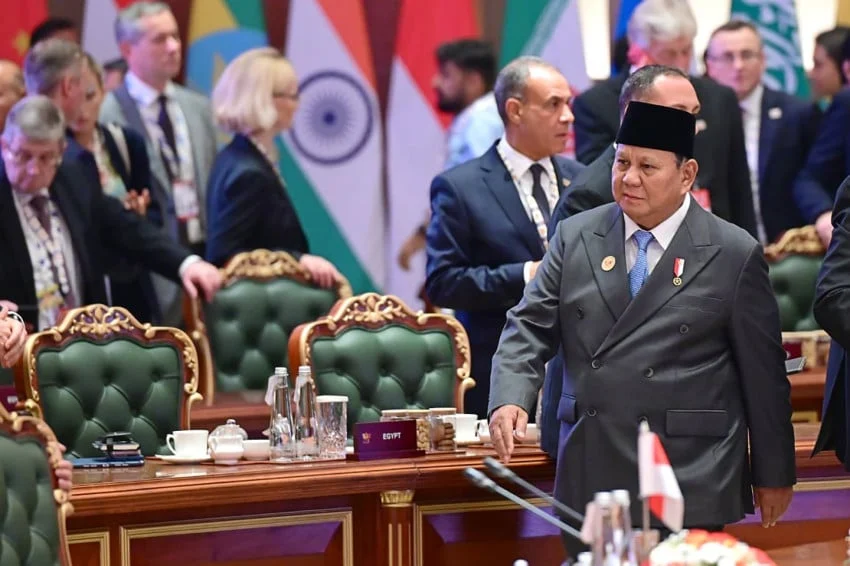
Indonesian President Prabowo Subianto officially addressed the international community at the 18th BRICS Summit in New Delhi, India, marking a monumental milestone for Southeast Asia’s largest economy. Participating as a newly inducted member of the intergovernmental organization, President Prabowo expressed profound gratitude and pride during a high-level limited session. The summit, hosted by the Republic of India, serves as a crucial geopolitical platform for emerging market economies to deliberate on pressing global financial, structural, and multilateral challenges.
The Indonesian leader’s maiden appearance at the summit underscores Jakarta’s shifting foreign policy calibration—balancing traditional non-aligned diplomatic principles with strategic economic integration within the Global South. As the world navigates persistent macroeconomic headwinds, supply chain fragmentation, and shifting geopolitical alliances, Indonesia’s entry into BRICS signifies a deliberate effort to diversify partnerships and amplify the voice of developing nations in shaping global governance.
A Historic Milestone for Indonesian Diplomacy
Addressing the assembly during a restricted plenary session centered on the theme “Inclusive Global Governance and Strengthening Multilateralism,” President Prabowo emphasized the weight of Indonesia’s inclusion. He formally acknowledged the swift consensus demonstrated by the founding nations of BRICS in welcoming Jakarta into the bloc.
“Merupakan suatu kehormatan besar bagi kami untuk hadir di sini dan bergabung dengan Anda semua dalam KTT ini,” President Prabowo remarked during the proceedings, before delivering his formal address in English. He highlighted that joining an organization representing roughly half of the global population is both a responsibility and a privilege for the Indonesian archipelago.
The President directed specific praise toward Indian Prime Minister Narendra Modi, commending his leadership as the current chair of the BRICS bloc and expressing appreciation for the exceptional hospitality extended to the Indonesian delegation. Prime Minister Modi’s stewardship of the 2026 summit has focused heavily on bridging developmental divides, fostering resilient supply chains, and reforming antiquated multilateral financial institutions such as the International Monetary Fund and the World Bank.
Background and Context: Indonesia’s Path to BRICS
Indonesia’s formal integration into BRICS follows years of careful diplomatic observation and internal deliberation. Long courted by various economic powerhouses within the bloc—traditionally consisting of Brazil, Russia, India, China, and South Africa—Jakarta historically maintained a stance of strategic hesitation, prioritizing regional stability through ASEAN and avoiding formal alignment with competing geopolitical axes.
However, the rapid post-pandemic evolution of the global economic architecture prompted a reassessment in Jakarta. With emerging economies increasingly seeking alternatives to Western-dominated financial systems, the appeal of BRICS—particularly its financial arm, the New Development Bank (NDB)—grew significantly. The expansion wave, which gained considerable momentum during the 2023 Johannesburg Summit and continued through subsequent expansions, has transformed BRICS from an acronymic grouping into a formidable geopolitical counterweight.
For Indonesia, joining the bloc aligns seamlessly with its domestic economic ambitions, notably President Prabowo’s vision of achieving robust national growth, ensuring food and energy security, and downstreaming critical mineral resources. Membership provides Jakarta with direct access to alternative trade networks, investment corridors, and a unified platform to advocate for fair trade practices that do not disadvantage developing nations.

The 18th BRICS Summit Agenda: Focus on Multilateralism and Inclusion
The New Delhi summit has convened world leaders against a complex backdrop of overlapping geopolitical crises, including ongoing trade tensions, regional conflicts in the Middle East, and persistent inflationary pressures affecting food and fuel markets worldwide. The agenda for the restricted sessions has been heavily focused on revitalizing multilateral frameworks that many developing nations view as outdated or unreflective of contemporary economic realities.
During the "Inclusive Global Governance and Strengthening Multilateralism" session, delegates engaged in robust debates regarding the reform of the United Nations Security Council, the democratization of international financial institutions, and the mitigation of unilateral economic sanctions. Indonesia’s perspective, articulated by President Prabowo, emphasizes practical cooperation, peaceful conflict resolution, and the preservation of an open, rules-based international order.
Diplomatic observers note that Indonesia’s active participation brings a distinct Southeast Asian perspective to the table. As Chair of ASEAN in recent years and a prominent voice in the Non-Aligned Movement, Jakarta is well-positioned to act as a bridge between BRICS economies and broader global communities, ensuring that the bloc’s initiatives complement, rather than undermine, existing multilateral architectures.
Testing Times: Geopolitical Friction Within the Bloc
The summit also unfolds under the shadow of intricate geopolitical friction among certain member states. Recent diplomatic and security challenges—such as tensions involving Middle Eastern members like Iran and the United Arab Emirates—have tested the internal cohesion and diplomatic agility of the bloc.
Analysts point out that as BRICS expands its footprint to encompass diverse political systems and conflicting regional interests, maintaining internal consensus becomes increasingly challenging. The inclusion of new members requires delicate diplomatic balancing acts to ensure that ideological or bilateral disputes do not paralyze the organization’s core economic and developmental mandates.
Despite these hurdles, the willingness of nations to engage in high-level dialogue in New Delhi demonstrates the enduring value participants place on the platform. For Indonesia, navigating these internal dynamics will require astute diplomatic maneuvering to maximize economic benefits while steadfastly maintaining its foundational constitutional principle of a "free and active" (bebas aktif) foreign policy.
Strategic Implications and Economic Outlook
The long-term implications of Indonesia’s BRICS membership are multi-layered, spanning trade, investment, and geopolitical positioning. Economically, membership opens avenues for enhanced bilateral trade agreements denominated in local currencies, potentially reducing transaction costs and mitigating exposure to currency volatility tied to traditional reserve currencies.
Furthermore, collaboration within the BRICS framework could accelerate technology transfers, joint ventures in green energy transition, and infrastructure financing through the New Development Bank. As Indonesia accelerates its downstream industrialization policies—particularly concerning nickel, bauxite, and other electric vehicle battery components—securing reliable markets and strategic investment partners within the Global South remains a paramount priority.
Domestically, the reception of Prabowo’s address has been overwhelmingly positive, reinforcing the administration’s narrative of an assertive, independent foreign policy that actively seeks partnerships across the globe. As the 18th BRICS Summit concludes its deliberations in New Delhi, the focus will inevitably shift from high-level rhetoric to actionable policy implementation, where Indonesia will be expected to play a constructive and defining role in shaping the future of global multilateralism.