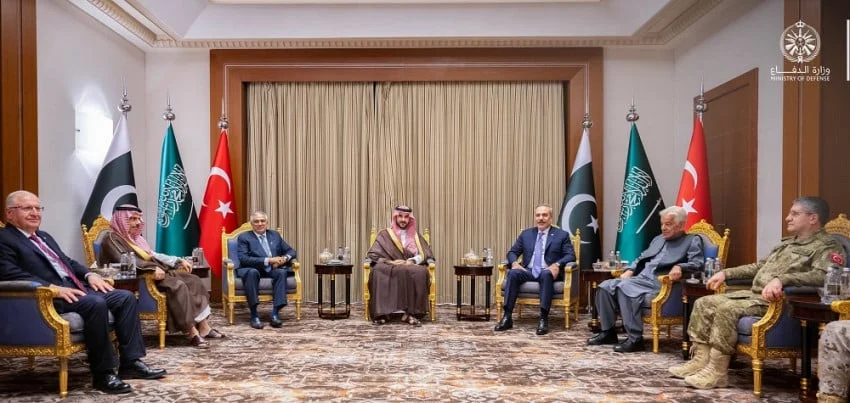
Tehran has emerged as the focal point for a sweeping diplomatic and strategic realignment following high-level bilateral and multilateral consultations involving defense and intelligence chiefs from regional heavyweights. In what foreign policy analysts are calling a potentially transformative diplomatic breakthrough, Iran has welcomed senior officials from Saudi Arabia, Turkey, and Pakistan to establish the foundational architecture for an endogenous regional security framework. The initiative, officially confirmed by Iranian Foreign Ministry Spokesperson Esmaeil Baghaei during a weekly press briefing in Tehran, seeks to pivot the Middle East and South Asia away from extra-regional security dependencies and toward indigenous problem-solving mechanisms.
The convergence of these nations marks a striking departure from decades of geopolitical rivalry, proxy conflicts, and diplomatic estrangement. By bringing together the defense minister of Saudi Arabia, the chief of army staff of Pakistan, and the head of national intelligence from Turkey, Tehran is positioning itself alongside historical competitors to craft a homegrown security paradigm. This development has captured the attention of international observers, who are closely monitoring whether this nascent alliance can withstand longstanding regional friction points and translate high-level rhetoric into durable geopolitical stability.
Genesis of the Initiative: The Pakistan Connection and Multilateral Outreach
The diplomatic momentum leading to the high-stakes meetings in Tehran can be traced back to recent high-level military diplomacy between Islamabad and Tehran. The security framework initiative was formally proposed during a strategic visit by Pakistan’s Chief of Army Staff, General Asim Munir, to the Iranian capital. During his engagements with Iranian military and political leadership, General Munir emphasized the imperative for neighboring Islamic nations to forge closer intelligence-sharing and defense coordination mechanisms to counter transnational threats, including terrorism, illicit drug trafficking, and external military interventions.
The Iranian government swiftly embraced the proposal, viewing it as an alignment with its long-standing doctrine of regional self-reliance. Esmaeil Baghaei elaborated on this during his press briefing, noting that Tehran has consistently advocated for decades that the security of West Asia and South Asia must be managed by the region’s inhabitants rather than Western powers. The conceptual blueprint discussed by the visiting delegations envisions a collaborative network involving Iran’s diplomatic and defense apparatus, Saudi Arabia’s military leadership, Turkey’s sophisticated intelligence network, and Pakistan’s battle-tested armed forces.
By inviting Saudi Arabia’s defense minister and Turkey’s intelligence chief to sit alongside Pakistani and Iranian counterparts, Tehran has effectively bridged the traditional fault lines that have fractured the broader region. This quadrilateral alignment brings together significant military might, intelligence assets, and strategic geographic positioning, spanning from the borders of Europe through the Middle East and deep into South Asia.
Core Objective One: Establishing Independent Regional Mechanisms
The primary impetus behind the Tehran talks is the creation of a sustainable, home-grown mechanism to manage regional crises without the meddling of external actors, particularly the United States and various European powers. Addressing domestic and international media outlets, Baghaei underscored the significance of regional capitals taking the initiative to deliberate on shared security concerns.
"From our perspective, the fact that regional countries are seeking to establish, or at least consider, regional security mechanisms based on their own interests and concerns is an encouraging development," Baghaei stated.
This objective directly targets the historical vulnerability of the Middle East and South Asia to foreign intervention. For decades, security architectures in the Persian Gulf and surrounding regions have relied heavily on Western security umbrellas, naval patrols led by extra-regional powers, and arms imports from the United States and Europe. Critics of the traditional model argue that external security guarantees often come with hidden geopolitical costs, exacerbating local tensions, fueling arms races, and leaving regional states susceptible to the shifting domestic political whims of Western capitals.
The newly proposed framework aims to decouple local stability from the foreign policies of Washington, Brussels, or other global centers of power. By institutionalizing regular consultations among Iran, Saudi Arabia, Turkey, and Pakistan, the participating states aim to create a diplomatic firebreak that can contain local conflicts before they escalate into regional conflagrations.
Core Objective Two: Fostering Endogenous Security Based on Collective Will
The second pillar of the Tehran consultations centers on the concept of "endogenous security"—a security paradigm driven entirely by the collective political will and strategic calculations of indigenous states. For Iran, which has spent decades under severe international sanctions and strategic isolation, the willingness of Saudi Arabia and Turkey to engage in security dialogues within Tehran is a major diplomatic vindication.
Baghaei articulated this philosophy explicitly during his weekly briefing, pointing out that true stability cannot be imported. "This meeting can serve as a prelude to further steps toward the formation of an endogenous security, an issue that we have emphasized for decades," Baghaei noted. "We have consistently emphasized that regional security can only be ensured by relying on the will and security perceptions of the countries in this region."
Endogenous security relies on shared threat perceptions. While Iran, Saudi Arabia, Turkey, and Pakistan have historically diverged on numerous geopolitical files—most notably the civil war in Syria, regional influence in the Persian Gulf, and competing visions for Islamic leadership—they share several acute, overlapping vulnerabilities. These include the persistent threat of transnational militant groups, maritime security challenges in vital trade chokepoints like the Strait of Hormuz and the Bab el-Mandeb Strait, the management of massive refugee flows, and the economic fallout of prolonged regional instability.
By focusing on these common denominators, the participating states are attempting to build a functional architecture that prioritizes economic connectivity, trade security, and border management over ideological or sectarian competition.
Geopolitical Context: The Post-Detente Middle East
To fully comprehend the magnitude of this security framework, it is necessary to examine the broader geopolitical evolution of the Middle East over the past several years. The most critical catalyst for this shift was the landmark, China-brokered normalization agreement signed between Iran and Saudi Arabia in Beijing in March 2023. That diplomatic breakthrough ended seven years of formal severance in diplomatic ties, opening the door for renewed economic engagement, high-level ministerial visits, and a cooling of proxy conflicts in Yemen and other regional theaters.
Since the 2023 reconciliation, Riyadh and Tehran have steadily rebuilt trust through sustained diplomatic communication. The inclusion of Saudi Arabia’s defense minister in security talks hosted by Iran represents the deepest level of military-to-military engagement between the two regional rivals in decades. It signals that both nations recognize the futility of perpetual confrontation and the mutual benefits of cooperative security frameworks.
Simultaneously, Turkey has pursued its own diplomatic recalibration. Ankara has worked to mend fences with regional adversaries, including Egypt, the United Arab Emirates, and Saudi Arabia, while maintaining complex, pragmatic relations with Iran and Russia. Turkey’s robust defense industry, advanced intelligence-gathering capabilities, and strategic footprint spanning the Caucasus, the Black Sea, and the Middle East make it an indispensable pillar of any comprehensive regional security architecture.
Pakistan, meanwhile, occupies a unique position as a nuclear-armed state with deep, historical, and fraternal ties to both Saudi Arabia and Turkey, alongside a long, porous border and intricate geopolitical relationship with Iran. Islamabad has historically sought to avoid being caught in sectarian or geopolitical rivalries between Riyadh and Tehran. Consequently, Pakistan’s active advocacy for an inclusive security framework aligns perfectly with its foreign policy goal of promoting regional connectivity and stability, particularly as it manages domestic security challenges along its western frontier.
Implications for Global Powers and International Security
The formation of an endogenous security alliance among Iran, Saudi Arabia, Turkey, and Pakistan carries profound implications for global geopolitics, particularly for the United States, European Union, Russia, and China.
For Washington, which has maintained a dominant military footprint in the Middle East since the end of the Gulf War, the rise of a self-policing regional security architecture complicates traditional defense strategies. For decades, U.S. foreign policy in the Middle East relied on maintaining a balance of power between Iran and its Arab neighbors, often leveraging security assistance to secure long-term military sales and strategic access. If regional powers successfully institutionalize a security framework that bypasses Western mediation, the leverage of the United States in regional dispute resolution will inevitably diminish.
Conversely, China stands to benefit significantly from this diplomatic evolution. Beijing has consistently championed multipolarity and regional solutions to regional problems. The security and stability of West Asia and South Asia are vital to the success of China’s Belt and Road Initiative (BRI), which relies on secure overland and maritime trade routes connecting Asia, Europe, and Africa. A stable Middle East insulated from major conflicts reduces risks to energy supplies destined for Asian markets, particularly China and India.
For Russia, which maintains close strategic ties with Iran and pragmatic working relationships with Turkey, Saudi Arabia, and Pakistan, a cohesive regional security framework offers opportunities to further reduce Western influence in the Eurasian and Middle Eastern spheres. Moscow has long argued that the presence of extra-regional military forces is the primary source of instability in the Persian Gulf.
Economic and Trade Implications
Beyond hard security and intelligence sharing, the establishment of an endogenous security framework is expected to yield substantial economic dividends. Chronic instability and geopolitical rivalry have historically imposed a massive economic tax on the Middle East and South Asia, deterring foreign direct investment, inflating defense budgets, and disrupting critical supply chains.
By establishing cooperative security mechanisms, Iran, Saudi Arabia, Turkey, and Pakistan can redirect state resources away from competitive arms buildups and toward regional economic integration. Enhanced border security and counter-terrorism cooperation will facilitate smoother overland trade corridors, connecting South Asia to the Middle East and onward to Europe through Turkey. Joint infrastructure projects, energy pipelines, and enhanced maritime security in the Arabian Sea and the Persian Gulf will lower transaction costs for international commerce.
Challenges and Potential Roadblocks
Despite the optimism surrounding the Tehran talks, foreign policy experts warn that significant hurdles remain before this nascent framework can be codified into a binding, effective security treaty. Deep-seated historical mistrust, lingering proxy disputes, and divergent foreign policy alignments cannot be erased overnight.
Firstly, structural differences in governance, political ideology, and international standing—particularly Iran’s ongoing tensions with the West over its nuclear program and regional policies—pose challenges for seamless integration with U.S.-allied states like Saudi Arabia and Turkey. Riyadh and Ankara maintain robust strategic and economic partnerships with Western nations, creating a delicate diplomatic balancing act as they forge closer security ties with Tehran.
Secondly, operationalizing an endogenous security framework requires establishing robust mechanisms for conflict resolution, transparent communication channels, and verifiable confidence-building measures. Without these institutional safeguards, misunderstandings or unexpected military escalations could easily derail the diplomatic momentum.
Conclusion and Future Outlook
The initiative launched in Tehran to establish an endogenous regional security framework marks a watershed moment in the modern history of the Middle East and South Asia. By bringing together the defense and intelligence leadership of Iran, Saudi Arabia, Turkey, and Pakistan, the region is actively testing a new paradigm of self-reliance and cooperative diplomacy.
While formidable challenges and historical rivalries remain, the willingness of these key capitals to sit at the same table and discuss collective security challenges underscores a shared recognition that regional stability is an indispensable prerequisite for future prosperity. As these nations continue their consultations in the months ahead, the international community will be watching closely to see whether this ambitious vision of endogenous security can successfully reshape the geopolitical landscape of the region for generations to come.