The 2026 edition of the tournament was particularly significant, as it was the first to feature an expanded format of 48 teams, hosted across three nations: the United States, Mexico, and Canada. The month-long festival of football culminated in a tactical chess match between two of the world’s most technically gifted sides. Argentina, led by a blend of veteran leadership and emerging talent, controlled much of the possession in the first half, yet they were unable to breach the disciplined Spanish defense. As the match progressed into extra time, the physical toll of the expanded tournament became evident. In the 114th minute, a swift counter-attack orchestrated through the midfield allowed Ferran Torres to find space in the penalty area, where he slotted a low finish past the Argentine goalkeeper, sealing the fate of the match and the tournament.
The 2026 Final: A Tactical Masterclass and the End of an Era
The defeat was a bitter pill for Argentina, a nation that had experienced a footballing renaissance following their 2022 victory in Qatar. By failing to secure the 2026 trophy, Argentina remains tied with three World Cup titles, missing the opportunity to join the elite tier of four-time winners currently occupied by Germany and Italy. For Spain, the victory represents the culmination of a decade-long rebuilding process. After the golden generation that won the 2008 and 2012 European Championships and the 2010 World Cup faded, the Spanish federation invested heavily in a new tactical philosophy that balanced their traditional "tiki-taka" style with more direct, athletic wing play.
The 2026 final served as the ultimate validation of this evolution. Statistical data from the match indicated that while Argentina held 54% of the ball, Spain produced more high-quality scoring opportunities, registering six shots on target compared to Argentina’s three. The Spanish midfield, anchored by a mix of experienced pivots and youthful energy, managed to neutralize Argentina’s creative engines, forcing the defending champions into wide areas where their crosses were repeatedly cleared.
A Century of Excellence: The Evolution of the World Cup
To understand the magnitude of Spain’s achievement in 2026, one must look back at the nearly century-long history of the FIFA World Cup. Since its inception in 1930, the tournament has grown from a small gathering of 13 invited nations in Uruguay to a global behemoth that captures the attention of billions. The 2026 tournament was the 23rd edition of the event, and Spain’s victory makes them one of only eight nations to have ever lifted the iconic gold trophy.
The history of the World Cup is a story of shifting continental powers. In the early years, South American nations and Central European powers dominated the landscape. Uruguay won the inaugural tournament in 1930 and repeated the feat in 1950 in a historic upset against Brazil known as the "Maracanazo." Italy dominated the 1930s, winning back-to-back titles in 1934 and 1938 under the leadership of Vittorio Pozzo. However, the tournament faced a significant hiatus in 1942 and 1946 due to the outbreak of World War II, which disrupted international sporting relations for over a decade.
The Era of Brazilian Dominance and European Resilience
Post-World War II, the tournament saw the rise of the most successful nation in World Cup history: Brazil. Led by the legendary Pelé, Brazil won three out of four tournaments between 1958 and 1970 (1958, 1962, and 1970). This era established the "Joga Bonito" style as the gold standard of football. During this period, only England managed to break the Brazilian-Italian-Uruguayan stranglehold by winning their sole title on home soil in 1966.
The 1970s and 1980s introduced the world to "Total Football" and the tactical brilliance of West Germany and Argentina. West Germany won in 1974, while Argentina claimed their first title at home in 1978. The 1982 tournament saw Italy return to the summit, followed by Diego Maradona’s iconic performance in 1986, which brought a second title to Argentina. West Germany would claim their third title in 1990, just before the reunification of the country.
The 1990s and early 2000s were defined by the resurgence of France and the continued excellence of Brazil. Brazil earned their fourth title in 1994 and their record-breaking fifth in 2002. France, hosting the tournament in 1998, secured their first title behind the brilliance of Zinedine Zidane. The 21st century has largely been a period of European dominance, with Italy (2006), Spain (2010), Germany (2014), and France (2018) winning four consecutive tournaments before Argentina broke the streak in 2022.
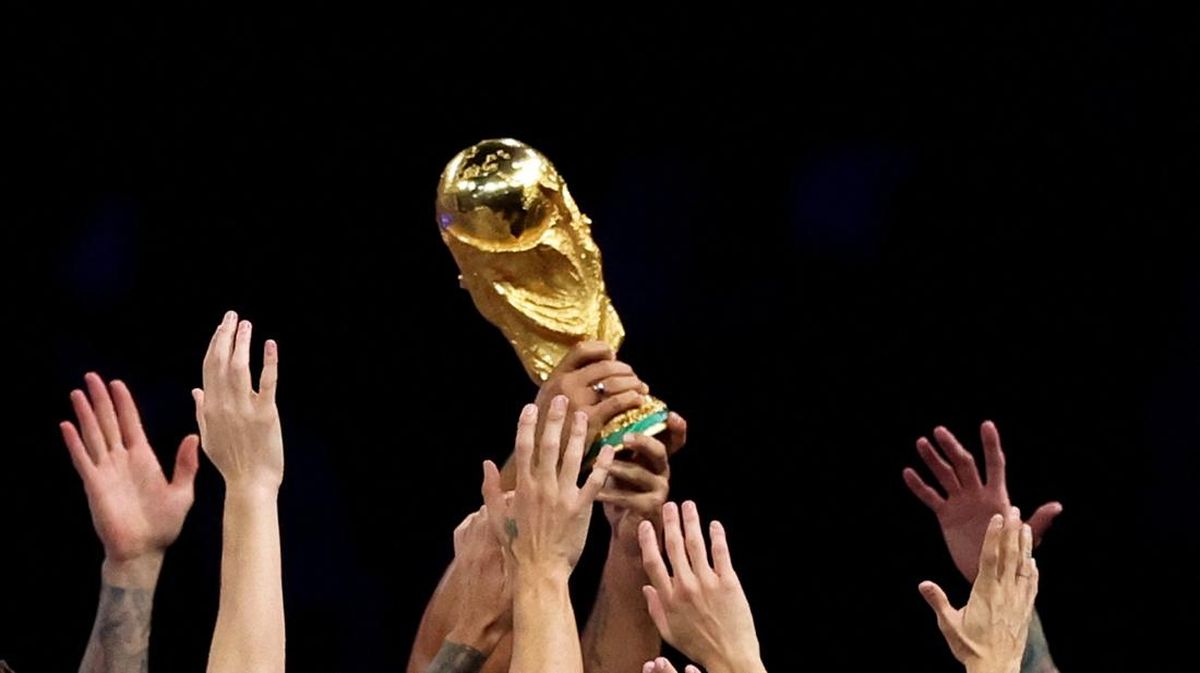
Complete List of World Cup Winners (1930–2026)
The following list provides a chronological record of the champions who have defined the sport over the last 96 years:
- 1930: Uruguay (Host: Uruguay)
- 1934: Italy (Host: Italy)
- 1938: Italy (Host: France)
- 1942: Not held (World War II)
- 1946: Not held (World War II)
- 1950: Uruguay (Host: Brazil)
- 1954: West Germany (Host: Switzerland)
- 1958: Brazil (Host: Sweden)
- 1962: Brazil (Host: Chile)
- 1966: England (Host: England)
- 1970: Brazil (Host: Mexico)
- 1974: West Germany (Host: West Germany)
- 1978: Argentina (Host: Argentina)
- 1982: Italy (Host: Spain)
- 1986: Argentina (Host: Mexico)
- 1990: West Germany (Host: Italy)
- 1994: Brazil (Host: USA)
- 1998: France (Host: France)
- 2002: Brazil (Host: South Korea/Japan)
- 2006: Italy (Host: Germany)
- 2010: Spain (Host: South Africa)
- 2014: Germany (Host: Brazil)
- 2018: France (Host: Russia)
- 2022: Argentina (Host: Qatar)
- 2026: Spain (Host: USA/Mexico/Canada)
Statistical Breakdown: The Hierarchy of Global Football
With the conclusion of the 2026 tournament, the distribution of World Cup trophies remains heavily concentrated among a small group of nations. Brazil continues to lead all nations with five championships, though their drought has now extended to 24 years, their longest since the gap between 1970 and 1994.
Germany and Italy remain tied for second place with four titles each. Both nations have faced recent challenges; Italy famously missed two consecutive tournaments in 2018 and 2022, while Germany suffered group-stage exits in those same years. However, their historical pedigree remains unmatched in Europe.
Argentina occupies the third tier with three titles. Their victory in 2022 was seen as a crowning achievement for Lionel Messi, and their run to the 2026 final proved that the nation remains a powerhouse even as it transitions to a new generation of players.
The fourth tier consists of France, Uruguay, and now Spain, all with two titles. Uruguay’s titles are often viewed through a historical lens, having occurred in the early 20th century, whereas France and Spain have achieved their success in the modern, highly competitive era of professionalized global academies. England remains the only nation with a single title, a fact that continues to be a point of intense national debate in the United Kingdom.
Implications of the 2026 Expansion and Future Outlook
The 2026 World Cup was more than just a victory for Spain; it was a litmus test for FIFA’s expanded 48-team format. Critics had initially feared that an increase in teams would dilute the quality of the competition. However, the tournament provided several high-profile upsets during the group stages, suggesting that the gap between traditional powerhouses and emerging footballing nations in Asia, Africa, and North America is narrowing.
The logistics of a three-country host system also proved successful, setting a precedent for the 2030 World Cup, which is slated to be a centenary celebration involving matches in South America, Europe, and Africa. Spain’s victory in 2026 provides them with immense momentum heading into the 2030 tournament, where they will likely be among the favorites once again.
For the global football community, Spain’s triumph reaffirms the importance of technical proficiency and tactical adaptability. As the "Red Fury" celebrates their second star, the rest of the world turns its eyes toward the next four-year cycle. The quest to join the elite list of winners continues, but for now, Spain sits atop the world, having navigated the largest and most complex World Cup in history to reclaim their status as the kings of football.