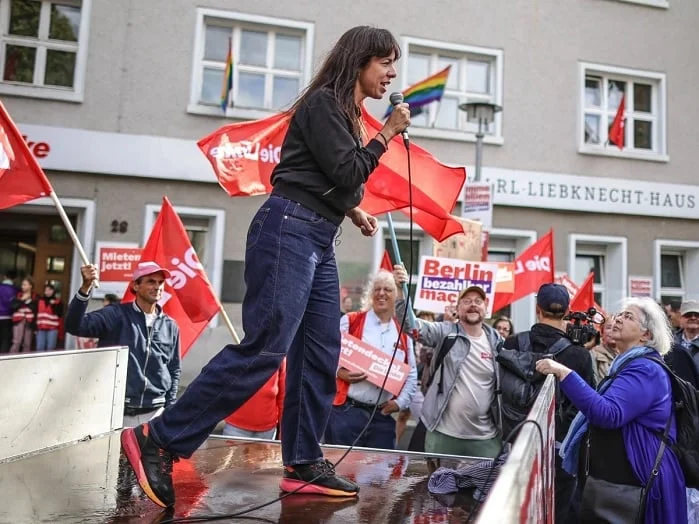
The recent political landscape of Berlin has undergone a seismic shift, culminating in a historic electoral breakthrough for Elif Eralp, a human rights activist of Turkish descent who now stands on the threshold of potentially becoming the first mayor of the city-state with a migrant background. Running under the banner of the democratic socialist Left Party (Die Linke), Eralp spearheaded a campaign that resonated deeply with urban voters grappling with escalating living costs, housing shortages, and socioeconomic disparities.
The outcome of the election has sent ripples across Germany and the wider European political sphere. The Left Party secured a remarkable 25.7 percent of the vote, effectively more than doubling its share compared to the municipal elections held three years prior. This dramatic surge stands in stark contrast to the party’s electoral standing earlier in the spring, when opinion polls placed its national and regional approval ratings firmly in the low teens. Political analysts attribute this sudden mobilization to Eralp’s populist-left messaging, which successfully captured the prevailing mood of frustration and a desire for structural change among Berlin’s diverse populace.
Addressing a jubilant crowd of supporters on Sunday evening, Eralp acknowledged the weight of the moment. "Berliners, thank you—thank you for your trust," she declared. "Together, we are making history today. From this moment on, we are going to change Berlin—together." Emphasizing a campaign platform rooted in solidarity, she asserted that "love and justice" had successfully triumphed over divisive rhetoric.
The Rise of Elif Eralp: Background and Early Influences
To understand Eralp’s political identity and resonance, one must examine her personal history and the socio-political backdrop of her upbringing. Born in Munich in 1981, Eralp is the daughter of Turkish immigrants who relocated to Germany in the wake of the turbulent military coup of 1980. Growing up, she experienced life as part of the country’s sizable Turkish diaspora, living across various German urban centers, including Dortmund and Hamburg, before eventually settling in Berlin sixteen years ago.
Her trajectory toward politics was heavily shaped by formative experiences with systemic inequality and xenophobia. Eralp has frequently recounted how, as a primary school student, she bore witness to and was directly impacted by the violent wave of extreme-right terrorism and xenophobic riots that targeted immigrant communities across Germany throughout the early 1990s. These early encounters with discrimination served as a primary catalyst for her decision to pursue the study of law, viewing the legal system as both a shield for the vulnerable and a tool for institutional justice.
Before entering formal electoral politics as a prominent candidate, Eralp carved out a career as a dedicated human rights activist. This grassroots foundation heavily influenced her operational style on the campaign trail. Rather than relying solely on conventional media advertising and high-level rallies, Eralp’s campaign team implemented a rigorous ground strategy, conducting door-to-door canvassing in diverse neighborhoods across the capital. Notably, her campaign did not shy away from engaging with historically conservative or anti-immigration strongholds, including areas where the far-right Alternative for Germany (AfD) party has traditionally found significant support.
The Zohran Mamdani Parallel and Ideological Alignment
In the months leading up to the election, political commentators and international observers increasingly drew parallels between Eralp’s political rise and the trajectory of New York City political figures who champion progressive, working-class platforms, most notably drawing comparisons to Zohran Mamdani. Eralp herself openly embraced the comparison during the final stretches of the campaign.
"I hope what was possible in Manhattan, New York, can also become a reality here in Berlin," Eralp stated in an interview with international media just days before the polls opened. Highlighting the strategic overlap, she noted, "Mamdani focused on social demands, and that is precisely what we are doing. He also succeeded in uniting various communities—a major achievement—and that is what we are striving for as well."
Mirroring the tactical focus of contemporary urban progressive movements, Eralp anchored her platform firmly to the material, daily economic pressures faced by ordinary citizens. Rather than centering abstract geopolitical debates, her campaign zeroed in on the escalating cost of living in the German capital: skyrocketing residential rents, mounting public transportation fares, and declining standards in municipal services, such as street cleaning and public infrastructure maintenance.
At the core of her policy proposals were aggressive interventions in the housing market. Eralp championed the implementation of strict caps on rental prices for municipal housing units, the establishment of a specialized governmental oversight body dedicated to investigating and prosecuting illegal rent hikes, and the revival of contentious proposals to expropriate major corporate real estate conglomerates, bringing large housing portfolios back into public ownership. Through these measures, the Left Party pledged to reverse the gentrification trend that has increasingly pushed lower- and middle-income residents out of Berlin’s central districts.
Chronology of the Electoral Campaign
The path to Berlin’s historic election night was marked by strategic recalibrations, grassroots mobilization, and a rapidly shifting public mood regarding economic security.
- Early Spring: Initial polling data for the year indicated that the Left Party was struggling to capture widespread public interest, hovering in the low-to-mid teens. Voter apathy and fragmentation within the center-left coalition presented significant hurdles for the party’s traditional base.
- Mid-Campaign Phase: Recognizing the acute public anxiety surrounding inflation and housing costs, Eralp and her campaign leadership pivoted toward a hyper-local, issue-driven strategy. The party initiated an extensive door-to-door outreach program, prioritizing direct conversations with residents regarding municipal utility costs and rental caps.
- Late Campaign Phase: International comparisons began to circulate, linking Eralp’s populist-left policy framework to successful municipal campaigns abroad. This external validation amplified her media visibility, helping to consolidate the progressive vote and draw disillusioned voters away from other center-left alternatives.
- Election Day: Turnout surged across several urban districts, driven heavily by first-time voters and urban professionals and working-class families concerned with housing affordability.
- Election Night Results: The Left Party secured 25.7 percent of the vote, outperforming all regional competitors and positioning Eralp as the leading candidate to form the next municipal administration.
Broader Implications for German Politics
The success of Elif Eralp and the Left Party in Berlin carries significant implications for the broader political landscape of the Federal Republic of Germany. For years, the traditional center-right and center-left parties—namely the Christian Democratic Union (CDU) and the Social Democratic Party (SPD)—have navigated a shifting electorate complicated by the rise of populist movements on both ends of the political spectrum.
The strong performance of a democratic socialist platform centered on economic justice and municipal intervention demonstrates that left-wing populism can successfully counter right-wing nationalist narratives if it directly addresses tangible socioeconomic grievances. Furthermore, Eralp’s background as the daughter of Turkish immigrants stepping into a high-profile leadership role underscores the evolving demographic and cultural fabric of modern Germany. It highlights the political maturation of the country’s multi-ethnic second and third generations, who are increasingly moving from marginalized labor demographics to positions of institutional authority and legislative leadership.
As negotiations and coalition talks commence in the wake of the election, the practical implementation of Eralp’s ambitious agenda will face rigorous scrutiny. Observers will be closely watching to see how a Left Party-led administration navigates the complex federal and state legal frameworks governing property rights, municipal finance, and intergovernmental cooperation. Nevertheless, the events of Sunday have irrevocably altered the political calculus in the German capital, marking a watershed moment for urban governance, representation, and progressive politics in Europe.