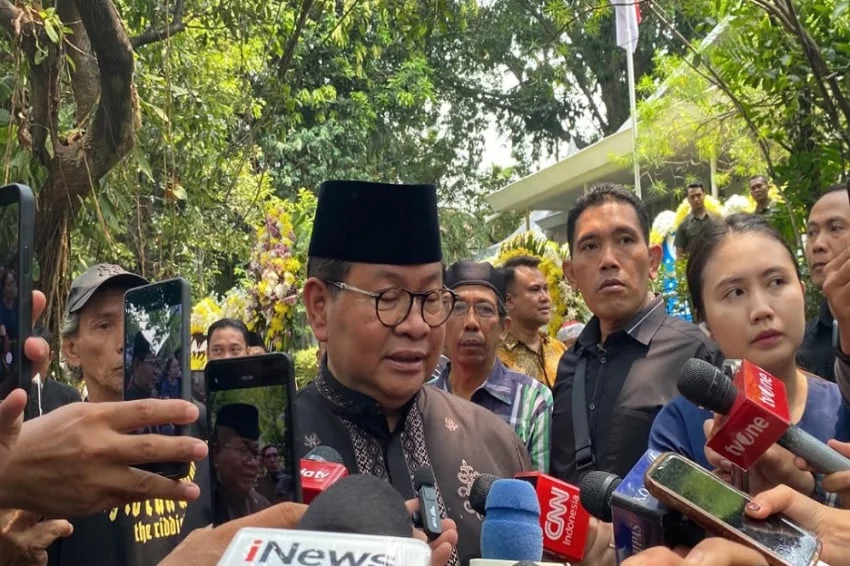
The passing of Guruh Soekarnoputra on Saturday, September 26, 2026, marks the end of an era for Indonesian arts, culture, and political discourse. A multifaceted figure whose life bridged the legacy of Indonesia’s founding father, Sukarno, with the contemporary creative landscape, Guruh’s death has elicited profound reactions from across the nation’s political and cultural spectrum. Among the prominent figures paying their final respects was the Governor of Jakarta, Pramono Anung, who visited the funeral home in Kebayoran Baru, South Jakarta, to honor a man he described as both a personal friend and a national icon.
A Multifaceted Legacy: Artist, Politician, and Cultural Icon
Guruh Soekarnoputra, born Mohammad Guruh Irianto Soekarnoputra on January 13, 1953, was the youngest son of President Sukarno and Fatmawati. Throughout his seven decades, he carved a unique path that refused to be confined to a single discipline. While his lineage placed him in the heart of Indonesian politics, his heart belonged to the stage, the dance studio, and the recording booth.
During his visit to the mourning residence, Governor Pramono Anung emphasized that categorizing Guruh merely as a politician would be an oversimplification. "I have known Mas Guruh for a very long time, and he was not just an artist, a cultural observer, or a musician; he was a dedicated politician and a visionary creator," Pramono stated. This multifaceted identity defined Guruh’s public life. He was a pioneer of the Indonesian creative industry, blending traditional Nusantara aesthetics with modern pop sensibilities, a feat best exemplified by his legendary dance company, Swara Mahardhika, which revolutionized Indonesian performing arts in the 1970s and 80s.
The Chronology of a Life Dedicated to Nationalism
Guruh’s influence stretched across various sectors of Indonesian society. To understand the magnitude of the loss, one must look at the timeline of his contributions:
- 1970s – The Artistic Awakening: Guruh emerged as a formidable force in the Indonesian music scene. His collaboration with the band Gipsy in the album "Guruh Gipsy" (1976) is widely regarded as a masterpiece of progressive rock, seamlessly incorporating gamelan elements into Western musical structures.
- 1977 – Formation of Swara Mahardhika: This collective became a cultural phenomenon, fostering a new generation of dancers and musicians who championed national identity through creative expression.
- 1990s – Transition to Formal Politics: Following the steps of his siblings, notably former President Megawati Soekarnoputri, Guruh joined the Indonesian Democratic Party of Struggle (PDI-P). He served multiple terms in the People’s Representative Council (DPR RI), focusing on education and cultural preservation.
- 2000s–2020s – Cultural Statesmanship: Throughout his later years, Guruh remained a staunch defender of Sukarnoist values, frequently appearing at cultural forums and political rallies to remind the youth of the importance of national character and the "Bhinneka Tunggal Ika" (Unity in Diversity) philosophy.
Political Context and the PDI-P Connection
Guruh’s death comes at a significant time for the Indonesian political landscape. As a key figure within the PDI-P, his absence is felt not only as a personal tragedy for the Soekarno family but also as a void in the ideological wing of the party. Pramono Anung, who has long been a close associate of the Soekarno family, noted that Guruh’s contributions were deeply rooted in his high sense of nationalism.
"We all feel a deep sense of loss. Personally, I pray that his path is eased. I hope that what he left behind—his works and his spirit—will continue to serve as a unifying force in our hearts, not just for his fans, but for everyone who experienced his work," Pramono added.
Analysts suggest that Guruh served as a bridge between the party’s historical roots and the modern generation of voters. His ability to communicate complex political ideals through art made him a unique asset to the party’s outreach efforts, particularly in engaging the creative and urban youth demographic.
The Cultural Impact: More Than Just Music
The implications of Guruh’s passing extend far beyond the political arena. He was a curator of Indonesian identity. In an era where globalization threatens to dilute local traditions, Guruh consistently advocated for a "national personality" in art.
Data from the Indonesian Ministry of Education, Culture, Research, and Technology highlights that cultural icons like Guruh play a vital role in national identity formation. His work in choreography and composition acted as a bridge between the classical Javanese traditions—which he mastered under the guidance of court dancers—and the contemporary influences of the West. His passing has triggered an outpouring of tributes from the Indonesian creative community, with many younger artists citing him as the reason they began to appreciate traditional Indonesian instruments and movements.
Official Responses and Public Sentiment
The funeral proceedings in Kebayoran Baru saw a steady stream of dignitaries, fellow artists, and ordinary citizens. The atmosphere was one of somber reflection, with many attendees sharing stories of Guruh’s humility and his meticulous approach to his craft.
Beyond the immediate political circle, the arts community has reacted with significant grief. Musicians who worked with him describe a perfectionist who could spend hours perfecting a single chord progression to ensure it carried the "soul" of the Indonesian spirit. "He taught us that to be a modern Indonesian artist, one must first understand where they come from," said a representative from the Jakarta Arts Council (Dewan Kesenian Jakarta).
Implications for the Future of Indonesian Culture
As the nation mourns, questions arise regarding the preservation of Guruh’s extensive archives. His collection of compositions, choreography notes, and political writings constitutes a significant portion of Indonesia’s modern cultural heritage.
Experts in cultural preservation suggest that the government should prioritize the digitization and formal archival of Guruh’s works. Given his status as a national figure, there is a strong call for a dedicated museum or a digital archive to ensure that future generations of students can study his approach to blending traditionalism with modern expression.
The death of Guruh Soekarnoputra is a moment of transition. It signals the departure of a generation that saw the direct, tangible impact of the independence movement on the nation’s cultural soul. For current leaders like Pramono Anung, the challenge lies in upholding the values that Guruh championed—namely, that nationalism is not merely a political slogan, but a creative practice that requires constant nurturing.
Conclusion: A Legacy That Endures
The mourning process will likely continue for several days, with memorial services expected to draw large crowds. As the flag flies at half-mast in various cultural institutions across the capital, the focus will gradually shift from the grief of his passing to the celebration of his monumental life.
Pramono Anung’s final words at the funeral home encapsulate the prevailing sentiment among those who knew him: "His soul of nationalism was very high. His legacy will not just be found in books or recordings, but in the pride we feel as Indonesians when we see our culture presented with dignity on the world stage."
Guruh Soekarnoputra’s journey has concluded, but his imprint on the Indonesian psyche remains indelible. From the melodies that defined a generation to the political ideologies that shaped the nation’s governance, his life serves as a testament to the power of the arts in constructing a national identity. As the nation reflects on his contributions, it is clear that while the man is gone, the cultural and political framework he helped build will continue to influence Indonesian life for decades to come. His death is not merely an end; it is a call for the preservation and continuation of the national spirit he held so dear.