Barcelona delivered a statement of intent in their opening match of the 2026/2027 UEFA Champions League campaign, dismantling Dutch side Feyenoord with a comprehensive 5-1 victory at the iconic Camp Nou on Thursday, September 10, 2026. Under the strategic guidance of manager Hansi Flick, the Blaugrana showcased a lethal blend of high-pressing intensity and clinical finishing, signaling their aspirations for European glory this season. The result places Barcelona in an immediate position of strength within the tournament’s revamped league phase format, setting a high standard for their upcoming continental fixtures.
A Masterclass in Offensive Transition
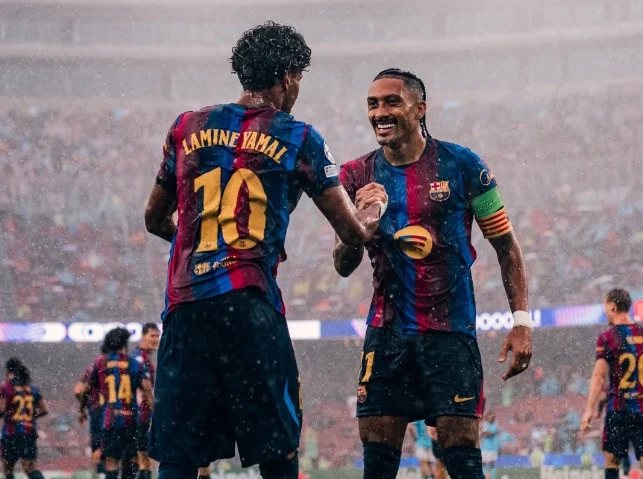
From the opening whistle, Barcelona dictated the tempo of the game, stifling Feyenoord’s attempts to build from the back and forcing the visitors into defensive disarray. The breakthrough arrived in the third minute, a moment that encapsulated the synergy between the team’s creative engines. Lamine Yamal, displaying vision beyond his years, threaded a precise pass to Raphinha. The Brazilian forward demonstrated remarkable composure, maneuvering past two Feyenoord defenders before firing a low, unstoppable shot past goalkeeper Tjark Ernst.
The early goal served as a catalyst for Barcelona, who maintained a relentless offensive pressure. By the 22nd minute, the lead was doubled. Karim Adeyemi, who has integrated seamlessly into Flick’s tactical setup, unleashed a powerful strike from outside the penalty area. The ball bypassed a crowded defense and found the back of the net, marking a significant moment in his burgeoning Barcelona career and putting the home side in a commanding 2-0 position heading into the break.
Second-Half Dominance and Tactical Flexibility
As the second half commenced, Barcelona displayed no signs of complacency. Hansi Flick’s side returned with increased verticality, stretching the Feyenoord defensive line and creating gaps in the midfield. In the 57th minute, Pedri provided a sublime through ball that sliced through the Feyenoord defense, finding Raphinha, who coolly dispatched the ball with his left foot. This goal marked the Brazilian’s brace, cementing his status as the most dangerous player on the pitch throughout the evening.
Feyenoord attempted a brief resurgence shortly thereafter, with Nacho Ferri finding the net in the 59th minute. However, the celebrations were short-lived, as the assistant referee signaled an offside infraction. The Video Assistant Referee (VAR) confirmed the decision, denying the visitors a lifeline and keeping the scoreline at 3-0.
The match continued to tilt heavily in favor of the hosts. In the 64th minute, Lamine Yamal added his name to the scoresheet. Following a tactical foul committed by the Feyenoord defense just outside the box, the young prodigy stepped up to take the resulting free kick. His curling effort bypassed the defensive wall, leaving Ernst stranded and extending the lead to four.
Feyenoord managed to register a consolation goal in the 82nd minute via Sem Steijn, capitalizing on a momentary lapse in Barcelona’s defensive concentration. Yet, the response from the Catalan giants was immediate and emphatic. Just three minutes later, Gabriel Jesus, who had been introduced as a late-game substitute, capitalized on a pinpoint assist from Yamal to score his debut goal for the club. The strike finalized the scoreline at 5-1, capping off a near-perfect night for the home side.
Tactical Analysis and Player Performance
The victory was not merely a product of individual brilliance but a testament to the tactical evolution under Hansi Flick. The team’s ability to transition from defense to attack in under five seconds was a hallmark of the performance.
The inclusion of Rodri in the midfield alongside Pedri and Dani Olmo provided a balance of physical presence and technical control that Feyenoord struggled to counter. Defensively, the back four—led by Pau Cubarsi and Jules Kounde—maintained a high line, successfully implementing the offside trap on multiple occasions, which frustrated the Feyenoord attacking rotation.
Statistically, Barcelona dominated the proceedings with over 65% possession and recorded 18 shots, 11 of which were on target. Feyenoord, conversely, found themselves restricted to deep blocks for the majority of the match, struggling to establish any meaningful rhythm in the final third. The individual performance of Lamine Yamal, who contributed directly to three of the five goals, highlights the teenager’s role as the focal point of the current Barcelona project.
Official Post-Match Reactions
Speaking to the press following the match, Hansi Flick expressed satisfaction with the team’s discipline and execution. "We knew that the first match in the Champions League is always fraught with nerves. The players executed the game plan perfectly. We pressed high, we were aggressive, and when we had the ball, we were decisive. However, we must remain grounded; this is only the first of many difficult challenges in this tournament," Flick noted.
Feyenoord manager Brian Priske acknowledged the gulf in class during the post-match conference. "Barcelona is a world-class team, and today they showed exactly why they are favorites for this competition. We were punished for our individual mistakes, and at this level, you cannot afford to give players like Raphinha or Yamal that much space. We have to learn from this and regroup for our next match in Rotterdam."
The Broader Context of the 2026/2027 Format
The 2026/2027 season marks a critical juncture for European football, as the league phase format continues to demand consistency across every matchday. Unlike the previous group stages, where teams could afford a singular stumble, the current structure places high importance on total points and goal difference.
For Barcelona, the 5-1 victory provides a substantial cushion in terms of goal difference—a metric that could prove vital should they finish level on points with other European heavyweights at the end of the league phase. The win also serves to bolster the team’s morale following a competitive start to their domestic campaign.
Looking Ahead: The Road to the Final
Barcelona’s schedule does not allow for long periods of celebration. The team is set to face a rigorous domestic fixture list before shifting focus back to the Champions League. The depth of the current squad, as evidenced by the successful integration of substitutes like Gabriel Jesus, Fermin Lopez, and Anthony Gordon, will be paramount as the season progresses.
The performance against Feyenoord is a clear indicator that the squad has successfully adapted to the high-intensity demands of the current coaching staff. Whether this momentum can be sustained through the winter months, when fatigue and injury risks typically increase, remains the primary question for analysts and supporters alike.
For Feyenoord, the defeat represents a difficult lesson in the intensity required for elite European competition. The Dutch side will look to utilize their home-field advantage in upcoming matches to recover their standing in the table.
As the competition moves into its second matchday, the 5-1 scoreline at the Camp Nou will likely be analyzed by rival scouts as a warning. Barcelona is not just competing in the 2026/2027 Champions League; they are signaling that they intend to dictate the terms of the tournament. The synergy between experienced anchors and emerging talents suggests that this Barcelona iteration is, perhaps, the most dangerous version of the club seen in the post-pandemic era.
The match concluded with a standing ovation from the Camp Nou faithful, reflecting the renewed optimism surrounding the club. As the players departed the pitch, the narrative surrounding the 2026/2027 campaign had shifted—from a question of potential to a demonstration of immediate, high-level impact. The path to the final in Munich remains long, but for Barcelona, the first step could not have been more decisive.