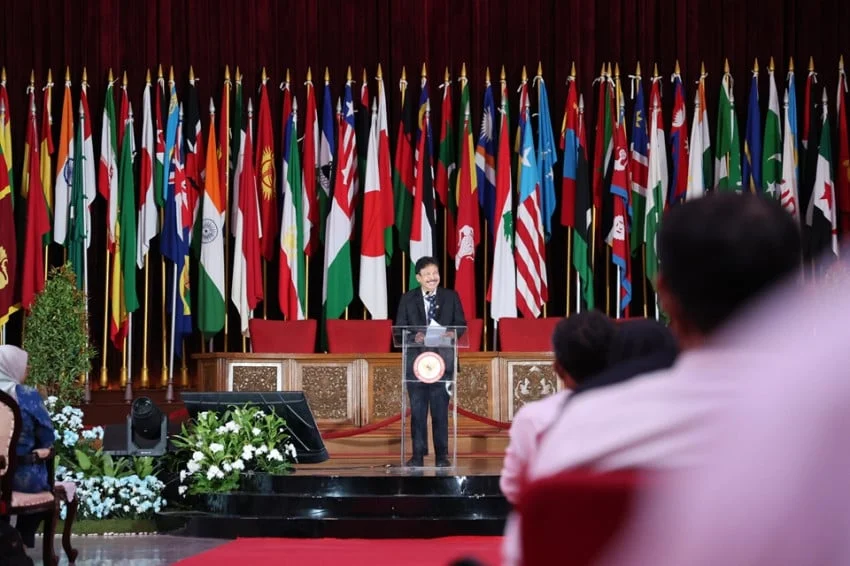
The ideological foundation of the Indonesian state, Pancasila, must transcend its traditional status as a mere normative philosophy to become the absolute benchmark and guiding compass for all national development policies and regulatory frameworks. This assertion was prominently delivered by the Head of the Agency for Pancasila Ideology Education (BPIP), Yudian Wahyudi, during a high-level national symposium held at the historic Gedung Merdeka in Bandung, West Java. The event, which brought together policymakers, legal experts, and regional leaders, served as a crucial platform to re-evaluate the trajectory of Indonesian governance through the lens of foundational state values.
According to Yudian, the process of synchronizing laws and regulations across central and regional governments can no longer be treated as a purely administrative exercise or a routine bureaucratic checklist. Instead, regulatory harmonization must be fundamentally substantive, guaranteeing that every legislative product and executive policy actively aligns with the ethical, social, and political principles enshrined in Pancasila. As Indonesia navigates complex modern socio-economic challenges, the state apparatus must ensure that national progress remains firmly anchored in the collective identity and constitutional goals of the republic.
The symposium, themed around the reinforcement of Pancasila ideology education and regulatory synchronization based on reflections from the 66th anniversary of the First General Session of the Provisional People’s Consultative Assembly (MPRS) and the concept of Planned National Development, provided a strategic moment for historical introspection. By revisiting the visionary frameworks established by Indonesia’s founding fathers during the formative years of independence, contemporary leaders can better contextualize current national development goals within the enduring demands of sovereignty, social justice, and national unity.
Historical Context and the Legacy of the Mprs First General Session
To fully grasp the gravity of the discussions in Bandung, it is essential to examine the historical weight carried by the First General Session of the MPRS. Convened during a critical juncture in Indonesia’s post-independence era, the MPRS sessions laid the foundational architecture for national governance, economic planning, and ideological consistency. The visionary leaders of that era conceptualized a sovereign nation that did not merely copy Western capitalist models or rigid socialist blueprints, but rather forged a unique path defined by the socio-cultural realities of a diverse archipelago.
The invocation of the 66-year milestone of the Mprs session at the symposium was not a matter of empty historical nostalgia. Rather, it served as a deliberate methodological approach to re-reading the original blueprint of Indonesian development. The founding fathers recognized that physical infrastructure alone could never sustain a multi-ethnic, multi-religious nation of thousands of islands. Development had to be accompanied by a robust ideological framework that fostered solidarity, mutual cooperation (gotong royong), and an unwavering commitment to the common good.
Yudian emphasized that contemporary policymakers often suffer from historical amnesia, separating technical economic planning from the moral imperatives of the state ideology. By anchoring current regulatory reform in the spirit of the MPRS milestones, the BPIP aims to bridge the historical gap between the idealistic vision of 1945 and the pragmatic demands of the 21st century. This historical continuity is deemed vital for preserving national identity in an increasingly globalized and interconnected world where external ideological pressures constantly test the resilience of the state.
Redefining National Development Beyond Physical Infrastructure
In his comprehensive address to the symposium, the BPIP chief challenged the conventional paradigm that measures national success strictly through macroeconomic indicators, gross domestic product (GDP) growth, and physical infrastructure megaprojects. While roads, bridges, digital connectivity, and industrial zones remain indispensable for economic competitiveness, Yudian argued that development devoid of ideological and moral orientation risks exacerbating social inequality and cultural alienation.
True national development, according to the BPIP mandate, must be holistic, simultaneously addressing the formation of national character, the strengthening of social cohesion, and the tangible realization of social justice for all citizens. When regulatory policies prioritize short-term economic gains over ethical considerations, the societal fabric frays, leaving vulnerable populations exposed to systemic marginalization, radical ideologies, and divisive identity politics.
To counteract these systemic vulnerabilities, the integration of Pancasila ideology education must not be confined to academic classrooms or symbolic state ceremonies. It must permeate every phase of public policy formulation—from initial academic drafts and legislative bill drafting to budgetary allocation, policy execution, and rigorous post-implementation evaluation. By weaving Pancasila into the machinery of public administration, the state can ensure that every rupiah spent and every law passed actively contributes to human dignity and national resilience.
West Java’s Strategic Commitment as a National Role Model
The call for actionable implementation found a receptive and proactive audience at the provincial level. During the symposium, the Vice Governor of West Java, Erwan Setiawan, stepped forward to articulate the provincial government’s official readiness to serve as a pioneer and testing ground—a comprehensive role model—for the practical implementation of measurable Pancasila values.
Erwan underscored that the provincial administration is fully committed to moving past abstract rhetoric. For West Java, the challenge lies in translating the five principles of Pancasila into concrete regional public policies, transparent bureaucratic services, and verifiable performance indicators. This means that government programs in sectors ranging from education and public health to poverty alleviation and agrarian reform will be subjected to ideological and ethical audits to ensure they genuinely serve the marginalized and foster social harmony.
"West Java is ready to become the leading role model in the concrete and measurable implementation of Pancasila values," Erwan stated during the plenary session. "These foundational principles must not remain locked inside textbooks or official speeches. They must materialize visibly in our public services, our regulatory transparency, and our daily engagement with the community, allowing the public to evaluate our governance objectively."
The commitment by West Java is viewed by political analysts as a potential template for other provinces across the republic. Decentralized governance in Indonesia often leads to a fragmented regulatory landscape where regional bylaws (peraturan daerah) occasionally contradict national laws or constitutional principles. By instituting a framework where regional policies are systematically evaluated against Pancasila metrics, West Java hopes to demonstrate that ideological consistency can enhance administrative efficiency rather than hinder it.
Broader Implications and Socio-Political Analysis
The initiative spearheaded by BPIP and endorsed by regional leaders comes at a pivotal moment in Indonesia’s socio-political evolution. As the nation deepens its democratic processes amidst the rapid acceleration of the digital age, state institutions face unprecedented threats from transnational radicalism, sectarian polarization, and the weaponization of identity politics on social media platforms.
Observers note that while law enforcement agencies and cyber-security units play a vital role in suppressing extremist networks and disinformation campaigns, punitive measures alone cannot heal societal fractures. Long-term stability requires a proactive ideological inoculation, wherein citizens—particularly the younger digital native generations—internalize the inclusive, pluralistic values of Pancasila as an organic part of their daily civic identity.
Furthermore, the push for rigorous regulatory synchronization addresses a chronic administrative bottleneck in Indonesia. For decades, the proliferation of overlapping, contradictory, and hyper-complex regulations between central ministries, provincial governments, and municipal administrations has stifled investment, delayed public projects, and created legal loopholes exploited by corrupt actors. By introducing Pancasila as the supreme substantive metric for regulatory review, the state introduces an overarching ethical hierarchy that can streamline legislative cleanup efforts. If a regional regulation promotes discrimination, infringes upon minority rights, or exacerbates economic disparity, it fails not only on technical constitutional grounds but also on fundamental ideological principles.
However, legal scholars and civil society organizations have also highlighted potential challenges in operationalizing this vision. The primary concern revolves around the danger of ideological subjectivism. Without transparent, objective, and universally accepted criteria for what constitutes a "Pancasila-compliant" policy, there is a risk that the framework could be interpreted arbitrarily by ruling authorities to suppress legitimate political dissent or diverse cultural expressions. To maintain public trust, BPIP and its governmental partners must establish clear, transparent, and participatory guidelines for regulatory evaluation, ensuring that the state ideology remains a unifying shield rather than an exclusionary tool.
Conclusion and Future Outlook
The symposium at Gedung Merdeka has set a rigorous agenda for the future of Indonesian governance. By linking the historical insights of the MPRS First General Session with the urgent contemporary demand for regulatory harmony, leaders like Yudian Wahyudi and Erwan Setiawan are pushing for a renaissance in statecraft—one that marries bureaucratic efficiency with deep ethical purpose.
As West Java prepares to roll out its framework for measurable Pancasila implementation, eyes across the archipelago will be fixed on the province’s legislative and administrative output. If successful, this initiative could redefine how Indonesia approaches national development, proving that economic progress and human-centric ideology are not mutually exclusive, but rather mutually reinforcing pillars of a resilient, just, and prosperous republic. The coming years will test whether this ambitious vision can successfully transform the complex machinery of Indonesian bureaucracy, ensuring that the nation sails firmly guided by its foundational star.