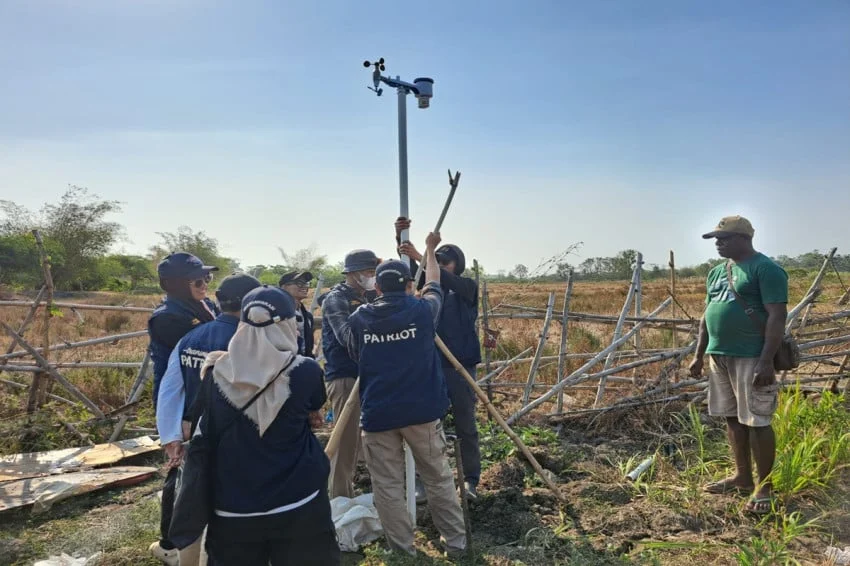
Merauke, South Papua — In an effort to tackle the persistent challenges posed by climate unpredictability and extreme weather, the IPB University Patriot Expedition Team has successfully installed an advanced Automatic Weather Station (AWS) in Kurik District, Merauke Regency, South Papua Province. This strategic deployment aims to provide local farmers and transmigrant communities with precise, real-time meteorological data, enabling them to mitigate the risks of crop failure, manage water resources efficiently, and optimize overall agricultural yields in Indonesia’s eastern frontier.
The initiative comes at a critical juncture for Merauke, a region designated as a major national food estate and agricultural hub. As shifting weather patterns, prolonged dry spells, and unseasonal rainfall increasingly disrupt traditional farming calendars, the integration of digital agricultural technology is being hailed as a vital step toward achieving regional food security and empowering local agrarians with data-driven decision-making tools.
Agricultural Vulnerability in South Papua
Merauke Regency has long been recognized as one of the primary agricultural strongholds of Papua, characterized by vast expanses of flat terrain suitable for paddy cultivation and horticulture. However, farmers in districts such as Kurik—home to a significant population of local residents and transmigrants from various parts of Indonesia—have historically relied on traditional weather indicators and intuition. This reliance leaves them profoundly vulnerable to the vagaries of modern climate change.
In recent years, global climate phenomena such as El Niño and La Niña have introduced severe volatility to Indonesia’s rainfall patterns. For farmers in Kurik, unpredictable weather manifests as sudden droughts that stunt plant growth, or unexpected heavy downpours that cause waterlogging, soil erosion, and favorable conditions for fungal diseases and pest infestations. Without access to localized, scientifically verified meteorological data, farmers often miss the optimal windows for planting, fertilizing, and harvesting, resulting in substantial economic losses and, in severe cases, total crop failure.
Recognizing these vulnerabilities, the IPB University Patriot Expedition Team identified Kurik District as a high-priority zone for technological intervention. By bridging the gap between cutting-edge agricultural science and grassroots farming practices, the team sought to replace guesswork with empirical precision.
Deployment of the Automatic Weather Station (AWS)
The core of this intervention is the installation of a state-of-the-art Automatic Weather Station (AWS) capable of monitoring a comprehensive suite of meteorological parameters. The system tracks ambient temperature, relative humidity, rainfall volume, wind speed and direction, solar radiation, and barometric pressure in real-time.
Unlike regional weather forecasts that rely on broad observations from distant airports or coastal stations, the newly installed AWS in Kurik provides hyper-local data. The technology possesses a monitoring radius of up to 40 kilometers, effectively covering vast agricultural tracts, including Kampung Harapan Makmur and surrounding farming communities.
Crucially, the hardware is paired with a user-friendly digital application accessible via smartphones and local community hubs. Through this interface, farmers can view live meteorological metrics, access predictive climate models projecting weather trends up to 15 days in advance, and receive automated early warnings regarding potential pest outbreaks or moisture deficits.
Empowering Transmigrants and Indigenous Farmers

The introduction of the digital weather station has been met with immense enthusiasm by the local agricultural community, particularly the transmigrant populations whose livelihoods depend entirely on annual crop cycles. For these communities, farming in the unique agro-ecological conditions of Papua presents distinct challenges, ranging from unfamiliar soil profiles to unfamiliar microclimates.
Community representatives in Kampung Harapan Makmur noted that having direct access to accurate weather predictions fundamentally changes their operational approach. Instead of reacting to weather anomalies after damage has already occurred, farmers can now proactively adjust their irrigation schedules, apply targeted pest control measures, and time their harvesting processes to align with optimal atmospheric conditions.
Furthermore, the transparency and accessibility of the AWS data foster greater collaboration among farming groups. Agricultural extension workers can utilize the data to conduct training sessions, advising community members on best practices for climate-resilient farming and resource management.
Broader Implications for National Food Security
The deployment of the AWS in Merauke aligns closely with broader national strategic objectives. The Indonesian government has placed considerable emphasis on expanding agricultural production in South Papua to bolster national food reserves and reduce reliance on food imports. However, large-scale agricultural intensification cannot succeed without localized climate adaptation strategies.
Experts note that equipping farmers with digital tools directly addresses the United Nations Sustainable Development Goals (SDGs), particularly Goal 2 (Zero Hunger) and Goal 13 (Climate Action). By mitigating the risks associated with climate variability, projects of this nature help stabilize farmer incomes, prevent rural poverty, and ensure a steady, reliable supply of staple crops to regional and national markets.
The success of the IPB University Patriot Expedition Team in Merauke also serves as a scalable model for other agricultural frontier regions across Indonesia. As climate change continues to intensify, replicating similar technological interventions in remote and vulnerable areas will be essential for safeguarding the nation’s agricultural backbone.
Future Outlook and Sustainability
Following the successful installation and calibration of the AWS, the IPB University Patriot Expedition Team plans to conduct comprehensive capacity-building workshops for local farmers and agricultural extension officers. These sessions will focus on digital literacy, data interpretation, and maintenance protocols to ensure the long-term operational sustainability of the station.
Local authorities and community leaders have expressed hope that this initiative will pave the way for further technological integration in Merauke’s agricultural sector, including the potential introduction of precision farming equipment, automated drone monitoring, and digital supply chain tracking.
As the data flows continuously from the new weather station to the hands of Kurik’s farmers, Merauke takes a decisive step forward—transforming from a region vulnerable to climate shocks into a resilient, data-empowered agricultural center poised for sustainable growth.