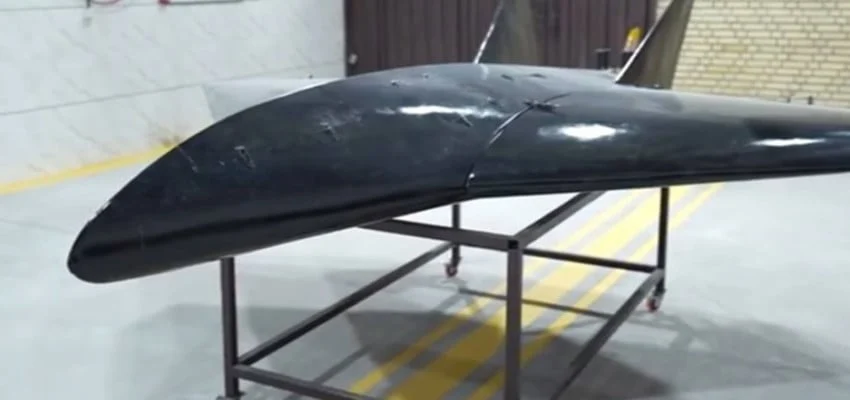
Tehran has once again captured the attention of global defense analysts by unveiling the latest iteration of its flagship loitering munition series, the Arash-3. The unveiling took place during an official visit by senior military leadership to a classified underground drone production facility. Released to the public via state-affiliated media channels on October 22, the footage showcased production-ready models of the upgraded one-way attack drone, emphasizing the Islamic Republic’s continuous push toward self-sufficiency in domestic defense manufacturing, expanding stockpiles, and diversifying its ever-growing arsenal of unmanned aerial systems.
The introduction of the Arash-3 marks a significant milestone in the evolution of Iran’s asymmetric warfare doctrine. While comprehensive technical specifications have not yet been fully detailed by military authorities, early briefings and visual evidence indicate substantial upgrades over its predecessors, particularly in payload capacity, guidance systems, and destructive potential. As modern conflicts in the Middle East and Eastern Europe increasingly demonstrate the tactical dominance of low-cost, high-impact aerial drones, Tehran’s latest military advancement highlights the shifting paradigm of contemporary warfare toward autonomous and semi-autonomous systems.
Main Facts of the Arash-3 Unveiling
The most striking feature of the newly unveiled Arash-3 is its massive payload capacity. Military engineers have successfully doubled the weight of the explosive warhead from the approximately 50 kilograms carried by earlier Arash models to a formidable 100 kilograms in the upgraded variant. This heavy payload is paired with advanced independent GPS navigation and cutting-edge artificial intelligence (AI) assistance for terminal guidance and target acquisition.
According to technical briefs provided by Iranian military specialists in the launch footage, the combination of a heavier payload, enhanced navigation accuracy, and newly formulated explosive and incendiary compositions increases the drone’s overall destructive potential against fortified targets by approximately 2.3 times compared to previous iterations. The engineering approach behind the Arash-3 focuses on a holistic upgrade rather than a simple scaling of weight, incorporating improvements in aerodynamics, thermal management, and electronic warfare resistance to ensure high survivability rates against modern air defense systems.
Chronology of the Arash Drone Family Development
The lineage of the Arash loitering munition series did not emerge in a vacuum; it is the product of years of iterative engineering and combat testing across various regional theaters. Understanding the development timeline provides critical context for the tactical significance of the Arash-3.
The origins of the Arash design trace back to Iran’s broader strategy of developing long-range suicide drones capable of bypassing sophisticated radar networks at a fraction of the cost of traditional cruise missiles or fighter jets. Early models, notably the Arash-1 and the widely exported Arash-2, were designed primarily for strategic strikes against high-value military infrastructure, radar installations, and command nodes. The Arash-2 gained considerable notoriety in military circles for its claimed capability to target radar-emitting systems and its long operating range, which Iranian officials previously boasted could reach targets across the region.
Throughout 2022 and 2023, iterations of the Arash series were heavily scrutinized by international intelligence agencies as similar designs began appearing in active conflict zones. The operational feedback gathered from these deployments evidently served as the foundational dataset for the engineering team responsible for the Arash-3. The transition from testing phases to mass production within underground facilities culminated in the October exhibition, signaling that the Islamic Republic has successfully integrated combat lessons into its state-of-the-art production lines.
Underground Manufacturing and Strategic Defense Infrastructure
A critical element of the recent announcement was the location of the unveiling: a heavily fortified underground drone production and storage facility. For decades, Iran has invested heavily in subterranean military infrastructure—colloquially referred to by defense analysts as "drone cities" and "missile cities"—spread across the rugged mountainous terrain of the country.
These subterranean complexes are designed to protect strategic assets from preemptive aerial bombardment, satellite reconnaissance, and electronic surveillance conducted by regional adversaries or global superpowers. By housing the manufacturing, assembly, and launch preparation of systems like the Arash-3 deep underground, Tehran ensures a high degree of strategic survivability. Even in the event of a sustained military campaign targeting its conventional industrial base, Iran’s underground network can theoretically sustain the continuous production and deployment of asymmetric weapon systems. This decentralized and hardened manufacturing capability is a cornerstone of Tehran’s deterrence strategy, ensuring that its military supply lines remain resilient under extreme pressure.
Technological Advancements: AI Integration and Propulsion
The integration of artificial intelligence into the Arash-3 represents a qualitative leap in Iran’s drone development program. Traditional loitering munitions often rely heavily on constant satellite links or pre-programmed coordinates, making them vulnerable to sophisticated GPS jamming and electronic spoofing—tactics that have become standard in modern electronic warfare environments.
The Arash-3 reportedly incorporates advanced independent navigation systems augmented by AI algorithms. This allows the drone to maintain course and identify targets even in heavily jammed electronic environments where traditional guidance signals are degraded or completely blocked. While the exact mechanics of the AI-assisted targeting remain classified, defense experts suggest the system likely utilizes optical scene-matching and autonomous terminal recognition to lock onto designated targets during the final phase of flight, significantly reducing the dependency on real-time operator control.
Furthermore, reports and technical expositions indicate that newer models within the broader Arash ecosystem are exploring alternative propulsion methods, including jet-assisted configurations, to increase cruising speeds and reduce transit time to target areas. While earlier versions relied predominantly on propeller-driven engines—which are cost-effective but slower and more susceptible to visual and acoustic detection—the incorporation of more advanced propulsion systems enhances the tactical flexibility of the platform, enabling it to conduct rapid strike operations over extended operational ranges.
Comparative Analysis with Global Loitering Munitions
To fully grasp the implications of the Arash-3, it must be contextualized within the global market of one-way attack drones and loitering munitions. Over the past five years, the global defense sector has witnessed a massive proliferation of systems like the Iranian-designed Shahed series, the Russian Geran, and various Western equivalents such as the American Switchblade or the Israeli Harop.
Most tactical loitering munitions typically carry warheads ranging from 2 to 50 kilograms, designed primarily for precision strikes against soft-skinned vehicles, personnel concentrations, or light fortifications. By equipping the Arash-3 with a 100-kilogram warhead, Iran is bridging the operational gap between tactical loitering munitions and strategic cruise missiles. A high-explosive payload of this magnitude is capable of inflicting catastrophic structural damage on command bunkers, radar installations, industrial facilities, and naval infrastructure.
However, this increased payload also comes with trade-offs. A heavier warhead inherently increases the overall physical dimensions and weight of the airframe, potentially reducing its maximum operational range or requiring larger, more powerful launch mechanisms, such as vehicle-mounted rocket-assisted take-off (RATO) systems. Nonetheless, the engineering choices reflect a deliberate tactical doctrine: prioritizing maximum destructive kinetic energy over sheer numbers for specific high-value strategic missions.
Regional Context and Geopolitical Implications
The unveiling of the Arash-3 occurs against a backdrop of heightened geopolitical tension and active conflicts across the Middle East. The proliferation and combat employment of unmanned aerial systems have radically altered regional security dynamics, empowering state and non-state actors alike with precision-strike capabilities that were once the exclusive domain of major military powers.
For Tehran, the continuous upgrading of the Arash series is a vital component of its broader asymmetric deterrence posture. Facing technologically superior conventional air forces and advanced integrated air defense networks fielded by regional rivals and Western nations, Iran has focused on developing cost-effective, high-volume saturation weapons. The logic of asymmetric warfare dictates that forcing an adversary to expend multimillion-dollar interceptor missiles (such as Patriot or Iron Dome interceptors) against low-cost drones creates an unsustainable economic and logistical imbalance.
International Reaction and Strategic Concerns
The international response to Iran’s expanding drone capabilities has been one of deep concern among Western capitals and regional neighbors. Governments in the United States, Europe, and Israel have repeatedly condemned Tehran’s drone proliferation, viewing it as a primary driver of instability in the Middle East and beyond.
Intelligence agencies are closely analyzing the footage of the Arash-3 to determine the extent of foreign component sourcing, despite Iran’s official narrative of complete domestic self-reliance. Past investigations into Iranian unmanned systems have frequently revealed global supply chain integration, with commercial off-the-shelf microprocessors, guidance chips, and engine components imported from various international markets despite strict export controls and sanctions.
The introduction of AI-assisted navigation in the Arash-3 particularly exacerbates proliferation fears. As autonomous targeting technology becomes more accessible and integrated into relatively inexpensive platforms, the traditional barriers to executing complex, precision-guided military strikes are drastically lowered. This trend poses acute challenges for modern air defense architectures, which are increasingly required to detect, track, and neutralize swarms of intelligent, low-radar-cross-section threats operating at varying altitudes.
Future Outlook for Iran’s Unmanned Aerial Program
The debut of the Arash-3 underscores a broader trajectory in military technological evolution: the democratization of precision strike capabilities through the convergence of affordable airframes, localized manufacturing, and artificial intelligence. As Iran continues to refine its domestic defense industrial base, shielded within reinforced underground facilities, the technological gap between its asymmetric capabilities and traditional conventional forces continues to narrow.
Defense analysts anticipate that future iterations of the Arash family—and Iran’s broader drone ecosystem—will likely feature even greater levels of swarm autonomy, enhanced electronic counter-countermeasures (ECCM), and diversified deployment platforms capable of launching from land, sea, and mobile units. For regional and global defense planners, the Arash-3 serves as a stark reminder of the evolving nature of aerial warfare, where the future of battlefield dominance is increasingly defined by mass, autonomy, and the relentless pursuit of technological adaptation.