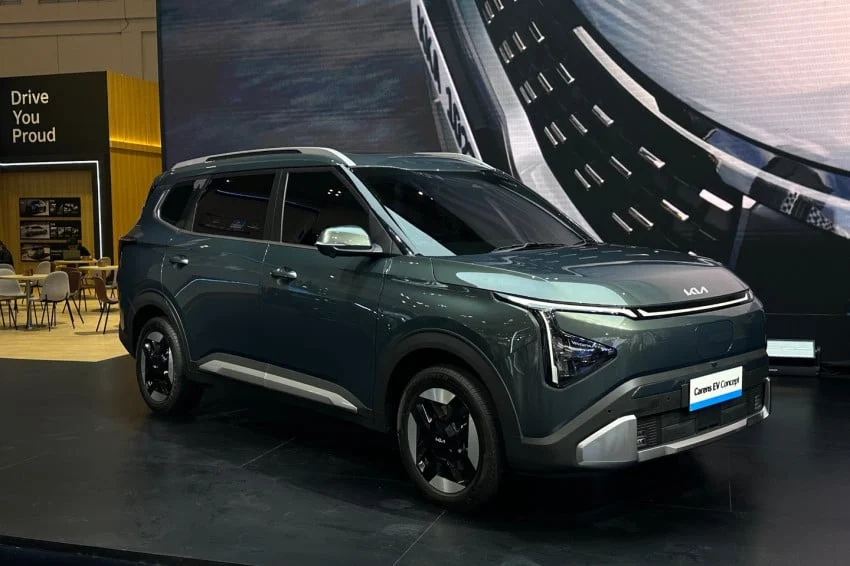
The Indonesian electric vehicle market is witnessing another strategic expansion with the official pre-booking phase of the Kia Carens EV, which commenced on Monday, October 26, 2026. Positioned as a modern, three-row electric multi-purpose vehicle (MPV), the Carens EV has entered the domestic market with an estimated on-the-road (OTR) Jakarta price range of IDR 382 million to IDR 432 million. Equipped with a battery capacity of up to 51.4 kWh, the vehicle aims to capture the growing family demographic seeking sustainable mobility solutions. However, market analysts and industry observers note that the primary challenge for the newcomer will not stem from external market pioneers such as the BYD M6, but rather from an internal corporate rival: the upcoming Hyundai Neira. Sharing a foundational vehicle platform, the Kia Carens EV and the Hyundai Neira are set to lock horns in a high-stakes battle for consumer preference within the same automotive ecosystem, where brand equity and dealership infrastructure will ultimately dictate market success.
Chronology of the Launch and Market Positioning
The journey of the Kia Carens EV to the Indonesian market began gaining serious momentum following its initial public debut as a concept vehicle at the Gaikindo Indonesia International Auto Show (GIIAS) in Jakarta earlier in 2026. The positive reception at the exhibition prompted Kia Sales Indonesia to fast-track its commercialization strategy, culminating in the opening of the pre-book phase on October 26, 2026.
This timeline reflects the aggressive pacing adopted by automotive brands operating under the Hyundai-Kia umbrella in Southeast Asia’s largest economy. As the Indonesian government continues to push for vehicle electrification through various fiscal incentives, tax exemptions, and infrastructure development, manufacturers are rushing to introduce locally assembled or competitively priced imported electric vehicles. The pricing strategy of IDR 382 million to IDR 432 million places the Carens EV squarely in the heart of the mass-market volume segment, directly challenging existing gasoline-powered MPVs while undercutting or closely competing with established battery-electric competitors.
Platform Synergy and Product Specifications
At the core of the competition between the Kia Carens EV and the Hyundai Neira is shared automotive engineering. Both vehicles are developed upon the same dedicated electric vehicle architecture, allowing the parent corporate group to optimize production efficiencies, component sourcing, and research and development costs.
The Kia Carens EV features a robust battery pack boasting a capacity of up to 51.4 kWh, engineered to provide a practical driving range suitable for both daily urban commuting and occasional intercity family trips. Its three-row cabin configuration is meticulously designed to accommodate up to seven passengers, retaining the traditional versatility and spaciousness that Indonesian consumers historically demand from an MPV.
Similarly, the Hyundai Neira—manufactured locally at Hyundai’s production facility in Bekasi, West Java—shares comparable technical underpinnings, powertrain outputs, and interior dimensions. Because both models share virtually identical mechanical DNA and battery capacities, industry experts predict that prospective buyers will find few differentiators when examining the spec sheets alone. This parity shifts the competitive battleground away from raw specifications toward intangible assets: brand perception, styling preferences, and, most importantly, after-sales support networks.

The Brand and Infrastructure Battle: Kia Versus Hyundai
While the BYD M6 has established a strong presence as an early contender in the electric MPV category, market analysts argue that the existential threat to the Kia Carens EV comes from within its extended corporate family. Hyundai Motor Group employs a multi-brand strategy globally, but in the Indonesian market, Hyundai has established a distinct operational head start compared to Kia.
Over recent years, Hyundai has aggressively invested in building a robust manufacturing footprint in Bekasi, alongside a comprehensive nationwide dealership and service network. This infrastructure includes authorized service centers, high-speed public charging stations, and a well-established supply chain for spare parts. Furthermore, Hyundai’s aggressive marketing campaigns and early entry into the Indonesian EV space with models like the Ioniq 5 and Kona Electric have cemented high brand recall and consumer trust.
In contrast, while Kia has experienced a steady resurgence under new management and distribution structures in Indonesia, its dealership density and service footprint remain smaller than Hyundai’s. For family buyers transitioning to electric vehicles for the first time, ownership peace of mind—guaranteed by the proximity of authorized service centers and readily available technical expertise—often outweighs minor design or feature differences. Consequently, the success of the Carens EV will heavily rely on Kia Sales Indonesia’s ability to reassure consumers regarding its after-sales readiness and service network expansion.
Broader Market Implications and Industry Outlook
The arrival of the Kia Carens EV and the impending launch of the Hyundai Neira signify a maturation phase in Indonesia’s electric vehicle landscape. The market is transitioning from early-adopter luxury segments into high-volume, family-oriented segments where utility and affordability reign supreme.
The strategy of deploying platform-sharing models under different brand banners allows the automotive group to test various design languages and target slightly different consumer demographics. Kia traditionally appeals to buyers seeking dynamic styling, youthful appeal, and European-inspired design aesthetics, whereas Hyundai often leans toward futuristic innovation, mainstream comfort, and technological integration.
However, this internal rivalry also carries strategic risks. If not carefully managed, cannibalization of sales between the Kia Carens EV and the Hyundai Neira could dilute the group’s collective market share, leaving room for external competitors such as BYD, Wuling, and emerging Chinese manufacturers to capture disgruntled or undecided consumers.
As the Indonesian government maintains its commitment to carbon reduction targets and local EV manufacturing incentives, the battle between the Carens EV and the Neira will serve as a fascinating case study in corporate synergy, brand positioning, and consumer psychology. For families looking to make the leap into zero-emission motoring without compromising on passenger capacity, the coming months will offer unprecedented choices—and a clear test of which automotive brand can deliver not just a superior vehicle, but a superior overall ownership experience.