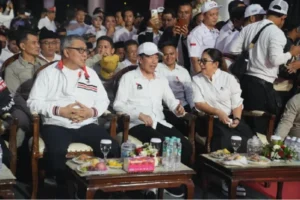
The Corruption Eradication Commission of the Republic of Indonesia executed a high-profile sting operation, locally known as an Operasi Tangkap Tangan (OTT), targeting the Land Offices in Bogor Regency, West Java, and Tangerang City, alongside other related locations. The decisive enforcement action, which unfolded on Monday, September 14, 2026, resulted in the apprehension of 17 individuals. This sweeping operation marks one of the most significant anti-corruption interventions within the land administration sector in recent years, drawing intense public and institutional scrutiny due to the high-ranking positions of the individuals implicated.
According to official statements released by the anti-graft agency, the clandestine operation was designed to intercept corrupt transactions tied to land rights administration and bureaucratic processing. The sweep reflects ongoing efforts by regulatory and law enforcement bodies to eradicate systemic bribery within public institutions that manage vital national resources and property documentation.
Key Figures Apprehended in the Nationwide Sweep
The scope of Monday’s operation became fully apparent as investigators detained a cross-section of high-profile public servants, bureaucrats, and political figures. Budi Prasetyo, speaking in his capacity as the spokesperson for the Corruption Eradication Commission, confirmed the scale of the arrests during a media briefing following the operation.
Among the 17 individuals taken into custody are several high-ranking government officials who hold immense responsibility within the national land governance framework. Most notably, the detained cohort includes the Director General of Land and Spatial Control and Management (PPTR) within the Ministry of Agrarian Affairs and Spatial Planning/National Land Agency (ATR/BPN), identified as Lampri. The involvement of a sitting Director General highlights the deep-seated nature of the alleged malfeasance, pointing to vulnerabilities at the highest tiers of ministerial oversight.
In addition to the Director General, the operation ensnared regional operational leaders responsible for local land administration. Sontang Coin Manurung, serving as the Head of the Bogor Regency Land Office (Kantah), and Tardi, the Head of the Tangerang City Land Office, were both apprehended by the anti-graft task force. These regional offices are frequently processing heavy volumes of commercial and residential property transactions, making them critical nodes in land management and potential hotspots for administrative corruption.
Beyond serving bureaucrats, the dragnet also captured prominent political and regional figures. Prasetyo confirmed that the individuals caught in the sting operation included Fahd El Fouz, widely known as Fahd A. Rafiq, a prominent politician affiliated with the Golkar Party, as well as Arif Sugiyanto, the former Regent of Kebumen. The presence of these political figures suggests a complex network of influence peddling, potentially linking political lobbying to bureaucratic facilitation in land acquisition and titling processes.
Allegations and Core Focus of the Investigation
The primary catalyst for the anti-corruption agency’s intervention centers on illicit financial flows and corrupt practices related to administrative processing. Preliminary findings indicate that the sting operation was directly linked to irregularities in the issuance and processing of Building Rights Titles, commonly referred to in Indonesia as Hak Guna Bangunan (HGB), within the Bogor Regency jurisdiction.
In addition to the HGB processing irregularities, investigators are probing broader allegations of systemic rent-seeking behavior. Prasetyo noted that the scope of the investigation encompasses other suspected illicit receipts and unauthorized payments received by officials involved in the case. The alleged scheme points toward an entrenched pattern of expediting administrative procedures through unofficial channels, bypassing legal compliance mechanisms in exchange for substantial financial kickbacks.
The issuance of HGB certificates is a critical legal process required for commercial developments, industrial expansion, and large-scale residential projects. Delays or blockages in these bureaucratic procedures often create financial pressures for developers and investors, rendering the system vulnerable to extortion, bribery, and fast-track corruption schemes managed by compromised officials.
Institutional Context and Background of Land Sector Corruption
The Ministry of Agrarian Affairs and Spatial Planning/National Land Agency (ATR/BPN) has long been identified by governance watchdogs and civil society organizations as a sector highly vulnerable to corrupt practices. Land administration involves complex legal verification, mapping, spatial planning approvals, and title issuances, all of which generate significant economic value and create fertile ground for administrative abuse.
Historically, land disputes and bureaucratic bottlenecks have plagued property development across Indonesia. Despite numerous administrative reforms introduced over the past decade—including the digitization of land services, electronic certificate rollouts, and the implementation of transparency initiatives—legacy bureaucratic structures and entrenched patronage networks continue to undermine institutional integrity.
The involvement of high-ranking ministry officials, such as a Director General, indicates that supervisory mechanisms at the central government level may have been compromised or bypassed. Observers note that systemic corruption in land offices not only distorts the investment climate by creating unfair advantages for compliant actors but also dispossesses ordinary citizens and exacerbates land tenure conflicts across regions experiencing rapid urbanization, such as Bogor and Tangerang.
Chronology of the Enforcement Operation
While the public confirmation of the arrests occurred on Monday, September 14, 2026, anti-graft operations of this magnitude typically require months of meticulous surveillance, intelligence gathering, and case building.
- Intelligence Phase: The anti-corruption commission’s monitoring units likely spent weeks tracking suspicious communications, financial transactions, and meetings between land office officials, political intermediaries, and private sector beneficiaries connected to major real estate developments in Bogor and Tangerang.
- Execution of the Sting: On the day of the operation, coordinated teams deployed simultaneously to multiple locations, including the Bogor Regency Land Office, the Tangerang City Land Office, and private residences or meeting spots associated with the suspects.
- Apprehension and Evidence Seizure: Investigators secured the 17 suspects and initiated the seizure of physical and digital evidence, including financial records, communication logs, and property documents relevant to the HGB processing cases under scrutiny.
- Initial Processing and Interrogation: Following the arrests, all 17 individuals were transported to the central detention facility of the anti-corruption commission in Jakarta for intensive questioning and preliminary legal processing within the statutory 24-hour window governing investigative detentions.
Official Responses and Institutional Stand
Following the execution of the operation, the leadership of the Corruption Eradication Commission emphasized its unwavering commitment to cleaning up public administration, particularly within sectors directly impacting economic development and public welfare. The agency reiterated that no public official, regardless of rank or political affiliation, is immune to enforcement actions if credible evidence of bribery or abuse of power is established.
Meanwhile, representatives from the Ministry of ATR/BPN have yet to issue a comprehensive official statement regarding the detention of their senior official, though internal coordination meetings are anticipated to address administrative continuity within the affected regional offices. The Ministry has previously maintained a zero-tolerance policy toward integrity violations, though civil society groups have repeatedly called for deeper structural reforms rather than sporadic punitive measures.
Political organizations linked to the detained figures have begun assessing the implications of the arrests. Party representatives stressed the principle of presumption of innocence while acknowledging the gravity of the legal process facing their members.
Broader Economic and Legal Implications
The interception of key bureaucratic and political actors in Bogor and Tangerang carries profound implications for Indonesia’s legal and economic landscape.
From an economic perspective, investor confidence is heavily dependent on the transparency and predictability of land acquisition and titling processes. When systemic corruption compromises core agencies like the National Land Agency, the cost of doing business rises significantly, deterring ethical investors and favoring enterprises willing to engage in illicit rent-seeking. The removal of compromised officials, while disruptive in the short term, is viewed by governance experts as a necessary step toward establishing a fairer marketplace.
Legally, the case is expected to test the anti-corruption agency’s investigative rigor, particularly in establishing the precise money trails linking political actors like Fahd El Fouz and former regional heads like Arif Sugiyanto to the administrative actions executed by bureaucrats such as Lampri, Sontang Coin Manurung, and Tardi. Under Indonesian anti-corruption laws, suspects charged with bribery and gratification face severe criminal penalties, including lengthy prison sentences and the asset forfeiture of ill-gotten gains.
As the investigation progresses, public attention will remain focused on the anti-corruption commission’s next procedural steps, including the formal announcement of suspect statuses, the potential expansion of the suspect list, and the eventual scheduling of court trials in the Jakarta Corruption Court. The outcome of this high-stakes case will likely serve as a benchmark for ongoing governance reforms within Indonesia’s critical land administration infrastructure.