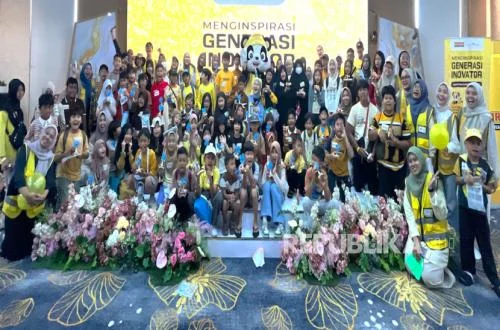
MR.DIY Indonesia, the nation’s leading home improvement retailer, has officially announced the launch of its "Menginspirasi Generasi Inovator" (Inspiring a Generation of Innovators) program, a massive educational outreach initiative designed to reach 8,600 children across the Indonesian archipelago. This ambitious campaign, timed to coincide with the celebration of National Children’s Day on July 23, aims to foster a culture of scientific inquiry and technological literacy among the youth. Throughout the month of July 2026, the company will conduct a series of interactive roadshows and educational workshops spanning major urban centers and rural districts, including Jakarta, Bandung, Surabaya, and Banyumas. By focusing on the pillars of Science, Technology, Engineering, and Mathematics (STEM), MR.DIY seeks to equip the next generation of Indonesians with the critical thinking and problem-solving skills necessary to navigate an increasingly complex global economy.
The cornerstone of this initiative is the deployment of specialized STEM Kits—curated educational toolsets designed to transform abstract scientific concepts into tangible, hands-on learning experiences. These kits are intended to bridge the gap between theoretical classroom instruction and practical application, encouraging children to experiment, fail, and iterate in a safe and supportive environment. As Indonesia continues its journey toward the "Indonesia Emas 2045" (Golden Indonesia 2045) vision, the demand for a workforce proficient in technical disciplines has never been higher. MR.DIY’s program represents a significant private-sector contribution to this national goal, targeting students during their most formative years to ignite a lifelong passion for innovation.
A Strategic Vision for National Education
The "Menginspirasi Generasi Inovator" program is not merely a corporate social responsibility (CSR) exercise; it is a calculated investment in the country’s human capital. Edwin Cheah, the President Director of MR.DIY Indonesia, emphasized that National Children’s Day serves as a vital momentum for the company to deepen its commitment to the community. He noted that the program is structured to bring high-quality educational resources directly to families, ensuring that geography and socioeconomic status do not become barriers to learning.
"The ‘Menginspirasi Generasi Inovator’ program is our concerted effort to bring STEM learning access closer to Indonesian families," Cheah stated during the program’s launch event. "We want children to learn through direct experiences that are fun, interactive, and easily accessible. By providing this access early on, we hope to nurture the curiosity and creativity that are essential for the birth of future Indonesian STEM talents. We believe that every child deserves the opportunity to grow, learn, and develop their potential to the fullest."
Cheah’s remarks reflect a broader trend in the Indonesian retail sector, where companies are increasingly aligning their social initiatives with national development priorities. By focusing on STEM, MR.DIY is addressing a specific vulnerability in the Indonesian education system. Despite improvements in school enrollment rates, Indonesia’s performance in international assessments such as the Programme for International Student Assessment (PISA) has historically highlighted a need for stronger outcomes in mathematics and science. Initiatives that supplement the national curriculum with practical, engaging activities are viewed by educators as essential for improving these metrics.
The Psychological Importance of Play-Based STEM Learning
The pedagogical philosophy behind the STEM Kit roadshow is rooted in the concept of "learning through play." To ensure the program’s effectiveness, MR.DIY collaborated with clinical psychologists and educational experts to tailor the activities to the developmental needs of children. Hertha Christabelle Hambalie, a Clinical Psychologist and Play Therapist, highlighted the profound impact that STEM-based play can have on a child’s cognitive and emotional growth.
According to Hambalie, play is the primary mechanism through which children interpret and understand the world around them. When STEM concepts are introduced through play, they become less intimidating and more intuitive. "STEM-based games help develop critical thinking, problem-solving abilities, and creativity, while simultaneously building a child’s self-confidence," Hambalie explained. "The act of learning while playing provides rich stimulation that fosters consistency, resilience, and a ‘never-give-up’ attitude. The value here extends beyond simple education; it creates a shared experience for families, allowing children to grow to love the process of learning itself."
Hambalie further noted that the STEM Kits are meticulously designed to match the age and ability levels of the participants. This scaffolding approach ensures that children are challenged without becoming overwhelmed. For younger children, the kits might focus on basic mechanical principles or simple chemical reactions, while older participants engage with more complex engineering puzzles and technological applications. This progression is vital for building "self-efficacy"—a child’s belief in their own ability to succeed—which is a key predictor of future academic and professional success.
Collaborations and Regional Implementation
The scale of the "Menginspirasi Generasi Inovator" program necessitates a robust network of partners. In Jakarta, MR.DIY has partnered with Indonesia Mengajar, a prominent non-profit organization dedicated to improving education across the country. This collaboration has facilitated the deployment of STEM Kit roadshows in high-traffic public spaces, ensuring maximum visibility and participation. Key locations in the capital include Taman Mini Indonesia Indah (TMII), the National Library (Perpustakaan Nasional), the Jakarta Library, and green urban spaces like Tebet Eco Park. In the initial Jakarta phase alone, the program successfully engaged approximately 500 children between the ages of 6 and 15.
The enthusiasm for the program has extended far beyond the capital. The roadshow’s itinerary includes:
- Bandung: Reaching approximately 5,800 children across 10 different schools.
- Banyumas Regency: Targeting 1,000 children in 3 selected schools.
- Surabaya: Engaging 300 children in 3 schools.
One of the most unique aspects of the campaign is the partnership with the Sriwijaya Air Group. In a move to celebrate National Children’s Day mid-flight, MR.DIY and the airline will distribute 1,000 STEM Kits as special gifts to children traveling on Sriwijaya Air flights on July 23, 2026. This partnership highlights the creative ways in which corporate entities can collaborate to reach children in non-traditional environments, turning a routine flight into an educational opportunity.
Timeline and Evolutionary Context
While the current roadshow is a highlight of the 2026 calendar, the "Menginspirasi Generasi Inovator" initiative has a history of regional engagement. The program was first piloted in April 2026 in Waingapu, East Sumba. The choice of Sumba as a starting point was symbolic of MR.DIY’s commitment to educational equity, reaching out to regions that are often overlooked by major corporate programs. The success of the Waingapu pilot provided the data and momentum needed to scale the project into the national roadshow currently underway.
Beyond the STEM Kits for younger children, MR.DIY Indonesia has also invested in vocational education through its "Teaching Factory" program. This initiative, currently active at SMKN 1 Katapang in Bandung, connects vocational high school students and teachers with real-world industrial experiences. By integrating industry-standard practices into the school’s curriculum, the Teaching Factory ensures that graduates possess the competencies required by modern employers. This dual approach—targeting both primary school curiosity and secondary school technical proficiency—demonstrates a comprehensive strategy for supporting the Indonesian education ecosystem.
Socio-Economic Implications and Future Outlook
The broader implications of MR.DIY’s STEM initiative are significant. In an era defined by the Fourth Industrial Revolution, the ability of a nation to innovate is directly tied to its proficiency in STEM fields. By popularizing these subjects through accessible kits and public roadshows, MR.DIY is helping to demystify technology for thousands of families.
Economic analysts suggest that private sector involvement in education is crucial for bridging the "skills gap" that many Indonesian industries face. When companies like MR.DIY provide resources that the state budget may not always cover—such as specialized high-tech educational kits—they act as a catalyst for social mobility. For many of the 8,600 children participating in this program, the STEM Kit may be their first encounter with the principles of engineering or digital logic, potentially steering them toward future careers in high-growth sectors.
Furthermore, the emphasis on parental involvement—encouraged by both Edwin Cheah and Hertha Hambalie—addresses a critical component of educational success: the home environment. By designing activities that parents and children can explore together, the program strengthens domestic support systems for learning. As children learn to be patient, to explore, and to take pride in what they have built, they develop the "soft skills" that are just as important as technical knowledge in the modern workplace.
As the July 2026 roadshow concludes, the data gathered from the 8,600 participants will likely inform future iterations of the program. MR.DIY’s "Menginspirasi Generasi Inovator" stands as a testament to the power of public-private synergy in addressing national challenges. By celebrating National Children’s Day through the lens of innovation, the program does more than just provide a day of entertainment; it lays the groundwork for a more resilient, creative, and technologically advanced Indonesia. The legacy of this initiative will be measured not just in the number of kits distributed, but in the future breakthroughs of the young innovators it has inspired.