The digital landscape has consistently demonstrated an affinity for anonymity coupled with altruism, yet few modern online personas have cultivated the level of intrigue surrounding the enigmatic figure known as "Nona Nego." While her sudden prominence across mainstream digital platforms has caught the attention of millions, a deeper investigation into her background reveals that her philanthropic endeavors are far from a recent social media experiment. Long before her digital handles began trending across algorithm-driven feeds, Nona Nego was quietly embedding herself within the grassroots network of humanitarian aid and community service in Indonesia, operating under a deliberate veil of secrecy that continues to baffle and fascinate observers alike.
Unveiling a History of Long-Term Humanitarian Commitment
To understand the phenomenon of Nona Nego, one must look past the carefully curated short-form videos and photographic documentation currently populating her official channels. Public curiosity initially spiked due to her unorthodox approach to content creation—where interactions with everyday citizens, street vendors, and marginalized groups are broadcasted without ever revealing the face or the true legal identity of the creator. However, accounts from community organizers and individuals familiar with her early grassroots work indicate that her commitment predates the current era of viral philanthropy.
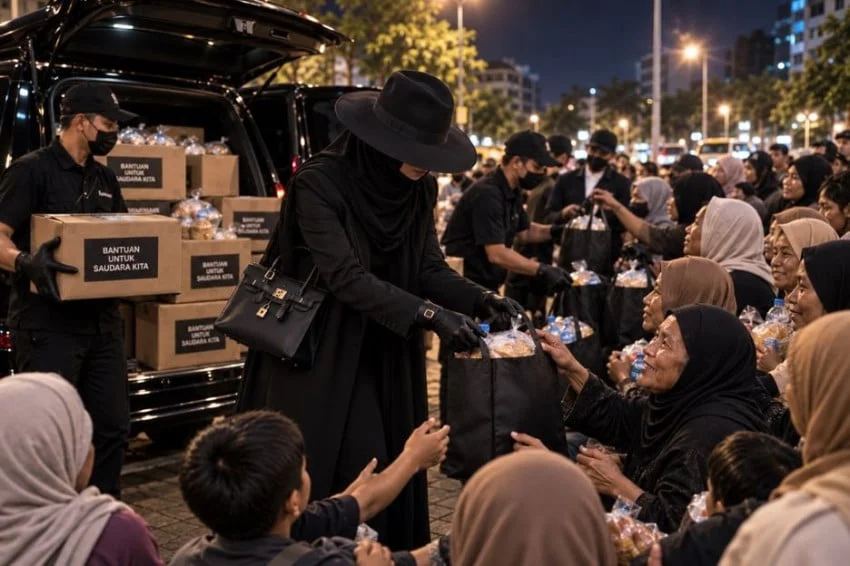
Before leveraging platforms like TikTok and Instagram to amplify her message, Nona Nego operated within localized relief networks. Her involvement was not restricted to the spontaneous distribution of cash or daily necessities to small-scale merchants, a practice that eventually became her digital trademark. Instead, her early portfolio of social work extended significantly into disaster response and emergency humanitarian relief. During periods of severe environmental calamity—ranging from flash floods to volcanic eruptions that frequently impact the Indonesian archipelago—she was reportedly observed on the ground, working shoulder-to-shoulder with local volunteers, logistics coordinators, and emergency response teams.
In these high-stress environments, where the immediate demands often overwhelm local infrastructure, Nona Nego’s contributions typically involved the direct procurement and distribution of essential supplies. From staple foods and clean water to emergency clothing and psychological support frameworks for displaced families, her participation was characterized by a distinct lack of self-promotion. While many contemporary digital creators utilize humanitarian crises as a vehicle for personal branding and audience acquisition, Nona Nego historically divorced her identity from her output, operating under the philosophical premise that the efficacy of aid supersedes the recognition of the benefactor.
The Evolution of Digital Anonymity: The TikTok and Instagram Era
The transition of Nona Nego from an anonymous ground-level volunteer to a recognized digital entity represents a fascinating shift in how modern social consciousness is communicated. The launch of her official digital footprint—anchored primarily by the TikTok account @negovsowner0 and the Instagram handle @nona.nego.real—did not dismantle her aura of mystery; rather, it codified it into a distinct brand of digital asceticism.
Rather than adapting to the hyper-personalized trends of modern social media, where creators often monetize their daily routines, emotional vulnerabilities, and physical appearances, Nona Nego institutionalized her anonymity. Her visual presentation on these platforms is strictly uniform: hands clad in signature black gloves, an all-dark wardrobe, and an intentional framing that obscures her facial features. This calculated concealment has transformed her into a symbol rather than an individual personality.
Media analysts and digital culture researchers suggest that this deliberate strategy serves a dual purpose. First, it safeguards her personal safety and privacy in an era where online doxxing and intense digital scrutiny pose genuine threats to public figures. Second, and more importantly, it shifts the audience’s focus away from the messenger and directs it entirely toward the socio-economic realities of the recipients. When viewers watch a video of Nona Nego interacting with a struggling street vendor or a family recovering from a disaster, the absence of a recognizable face eliminates parasocial distractions, forcing the consumer to confront the raw economic disparity and human vulnerability depicted on screen.
The Operational Mechanics of Anonymous Philanthropy
The operational scope of Nona Nego’s activities requires a sophisticated logistical framework, despite the seemingly spontaneous nature of her video content. In disaster zones, the challenges of distributing aid are compounded by infrastructural damage, bureaucratic hurdles, and the sheer volume of displaced individuals. Historical data from Indonesia’s National Board for Disaster Management (BNPB) consistently highlights that immediate post-disaster phases require coordinated efforts to prevent supply bottlenecks.
While official agencies and large non-governmental organizations (NGOs) handle macro-level rescue operations and infrastructural rehabilitation, decentralized actors like Nona Nego often fill the crucial micro-level gaps. By maintaining liquid financial resources and nimble supply chains, independent philanthropists can provide rapid, unredacted assistance to populations that might otherwise fall through the cracks of formal bureaucratic distribution lists.
According to community leaders who have worked alongside independent humanitarian networks in Indonesia, anonymous giving carries both operational advantages and limitations. On the positive side, it minimizes the risk of corruption, political co-optation, or the commercialization of poverty—a phenomenon where vulnerable individuals are exploited for digital engagement metrics. Conversely, the lack of formal registration or institutional oversight can sometimes lead to redundancy in aid distribution or challenges in long-term accountability. Nona Nego’s ability to sustain her operations over an extended period suggests a degree of internal organization and resource management that goes far beyond casual charity.
Socio-Economic Implications and Public Reaction
The public fascination with Nona Nego reflects a broader cultural fatigue with performative altruism. In an era where digital charity is frequently criticized as "virtue signaling" designed to boost follower counts and secure corporate sponsorships, Nona Nego’s insistence on remaining faceless has struck a profound chord with netizens.
Sociologists examining the rise of anonymous digital philanthropy point to a growing psychological desire among internet users for authenticity. When a benefactor refuses to claim personal glory, the audience is more inclined to perceive the action as pure and unmotivated by personal gain. This dynamic has fostered a highly engaged and protective digital community around her channels, where followers frequently police comment sections to deter impostors and maintain the sanctity of her core philosophy.
However, this dynamic also raises critical questions about the systemic nature of poverty and disaster relief in developing economies. While viral philanthropy and independent actors provide immediate, tangible relief to individuals, economists and public policy experts emphasize that such interventions cannot substitute for systemic social safety nets. The viral nature of Nona Nego’s content highlights the persistence of economic vulnerability, drawing millions of views precisely because the struggles of the merchants and disaster victims resonate with a populace facing similar economic pressures.
Chronology of Public Emergence and Media Trajectory
To contextualize the trajectory of Nona Nego, a retrospective examination of her digital footprint outlines her steady rise to public consciousness:
- Pre-Digital Era (Estimated Years Prior to 2024): Active participation in localized volunteer networks, disaster relief operations, and spontaneous humanitarian assistance across various Indonesian regions without digital documentation or public recognition.
- Initial Digital Incubation: Gradual recording and compilation of grassroots interactions, focusing heavily on supporting informal sector workers, small-scale traders, and marginalized communities.
- Platform Formalization: Establishment of official digital channels, specifically the TikTok account @negovsowner0 and Instagram handle @nona.nego.real, marking the formal introduction of her signature aesthetic—black gloves and obscured identity.
- Broad Public Engagement: Exponential growth in viewership and digital discussion, accompanied by heightened media coverage regarding the dichotomy between her high-profile content and her deeply guarded personal identity.
- Current Status: Ongoing operation of humanitarian initiatives, with public discourse continuing to speculate on her true identity while largely celebrating the tangible benefits of her philanthropic interventions.
Expert Perspectives and Institutional Responses
While formal institutions—including government bodies and established humanitarian organizations—rarely issue direct statements concerning individual content creators, social welfare experts have weighed in on the broader implications of the "Nona Nego phenomenon."
Dr. Hendra Kusuma, a socio-cultural researcher based in Jakarta, notes that the rise of anonymous digital philanthropy signals a democratization of empathy. "For decades, institutional philanthropy was dominated by corporate foundations and state-run agencies, which often felt distant to the average citizen," Dr. Kusuma explains. "Figures like Nona Nego bridge the emotional gap between the donor and the recipient. By stripping away corporate branding and personal vanity, the interaction is reduced to its purest human element: one person recognizing the dignity of another."
At the same time, consumer protection and digital ethics advocates urge audiences to maintain a balanced perspective. While the emotional resonance of Nona Nego’s videos is undeniable, experts remind the public that digital content—no matter how altruistic its intent—is still subject to the mechanics of social media algorithms. The curation of specific narratives, the editing of emotional peaks, and the strategic deployment of mystery are all sophisticated tools of modern digital engagement.
The Future of the Enigma
As Nona Nego continues to expand her digital presence, the central question remains whether the mystery surrounding her identity can be maintained indefinitely. In an era of advanced digital forensics, facial recognition technology, and relentless investigative journalism by curious internet sleuths, preserving total anonymity becomes increasingly difficult over time.
Yet, for millions of followers, the true value of Nona Nego lies precisely in her elusiveness. By choosing to remain faceless, she has transformed herself into an abstract ideal—a reminder that empathy requires no applause and that genuine humanitarian impact can exist independently of personal fame. Whether her future endeavors involve scaling her operational capacity or maintaining her current grassroots approach, Nona Nego has permanently altered the landscape of digital philanthropy in Indonesia, proving that in a world obsessed with visibility, true power can sometimes be found in the shadows.