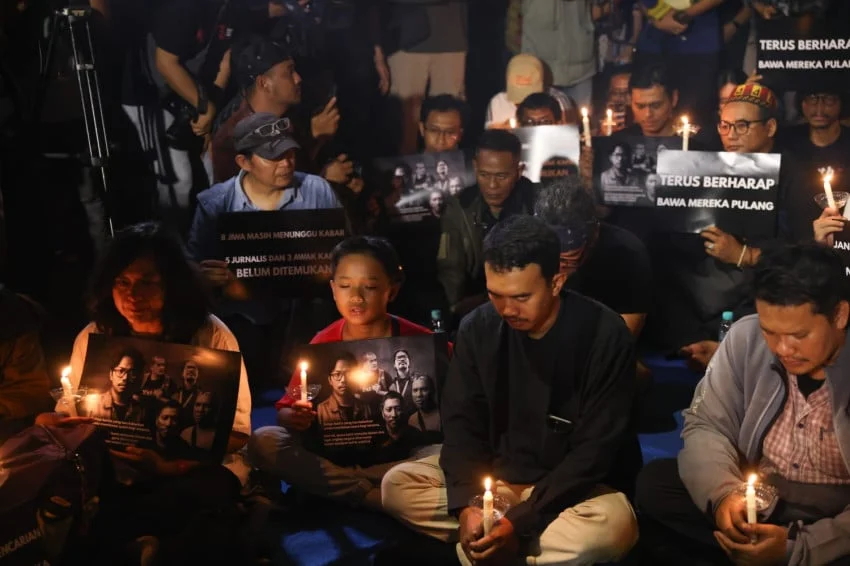
The vicinity surrounding the iconic Welcome Monument at Bundaran Hotel Indonesia (HI) in Central Jakarta transformed into a scene of profound solemnity on Friday night, September 11, 2026. Hundreds of journalists, media practitioners, and concerned citizens gathered under the night sky to offer collective prayers and expressions of solidarity for five reporters who have been missing in the waters of the Sunda Strait since Monday, September 7, 2026. The group had been deployed on a professional assignment to cover the heightened volcanic activity of Mount Anak Krakatau when contact was abruptly lost.
Led in prayer by a local cleric, the vigil was formally organized by the Jakarta chapter of the Alliance of Photojournalists (Pewarta Foto Indonesia, or PFI Jakarta). Attendees clutched candles and held banners aloft, uniting in a shared hope that the ongoing search-and-rescue operations would yield positive results and that the missing media personnel would be located safely. The emotional atmosphere underscored the inherent physical dangers frequently encountered by media workers operating in high-risk environments across the Indonesian archipelago.
Chronology of the Disappearance and Rescue Operations
The sequence of events leading to the mass prayer vigil began nearly a week prior. On the morning of Monday, September 7, 2026, a specialized media team comprising five journalists embarked on a maritime journey toward the vicinity of Mount Anak Krakatau in the Sunda Strait. Their objective was to document recent geological developments, seismic shifts, and eruptive phases of the volatile volcanic island, which sits between the islands of Java and Sumatra.
By late afternoon, marine tracking systems and base newsrooms noted an unexpected cessation of communication. Initial attempts by respective media offices to reach the team via satellite phones, mobile devices, and marine radios failed to yield a response. As night fell and weather conditions in the Sunda Strait deteriorated—marked by high waves and unpredictable winds—media organizations escalated their concerns to local authorities.
On Tuesday morning, September 8, 2026, a joint search-and-rescue (SAR) operation was officially launched, coordinated by the National Search and Rescue Agency (Basarnas), the Indonesian Navy, and local marine police units. Naval vessels, fast rescue boats, and aerial reconnaissance assets were deployed across the designated maritime corridors surrounding the Krakatau archipelago. Despite continuous sweeps, adverse weather patterns, strong underwater currents, and the remote nature of the search zone significantly hampered early rescue efforts. By the time the solidarity vigil took place in Jakarta on Friday night, the intensive search entered its fifth day with authorities yet to discover definitive traces of the missing vessel or its occupants.

Solidarity and Statements from Press Organizations
The Jakarta vigil served not only as a spiritual gathering but also as a powerful display of professional unity across Indonesia’s diverse media landscape. Representatives from various press councils, journalist associations, and major news outlets stood shoulder-to-shoulder with the families of the missing reporters.
Dwi Pambudo, Chairman of the Pewarta Foto Indonesia (PFI) Jakarta, delivered a poignant address during the proceedings, emphasizing the immense sacrifices made by frontline reporters. He expressed deep gratitude to the press constituents and family members who attended the vigil, highlighting the psychological toll that such incidents inflict upon loved ones and colleagues alike.
"Tonight, we pray together as a unified body of press professionals and constituents," Dwi stated to the gathered crowd. "We extend our deepest gratitude for the presence of everyone here, including colleagues and family members who have made the journey to stand with us during this difficult hour."
Dwi further stressed that the missing individuals were performing vital duties protected and mandated by national legislation. He described them as steadfast guardians of the freedom of the press who place themselves in harm’s way to keep the public informed of natural phenomena and national events.
"We earnestly request prayers and steadfast support from the entire press community and the wider public. Our friends who departed to cover Mount Anak Krakatau are heroes of press freedom, acting in accordance with our nation’s press laws. Journalists operate as the vanguard of national reporting, laboring tirelessly to ensure that critical, life-saving information reaches the citizens who need it most," Dwi added.
Background on Mount Anak Krakatau and Maritime Reporting Hazards
The disappearance of the five journalists highlights the persistent occupational hazards associated with environmental and disaster reporting in Indonesia. Mount Anak Krakatau—literally translated as the "Child of Krakatoa"—emerged from the caldera left by the cataclysmic 1883 eruption of the original Krakatoa volcano. It remains one of the most active and closely monitored geological formations in the region, characterized by frequent Strombolian eruptions, ash plumes, and sudden flank collapses that can trigger localized tsunamis.

Reporting on active marine volcanoes requires navigating a complex matrix of environmental variables. Journalists covering such phenomena must routinely contend with volatile weather, sudden squalls in the Sunda Strait, volcanic debris, toxic gases, and unpredictable sea states. While safety protocols are standard procedure for major media houses, the sheer unpredictability of geological disasters often places field crews in high-risk zones where margins for error are razor-thin.
Historically, Indonesian journalists have frequently faced dangers while covering natural disasters, ranging from earthquakes and tsunamis to volcanic eruptions across the Pacific Ring of Fire. The ongoing incident involving the PFI Jakarta members has reignited discussions within media management circles regarding mandatory safety gear, specialized maritime survival training, and real-time tracking systems for field reporters operating in hazardous environments.
Official Responses and Inter-Agency Coordination
In the wake of the incident, government bodies, regulatory agencies, and professional press organizations have maintained continuous communication regarding the status of the search operations. Basarnas has scaled up its deployment, incorporating advanced sonar equipment and expanding the search radius based on oceanic drift models provided by the Meteorology, Climatological, and Geophysical Agency (BMKG).
The Indonesian Press Council (Dewan Pers) has also issued statements monitoring the rescue efforts closely, urging maritime authorities to utilize all available resources to locate the missing journalists. Furthermore, the council has appealed to media institutions nationwide to review and reinforce safety protocols for journalists deployed to disaster-prone areas, ensuring that risk assessments are rigorously conducted prior to field assignments.
As search teams press forward into the weekend, the families of the missing journalists, alongside their peers in newsrooms across Jakarta and the provinces, remain locked in anxious anticipation. The vigil at Bundaran HI stands as a poignant reminder of the human cost often hidden behind daily news reports, reflecting both the resilience and the vulnerability of those who document history from the front lines.