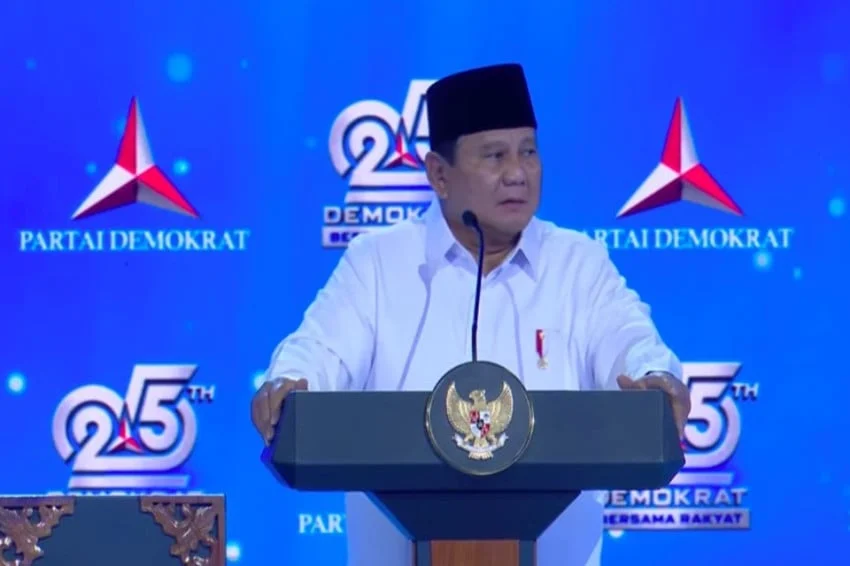
The political landscape of Indonesia experienced a significant moment of reflection and political alignment as President Prabowo Subianto took center stage to deliver a keynote address during the grand celebration of the Democratic Party’s 25th anniversary. Held at the sprawling Indonesia Arena in Central Jakarta, the silver jubilee celebration drew the attendance of high-ranking government officials, coalition leaders, and thousands of enthusiastic party cadres. The event, which commemorated a quarter-century of the party’s existence on the national political stage, quickly became a platform for addressing broader questions regarding political discourse, governance limits, and the intrinsic value of constructive criticism within a democratic society.
At the heart of President Prabowo’s address was a direct reference to the recent public discourse surrounding a speech delivered by Democratic Party Chairman Agus Harimurti Yudhoyono, widely known as AHY. The speech in question, which touched upon the philosophical and practical boundaries of political power, had previously sparked intense debate across various media platforms and political circles. Critics and analysts alike had scrutinized the phrasing and underlying tone of the address, interpreting it through diverse political lenses. Addressing this controversy head-on, President Prabowo offered a measured and statesmanlike perspective, framing the exchange not as a sign of coalition friction, but as a healthy manifestation of a maturing democracy.
A Chronology of Political Discourse and the Silver Jubilee
The sequence of events leading up to President Prabowo’s address began days prior with AHY’s controversial remarks regarding the limitations of power. The statement, which asserted that power has inherent boundaries and must be exercised with restraint and accountability, resonated deeply with the public but also drew sharp evaluations from rival political commentators. The Democratic Party subsequently clarified that the speech was designed to reaffirm the foundational values and ideological identity of the party rather than to challenge the ruling administration.
The culmination of this discourse occurred on Wednesday, September 9, 2026, during the silver anniversary celebrations. The event was meticulously planned to showcase the party’s journey from its establishment in 2001 by former President Susilo Bambang Yudhoyono to its current role as a vital pillar within the current national coalition government. As party leaders gathered to evaluate their institutional milestones, the anticipation surrounding how the executive branch would respond to the recent political debates was palpable. President Prabowo’s arrival and subsequent speech served to alleviate tensions, steering the narrative back toward national unity and shared governance objectives.
Core Themes of the Presidential Address and Democratic Resilience
In his comprehensive address to the gathered cadres, President Prabowo emphasized that a robust nation must possess the maturity to embrace differing viewpoints. He argued that when a country commits itself to the path of democracy, it inherently accepts the responsibility to listen to critique, evaluate internal governance, and utilize external feedback as a mechanism for self-correction.
"Indeed, yesterday there were circles that assessed Pak AHY’s speech a few days ago as a sharp criticism," President Prabowo remarked during the event. Expanding on this observation, he articulated a foundational philosophy of governance within a pluralistic society: "However, brothers and sisters, a great nation that has chosen the path of democracy must be grateful for criticism and correction."
This viewpoint underscores a critical facet of contemporary Indonesian political culture. Rather than viewing critique as an existential threat to executive stability, the administration has increasingly sought to frame dialogue as an essential component of administrative refinement. President Prabowo further solidified this stance by highlighting the genuine intentions behind AHY’s political declarations. He explicitly noted that the underlying message of the debated speech was rooted in a steadfast commitment to serving the general populace. "What is clear is that he firmly conveyed his intention and the Democratic Party’s intention, which is to work together for the people," Prabowo stated.
Thematic Alignment: Economic Advancement and Justice
Beyond addressing the political commentary, President Prabowo took the opportunity to praise the overarching theme chosen by the Democratic Party for its twenty-fifth anniversary. The official slogan for the milestone event—Advancing the People’s Economy, Upholding Justice, and Keeping Democracy Alive—served as a strategic blueprint that harmonized with the broader national development agenda championed by the administration.
The selection of this theme reflects the party’s strategic positioning within the national political sphere. By emphasizing economic advancement at the grassroots level, the Democratic Party continues to align its historical populist appeal with modern fiscal policies. President Prabowo expressed genuine enthusiasm for these focal points, noting that the triple pillars of economic empowerment, legal justice, and democratic preservation represent the collective responsibility of all political stakeholders in the country.
"I am very pleased with the theme chosen by the Democratic Party," Prabowo expressed. "Advancing the people’s economy, upholding justice, keeping democracy alive. This is what we must fight for, and this is our shared responsibility."
Background Context of the Democratic Party at Twenty-Five
To fully understand the significance of the event, it is necessary to examine the institutional trajectory of the Democratic Party over the past two and a half decades. Founded in September 2001, the party rose rapidly to prominence under the leadership of Susilo Bambang Yudhoyono, who served as Indonesia’s sixth president from 2004 to 2014. The party’s foundational ethos has traditionally centered on nationalism, religious pluralism, democracy, and social justice.
Over the years, the party has navigated various political transitions, transitioning from the ruling party to a vocal opposition bloc, and eventually returning to the heart of executive governance in the current administration led by President Prabowo. The leadership transition from the senior Yudhoyono to his son, Agus Harimurti Yudhoyono, marked a generational shift aimed at modernizing the party’s infrastructure, attracting younger demographic cohorts, and adapting to the fast-paced realities of digital-era politics. The twenty-fifth anniversary served not only as a celebration of historical achievements but also as a definitive statement of institutional longevity and future political relevance.
Implications for the National Coalition and Future Governance
The public defense of AHY by President Prabowo carries profound implications for the stability and cohesion of the ruling coalition. In multi-party presidential systems such as Indonesia, maintaining alignment among disparate political factions requires continuous negotiation, ideological reconciliation, and public displays of solidarity. By openly validating the legitimacy of constructive debate, the president has reinforced a political culture where internal critique does not automatically translate into coalition fracture.
Political analysts examining the event suggest that Prabowo’s remarks serve multiple strategic functions. First, they neutralize potential opposition narratives that seek to exploit minor policy debates as evidence of internal government discord. Second, they elevate the status of coalition partners, signaling that intellectual independence and value-driven rhetoric are tolerated and respected within the broader administrative framework. Finally, the endorsement helps insulate younger leaders like AHY from disproportionate political fallout, allowing them to maintain their distinct political identity while remaining anchored to the collective national agenda.
As Indonesia continues to navigate complex socioeconomic challenges—ranging from global economic uncertainties to domestic infrastructure development—the synergy between the executive branch and its legislative allies remains paramount. The silver anniversary of the Democratic Party, marked by mutual displays of respect and a shared commitment to democratic principles, suggests that the ruling coalition remains focused on its primary governance mandate: delivering tangible results for the Indonesian populace while safeguarding the foundational freedoms that define the nation’s democratic experiment.