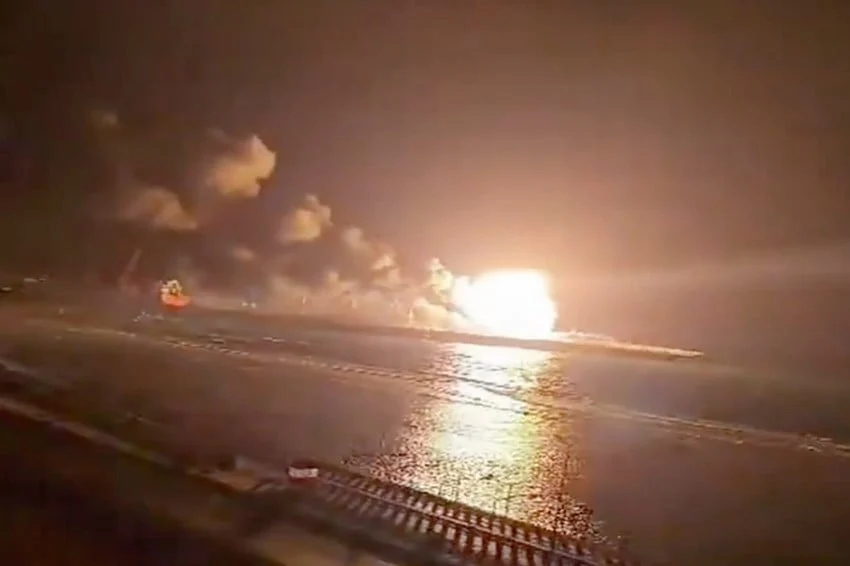
The geopolitical ripples of the ongoing conflict in Eastern Europe have extended deep into the Mediterranean basin following the dramatic destruction of a Russian naval vessel in North Africa. The Russian warship Merkury was struck and ultimately sunk in the early hours of Sunday while docked at the strategic port city of Benghazi in Libya. According to local officials, intelligence briefings, and preliminary operational assessments, the vessel was targeted by what are strongly suspected to be Ukrainian uncrewed surface vessels, commonly known as maritime drones.
The incident has triggered widespread international concern, effectively demonstrating that the theater of operations between Moscow and Kyiv is no longer confined to the territorial waters of the Black Sea or traditional land frontiers. Instead, the strike highlights an unprecedented geographical expansion of the nearly five-year war, projecting asymmetric maritime warfare more than 1,000 miles (approximately 1,609 kilometers) south of Ukraine’s coastline.
Chronology of the Benghazi Strike
The sequence of events leading to the loss of the Merkury began when the Russian warship made a scheduled logistical stop at the Libyan port of Benghazi. Operating far from its home waters, the vessel had pulled into the harbor to refuel and take on essential provisions.
According to initial reports provided by regional Libyan authorities to international news agencies, the port’s security apparatus detected incoming fast-moving aquatic threats in the pre-dawn hours of Sunday. The defending forces reportedly managed to intercept and destroy at least four incoming maritime drones utilizing coastal defense and close-in weaponry. However, the saturation tactics employed by the attackers overwhelmed the remaining defense mechanisms. At least two uncrewed surface vessels successfully bypassed the harbor defenses and detonated their payloads against the hull of the Merkury.
The resulting blasts caused catastrophic structural damage. High-resolution satellite imagery analyzed in the aftermath of the attack confirmed that the warship settled onto the seabed within the port limits.
The escalation did not conclude with the destruction of the naval vessel. Merely hours after the Merkury was sent to the bottom of the Mediterranean, a second maritime incident occurred off the coast of Benghazi. A Russian-linked cargo vessel identified as the Ascalon, reportedly transporting military supplies and logistics equipment, was similarly targeted by a maritime drone. Video footage recovered from the scene depicted an uncrewed craft navigating at high speed directly into the stern of the cargo carrier, triggering a secondary massive explosion.
Search and rescue operations launched by the Libyan National Army’s naval forces successfully evacuated the surviving crew members from the stricken cargo ship. Representatives from the Libyan Ministry of Health confirmed that several rescued sailors sustained minor to moderate injuries and were listed in stable condition, though comprehensive details regarding the exact number of casualties and the nationalities of the affected crew members remain unverified by official state registries.
Strategic Context and the Evolution of Ukraine’s Asymmetric Naval Doctrine
To fully comprehend the significance of the Benghazi strike, one must examine the profound transformation of naval warfare demonstrated throughout the Russian-Ukrainian conflict. At the outbreak of full-scale hostilities in February 2022, Ukraine entered the naval domain at a severe disadvantage, possessing virtually no conventional blue-water navy or capital ships capable of challenging the dominant Russian Black Sea Fleet.
Faced with this stark asymmetry, Kyiv pioneered an asymmetric warfare strategy centered on domestic innovation, particularly the rapid development and deployment of long-range maritime drones packed with high explosives. This strategy fundamentally altered the balance of power in the Black Sea. Ukrainian drone campaigns successfully crippled or sank multiple high-value Russian naval assets, including landing ships, patrol boats, and even the guided-missile cruiser Moskva, which was sunk by traditional anti-ship missiles earlier in the conflict.
The persistent threat posed by these low-cost, highly maneuverable uncrewed surface vessels forced the Russian military command to fundamentally reorganize its naval posture. Unable to guarantee the safety of its fleet in forward operating bases such as Sevastopol in the occupied Crimean Peninsula, the Russian Ministry of Defense ordered the bulk of its Black Sea Fleet assets to relocate eastward to the more secure port of Novorossiysk within the Russian mainland.
The recent attack in Libya, however, proves that moving out of the Black Sea does not necessarily grant immunity from Ukraine’s expanding long-range asymmetric strike capabilities. By projecting power into the Mediterranean, Ukrainian operators or their proxies have exposed critical vulnerabilities in Russian logistics and force protection mechanisms operating abroad.
Geopolitical Landscape of Benghazi and the Role of the Libyan National Army
The choice of Benghazi as the theater for this maritime strike brings a complex web of Middle Eastern and North African geopolitics into the equation. The port city and the broader eastern and southern regions of Libya are firmly under the operational control of the Libyan National Army (LNA), an armed faction led by General Khalifa Haftar.
The LNA maintains a complicated and pragmatic relationship with Moscow. Over recent years, the Russian Federation has increasingly utilized eastern Libyan ports and airbases—such as those in Benghazi and Tobruk—as logistical waypoints to project influence across the African continent. These facilities have frequently served as transit hubs for Russian military contractors, formerly associated with the Wagner Group and subsequently restructured under state oversight, to move personnel, equipment, and resources to allied nations in the Sahel region, including Mali, Sudan, and the Central African Republic.
The presence of Russian warships and logistical supply vessels in Benghazi was thus part of a broader network designed to sustain Moscow’s strategic footprint in North Africa and the Mediterranean. The successful targeting of these assets directly undermines Russia’s ability to project logistical power along its southern flank, complicating maritime supply lines that bypass international chokepoints tightly monitored by Western powers.
Official Responses and International Silence
In the immediate aftermath of the attacks on the Merkury and the Ascalon, official channels in Moscow remained largely silent. The Russian Ministry of Defense has historically observed a policy of delayed reporting or strict containment regarding operational setbacks sustained far from active combat zones. As of press time, no high-ranking Kremlin official or military spokesperson has issued a definitive statement confirming the total loss of the warship or detailing the extent of the damage to the cargo vessel.
Similarly, officials in Kyiv have maintained a measured diplomatic posture. While Ukrainian defense officials and military intelligence units frequently claim responsibility for successful asymmetric strikes against Russian infrastructure and naval assets, direct acknowledgment of operations conducted within the territorial waters of third-party sovereign nations often involves delicate diplomatic considerations. International law governing the conduct of belligerent states within the neutral waters or ports of non-belligerent nations introduces complex legal ramifications, likely prompting a calculated ambiguity from Ukrainian authorities.
Broader Implications for Global Shipping and Maritime Security
The sinking of the Merkury and the subsequent drone strike on the Ascalon carry profound implications for international maritime security, commercial shipping, and the rules of engagement in modern asymmetric warfare.
First, the incident signals a dangerous precedent: the expansion of active combat zones into the sovereign ports of neutral or non-aligned states. Libya, which has struggled to achieve stable governance and national unification following the 2011 uprising, now finds its vital maritime infrastructure drawn directly into the crosshairs of a European conflict. Regional governments in North Africa and the Mediterranean are likely to review their port security protocols, raising concerns over whether foreign warships belonging to belligerent nations can continue to utilize local refueling hubs without endangering domestic stability and harbor safety.
Second, the deployment of maritime drones over distances exceeding a thousand miles indicates rapid technological advancements in range, satellite guidance, and autonomous navigation systems. Early iterations of uncrewed surface vessels were largely limited to line-of-sight operations or coastal defense missions. The ability to coordinate and execute complex strikes thousands of kilometers away from home territory suggests a sophisticated command-and-control network, potentially reliant on advanced satellite communications and resilient navigation technologies designed to counter electronic jamming.
Finally, the incident underscores the vulnerability of auxiliary and logistical shipping lines utilized by major military powers. While modern blue-water navies invest heavily in the defense of frontline combatants like destroyers and frigate-class vessels, logistical vessels such as oilers, repair ships, and chartered cargo carriers often lack adequate point-defense systems. As asymmetric warfare continues to evolve, military planners worldwide will be forced to reconsider how auxiliary fleets are protected when operating outside heavily defended home waters.
As international maritime monitors, intelligence analysts, and diplomatic corps continue to assess the wreckage in Benghazi harbor, the event stands as a watershed moment in the Russia-Ukraine war—signaling that modern military technology has effectively abolished traditional concepts of geographical distance and sanctuary in naval warfare.