
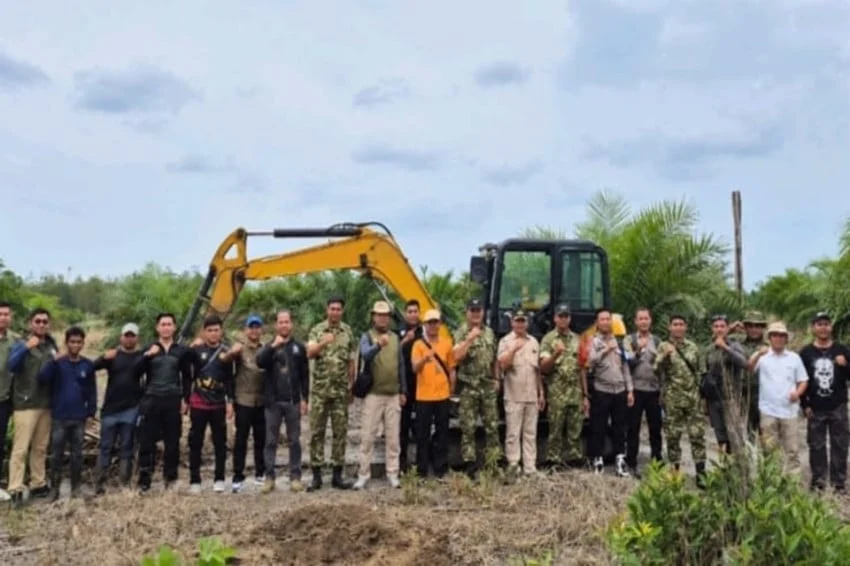
SUKAMARA — In a decisive move to restore ecological integrity and enforce environmental laws, the Ministry of Forestry (Kemenhut), acting in close coordination with the Indonesian National Armed Forces (TNI), the Indonesian National Police (Polri), the Attorney General’s Office, local government bodies, and local communities, successfully executed a major enforcement operation targeting illegal agricultural activities. The joint operation resulted in the formal reclamation and clearing of 88 hectares of illicit oil palm plantations situated deep within the sensitive confines of the Lamandau Wildlife Sanctuary (Suaka Margasatwa) in Central Kalimantan.
The large-scale intervention underscores the government’s escalating resolve to crack down on illegal land clearing, agricultural encroachment, and unauthorized commercial operations within designated conservation zones and protected forests across the archipelago. The Lamandau Wildlife Sanctuary, renowned for its rich biodiversity and critical role as a habitat for endangered species such as the Bornean orangutan, has faced increasing anthropogenic pressures in recent years, prompting federal and regional authorities to deploy integrated task forces to halt environmental degradation at its source.
Multi-Agency Synergy and Operational Execution
The complex enforcement operation was spearheaded by the Directorate General of Forest Law Enforcement—specifically through the Directorate of Forest Crime Investigation and the Kalimantan Region Forest Law Enforcement Agency—alongside the Directorate General of Natural Resources and Ecosystem Conservation (KSDAE) via the Central Kalimantan Natural Resources Conservation Center (BKSDA). Operational muscle and logistical support were heavily reinforced by regional stakeholders, including the Sukamara Regency Government, the Kodim 1014/Pangkalan Bun military district, the Sukamara Regency Police, the Sukamara State Prosecutor’s Office, the Sukamara-Lamandau Forest Management Unit (KPHP), as well as active participation from the residents of Kartamulia Village and local indigenous customary leaders.
According to official operational reports, the multi-agency coalition successfully felled and removed a staggering 11,180 illegal oil palm trees currently occupying the sanctuary. The systematic destruction of the illicit crops was carried out meticulously to prevent further commercial exploitation of the protected land. Furthermore, the operation achieved significant compliance without resorting to widespread conflict, as 43 individuals and entities who had previously illegally occupied and commercially exploited the conservation zone agreed to cease their activities entirely on a voluntary basis. Complementing this peaceful disengagement, 28 operational huts and temporary shelters constructed within the sanctuary limits were independently dismantled by the respective parties who had utilized them for agricultural oversight and housing.
Chronology and Investigation Roots
The roots of this sweeping enforcement action trace back to rigorous investigative proceedings initiated by Forest Civil Servant Investigators (PPNS) under the Directorate of Forest Crime Investigation. The operation was not merely a spontaneous raid, but a direct legal follow-up to a high-profile forest and land fire (Karhutla) investigation within the Lamandau Wildlife Sanctuary. Unauthorized land clearing through slash-and-burn techniques has long been identified as a primary driver of devastating seasonal wildfires in Central Kalimantan, which pose severe hazards to public health, regional aviation, and global climate stability.
During the preliminary investigation phase, PPNS forestry investigators summoned, interrogated, and thoroughly examined 43 illegal encroachers and cultivators. These individuals were found to have systematically converted portions of the protected wildlife sanctuary into productive oil palm estates, violating multiple national conservation and forestry statutes. The gathering of comprehensive testimonial and physical evidence laid the necessary legal groundwork for the comprehensive reclamation sweep, ensuring that all actions taken by the joint task force complied strictly with Indonesian administrative and criminal law.
Cultural Sensitivity and Persuasive Law Enforcement
While the operation wielded the full authority of the state, it strategically prioritized a persuasive, community-centric approach to ensure long-term sustainability and prevent friction with local populations. Law enforcement officials worked hand-in-hand with village communities and traditional leadership structures, notably engaging local Demung figures—recognized custodians of Dayak customary law and governance—to foster a collective awareness regarding the ecological imperative of preserving the sanctuary.
This culturally attuned methodology proved instrumental in convincing local actors to abandon their illicit operations voluntarily. By integrating indigenous leaders into the dialogue, the state demonstrated respect for local wisdom while firmly communicating the non-negotiable boundaries of national conservation laws. The active participation of Kartamulia villagers and traditional leaders signaled a growing regional consensus that environmental degradation undermines the cultural, economic, and physical well-being of communities residing near protected ecosystems.
Broader Policy Context and National Crackdown on Environmental Crimes
The intervention in the Lamandau Wildlife Sanctuary aligns seamlessly with broader, aggressive national policy directives aimed at reclaiming millions of hectares of unlawfully occupied state forest land across Indonesia. In recent years, the central government has ramped up its anti- deforestation campaign, targeting illegal mining operations and unpermitted agricultural ventures that operate with impunity within state-sanctioned conservation areas, protection forests, and production forests.
National data highlights the sheer scale of this ongoing administrative cleanup. Across the nation, concerted multi-sectoral crackdowns have targeted thousands of illegal mining sites and millions of hectares of unauthorized palm oil estates operating outside regulatory frameworks. These illicit conversions not only deprive the state of crucial tax revenues and non-tax state revenue (PNBP) but also fragment critical ecological corridors, exacerbate human-wildlife conflicts, and accelerate the emission of greenhouse gases through peatland drainage and forest conversion.
Environmental and Economic Implications
The successful reclamation of the 88 hectares in Central Kalimantan carries profound implications for both local ecology and national governance. Ecologically, removing thousands of mature oil palm trees from a dedicated wildlife sanctuary immediately relieves anthropogenic pressure on fragile habitats. Oil palm agriculture demands intensive water usage, chemical fertilizers, and pesticides, all of which degrade soil composition and leach into local watersheds, poisoning aquatic life and threatening the survival of endemic fauna relying on the sanctuary for sanctuary and foraging.
Furthermore, restoring the canopy and replanting native forest species—a subsequent phase typically managed by conservation authorities following clearance—will gradually re-establish the ecological corridors necessary for species migration and breeding. For the Lamandau Wildlife Sanctuary, which serves as a vital sanctuary for reintroduced orangutans and other protected Indonesian wildlife, every reclaimed hectare represents a tangible step back from the brink of ecological fragmentation.
Economically and legally, the operation sends an unequivocal deterrent message to speculators, corporate backers, and local actors attempting to monetize protected state assets. The enforcement action demonstrates that even small-to-medium scale encroachments, when aggregated across critical conservation landscapes, are subject to rigorous state oversight and systematic eradication. By enforcing accountability up to the judicial level, the Ministry of Forestry and its institutional partners are reinforcing the rule of law in regions historically plagued by land mafia networks and weak regulatory enforcement.
Future Outlook and Ongoing Monitoring
As the dust settles on the Lamandau operation, the Ministry of Forestry and its regional apparatus face the ongoing challenge of post-clearance monitoring and ecological rehabilitation. Experience from previous reclamation drives indicates that without continuous surveillance and physical patrols, cleared areas remain vulnerable to secondary encroachment by opportunistic cultivators seeking to re-establish stalled agricultural ventures.
To mitigate this risk, the local forestry management units, in collaboration with regional military, police, and community watch groups, have committed to maintaining a heightened security presence around the perimeter of the Lamandau Wildlife Sanctuary. Plans are currently underway to initiate structural reforestation programs utilizing endemic tree species to heal the scarred landscape and accelerate ecological succession.
Ultimately, the collaborative success in Sukamara Regency serves as a replicable model for environmental law enforcement across Indonesia. By fusing rigorous investigative police work, inter-agency logistical cooperation, indigenous cultural engagement, and steadfast political will, the Indonesian government continues to demonstrate its capacity to reclaim its natural heritage from illegal exploitation, paving the way for a more sustainable, legally compliant, and ecologically resilient future.
