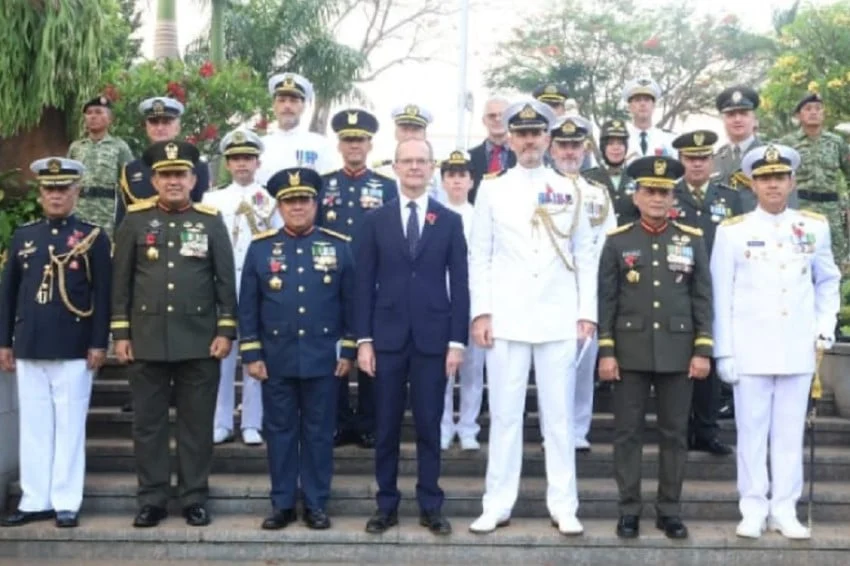
The diplomatic landscape of defense cooperation and historical remembrance was underscored on Sunday, November 8, 2026, as the Deputy Minister of Defense (Wamenhan) for Logistics, Defense Industry, and Technology, Air Marshal Yusuf Jauhari, attended the solemn Remembrance Sunday War Memorial ceremony. Held at the historic Menteng Pulo War Cemetery in South Jakarta, the event brought together international dignitaries, military attachés, and Indonesian defense officials to pay tribute to fallen soldiers of global conflicts, most notably World War II.
The high-level attendance by a senior Indonesian defense official highlights Jakarta’s active engagement in international diplomacy, mutual historical acknowledgment, and the fortification of bilateral security partnerships with allied nations. Beyond honoring the casualties of past wars, the ceremony served as a poignant reminder of the enduring global commitment required to maintain international peace and security in an increasingly complex geopolitical environment.
Chronology and Proceedings of the Ceremony
The commemoration commenced on the morning of November 8, 2026, at the Menteng Pulo War Cemetery, a site deeply intertwined with the historical memory of the region. Air Marshal Yusuf Jauhari arrived at the complex representing the Indonesian Ministry of Defense, joining a distinguished assembly of international representatives.
The ceremony featured traditional elements customary to Remembrance Sunday observances globally. These included the laying of wreaths at the memorial grounds, a moment of silence dedicated to fallen service members, and solemn reflections delivered by diplomatic and military leaders.
Accompanying Air Marshal Yusuf Jauhari was the Inspector General of the Ministry of Defense, Lieutenant General TNI Rui FGP Duarte. Their presence alongside numerous foreign ambassadors, defense attachés, and military representatives from various friendly nations emphasized the multinational character of the event. The proceedings were conducted in a spirit of shared solemnity, reflecting a unified global resolve to remember the devastating human cost of armed conflict and to honor those who made the ultimate sacrifice.
Historical Context of Menteng Pulo War Cemetery
To fully understand the significance of the Remembrance Sunday gathering at Menteng Pulo, it is essential to examine the historical weight carried by the cemetery itself. Located in South Jakarta, the Menteng Pulo War Cemetery is the final resting place for thousands of military personnel and civilians who lost their lives during World War II and the subsequent Indonesian National Revolution.
The cemetery contains multiple distinct sections, including graves of Commonwealth soldiers, Dutch military personnel, and local victims of the wartime era. Maintained with meticulous care, the grounds serve not only as a historical archive inscribed in stone and landscape but also as an active site for international reconciliation and remembrance.
Remembrance Sunday, traditionally observed on the second Sunday of November, originates from Commonwealth traditions commemorating the end of hostilities in World War I on November 11, 1918. Over decades, the scope of the observance has expanded to honor all military personnel who have died in conflicts worldwide. By hosting and participating in such ceremonies at sites like Menteng Pulo, Indonesia demonstrates its integration into global frameworks of historical commemoration, acknowledging that the struggles of the past have shaped the sovereign nations of the present.
Official Statements and Diplomatic Significance
The Ministry of Defense of the Republic of Indonesia released an official statement following the conclusion of the event, emphasizing the strategic and diplomatic dimensions of the government’s participation. The ministry underscored that the presence of high-ranking Indonesian officials was a testament to the nation’s respect for the sacrifices of past generations and a reaffirmation of its commitment to international cooperation.
"Partisipasi Indonesia juga menunjukkan pentingnya menjaga hubungan persahabatan dan kerja sama yang telah terjalin dengan negara-negara mitra, terutama di bidang pertahanan dan keamanan," the Ministry of Defense stated, as highlighted on Monday, November 9, 2026. This translated stance underscores that modern defense policy is not solely built on procurement, technological advancement, and strategic deterrence, but equally on shared values, mutual trust, and historical ties with international partners.
The attendance of Air Marshal Yusuf Jauhari—whose official portfolio encompasses defense logistics, industrial collaboration, and technological advancement—adds a pragmatic dimension to the diplomatic engagement. While Remembrance Sunday is fundamentally a solemn, reflective occasion, gatherings of high-level defense delegations naturally facilitate quiet diplomatic dialogues regarding contemporary regional security, supply chain resilience, and defense industry partnerships among friendly states.
Broadening Defense Cooperation and Regional Stability
Indonesia’s active participation in multilateral memorial events aligns with its longstanding foreign policy doctrine of "free and active" (bebas aktif), wherein the nation maintains an independent stance while continuously building constructive partnerships across the global stage. In recent years, the Indonesian Ministry of Defense has increasingly emphasized the necessity of collaborative security frameworks to address transnational challenges.
This event occurs within a broader calendar of defense diplomacy for Indonesia. As regional and global security architectures face mounting pressures—ranging from maritime security concerns in the Indo-Pacific to supply chain disruptions affecting defense manufacturing—maintaining robust diplomatic channels is paramount. By standing shoulder-to-shoulder with international allies at a war memorial, Indonesia communicates reliability, historical consciousness, and a steadfast dedication to collective peace.
Furthermore, the involvement of senior officials such as Inspector General Lt. Gen. TNI Rui FGP Duarte reinforces internal institutional alignment with these diplomatic objectives. The Ministry of Defense continues to balance its domestic priorities—such as the modernization of military hardware, the development of a self-reliant domestic defense industry, and the enhancement of logistical capabilities—with proactive international engagement.
Fact-Based Analysis of Implications
The participation of Wamenhan Marsekal TNI Yusuf Jauhari in the Remembrance Sunday War Memorial carries several notable implications for Indonesia’s defense posture and international relations:
- Reinforcement of Soft Power and Diplomatic Goodwill: Participation in culturally and historically significant international commemorations enhances Indonesia’s soft power. It signals to Western and Commonwealth nations, as well as regional partners, that Indonesia respects shared global history and honors the sacrifices of multinational service members.
- Strengthening Bilateral Security Ties: War cemeteries and memorial services provide neutral, respectful platforms for defense officials and foreign attachés to interact outside the high-pressure environment of formal negotiations. These interactions lay the groundwork for future bilateral defense agreements, joint exercises, and technological exchanges.
- Alignment with Global Security Discourse: By engaging in events dedicated to remembering the devastation of past wars, Indonesia reaffirms its ideological alignment with international norms centered on conflict prevention, peaceful resolution of disputes, and global stability. This reinforces Jakarta’s credibility as a constructive leader within ASEAN and the broader international community.
- Integration of Historical Awareness with Modern Defense Strategy: The Ministry of Defense’s dual focus—managing cutting-edge defense technologies and logistics while honoring historical sacrifices—illustrates a mature defense establishment. It acknowledges that modern military capabilities must ultimately serve the preservation of peace, honoring the lessons of history to prevent future conflicts.
Conclusion
The observance of Remembrance Sunday at the Menteng Pulo War Cemetery on November 8, 2026, marked a significant moment of reflection, diplomacy, and international solidarity. Through the presence of Deputy Minister of Defense Air Marshal Yusuf Jauhari and Inspector General Lt. Gen. TNI Rui FGP Duarte, the Indonesian government reaffirmed its respect for the historical sacrifices that shaped the modern world.
As geopolitical dynamics continue to evolve, Indonesia’s active participation in such multinational commemorations demonstrates that its defense strategy is rooted not only in modern technological advancement and industrial capacity but also in enduring friendships, mutual respect, and an unwavering commitment to global peace and stability.