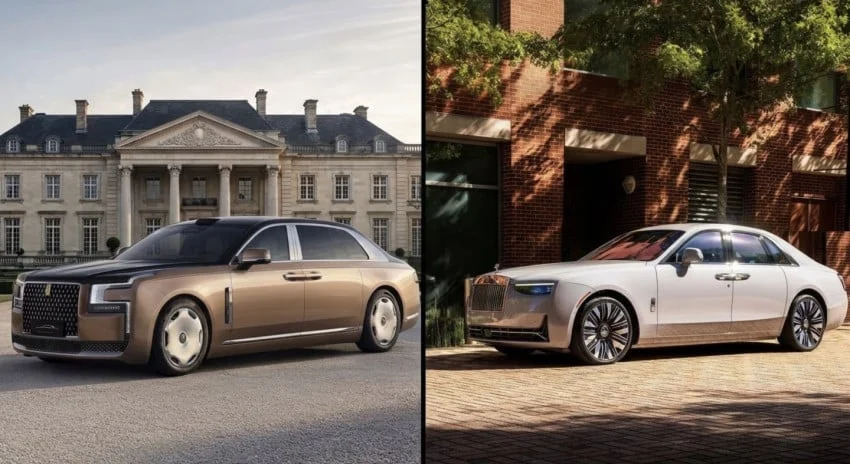
The global landscape of ultra-luxury limousines is undergoing a profound paradigm shift, underscored by the official unveiling of the Yangwang Altior in Abu Dhabi, United Arab Emirates. Manufactured by BYD’s premier luxury division, Yangwang, the Altior has been explicitly engineered to challenge legacy automotive titans such as the Rolls-Royce Ghost and the Mercedes-Maybach S-Class. By combining cutting-edge electric vehicle architecture with dimensions and luggage capacities that surpass established benchmarks on paper, Yangwang is signaling a direct assault on the traditional bastions of aristocratic motoring. The debut in the affluent market of Abu Dhabi was no coincidence; it serves as a strategic statement to the epicentre of ultra-high-net-worth individuals who traditionally favor British craftsmanship and German engineering over emerging Chinese luxury marques.
Strategic Debut in the Middle East
The choice of Abu Dhabi as the launchpad for the Yangwang Altior highlights the brand’s aggressive global ambitions. Historically, the Middle East has been a stronghold for ultra-luxury brands like Rolls-Royce, Bentley, and Mercedes-Maybach. By introducing the Altior in this region, BYD is directly testing the appetite of discerning consumers who prioritize prestige, road presence, and cutting-edge technology.
The unveiling event attracted significant attention from regional automotive enthusiasts, industry analysts, and prospective buyers. Yangwang positioned the Altior not merely as an alternative, but as a technological leap forward in a segment that has been historically conservative regarding powertrain transitions. While Rolls-Royce continues to navigate its own electrification roadmap with models like the Spectre, the Ghost remains anchored to its internal combustion engine heritage—a vulnerability that the fully electric Yangwang Altior seeks to exploit.
Dimensions and Spatial Supremacy
On paper, the Yangwang Altior commands attention through its sheer physical footprint. Measuring 5,600 millimeters in overall length, the Altior surpasses the standard Rolls-Royce Ghost Series II by 54 millimeters, as the latter measures 5,546 millimeters. Furthermore, the Altior’s wheelbase exceeds that of the standard Ghost by a substantial 205 millimeters, translating directly into enhanced rear-cabin legroom—a critical metric for buyers in this segment who often utilize chauffeur services.
Even when compared against the long-wheelbase variant, the Ghost Extended, the Altior’s wheelbase manages to outstretch it by 35 millimeters, although the Ghost Extended still retains a slight advantage in total overall length at 5,716 millimeters due to differing front and rear overhangs. In terms of width and height, the Altior measures 2,030 millimeters and 1,590 millimeters, respectively, providing a commanding road presence.
Practicality has also been thoughtfully integrated into the design. The Yangwang Altior boasts a luggage capacity of 532 liters. This outclasses the Rolls-Royce Ghost Series II, which offers 464 liters of boot space, providing a distinct functional advantage for owners who frequently travel with luggage or require ample cargo utility from their primary luxury transport. Additionally, the Altior features rear doors engineered to open up to a staggering 90 degrees, ensuring effortless ingress and egress for VIP passengers.
Pricing Strategy and Market Positioning
Pricing in the ultra-luxury segment acts as both a financial barrier and a psychological statement of value. In its domestic market of China, the Yangwang Altior carries a pre-sale price tag of approximately 2.08 million yuan, which translates to roughly $290,000 USD or around Rp5.31 billion.
To contextualize this pricing structure, the Rolls-Royce Ghost Series II starts at an MSRP of approximately $370,750 USD (roughly Rp6.64 billion) in the United States, before factoring in the inevitable bespoke customizations that typically inflate the final transaction price by tens or hundreds of thousands of dollars. While direct cross-market price comparisons are complicated by regional import tariffs, luxury taxes, and local specifications, the preliminary pricing of the Altior positions it at a notable discount compared to its British rival, while offering superior baseline dimensions and an advanced electric powertrain.
This pricing strategy is calculated to tempt buyers who are increasingly open to technological innovation, provided the value proposition significantly undercuts established status symbols without compromising on spatial luxury or build quality.

Technological Architecture and Powertrain Implications
While the physical dimensions and pricing set the stage, the mechanical and electronic architecture of the Yangwang Altior represents its true competitive edge. Built upon BYD’s advanced New Energy Vehicle (NEV) platforms, the Altior benefits from sophisticated electric motor deployment, likely incorporating advanced torque vectoring, active suspension systems, and instantaneous power delivery native to high-end EVs.
The transition from traditional internal combustion engines—such as the V12 or V8 powerplants traditionally favored in this class—to a pure electric propulsion system brings distinct operational advantages to the limousines of the future. Silent operation, vibration-free acceleration, and zero tailpipe emissions align seamlessly with the evolving regulatory landscapes in global metropolitan areas, as well as the shifting preferences of younger, tech-forward billionaires.
Industry analysts note that while traditional brands carry decades of heritage, narrative, and bespoke craftsmanship prestige, newcomers like Yangwang are leveraging unmatched supply chain integration, advanced computing power, and aggressive R&D spending to leapfrog legacy engineering in areas such as cabin connectivity, automated driving assistance, and powertrain refinement.
Industry Reactions and Competitive Landscape
The arrival of the Yangwang Altior has prompted quiet re-evaluations within the boardrooms of legacy European luxury automakers. While established marques have historically dismissed Chinese luxury entries as regional novelties, the rapid technological maturation of brands under the BYD umbrella—exemplified by Yangwang’s portfolio of high-performance supercars and luxury SUVs—demands a more serious competitive assessment.
Competitors in the luxury limousine segment, including the Mercedes-Maybach S-Class and the Bentley Flying Spur, are monitoring how the market responds to the Altior’s combination of immense proportions and electric propulsion. Analysts suggest that while brand loyalty and centuries-old heritage will protect Rolls-Royce and Maybach from an immediate mass migration of buyers, the presence of a viable, technologically superior alternative will force legacy brands to accelerate their own electrification and cabin-space optimization timelines.
Furthermore, the bespoke nature of European luxury remains a key differentiator. Rolls-Royce offers virtually limitless personalization through its Bespoke division, allowing clients to commission one-of-a-kind art pieces on wheels. For Yangwang to fully capture the loyalty of the ultra-wealthy, establishing an equally rarefied personalization ecosystem will be essential.
Broader Economic and Global Market Implications
The launch of the Altior in Abu Dhabi serves as a micro-cosm of a broader macro-economic trend: the rise of Chinese luxury automotive brands on the global stage. For decades, the flow of luxury automotive prestige moved strictly from Europe to the rest of the world. Today, the convergence of advanced battery technology, massive domestic capital investments, and world-class industrial design is reversing that traffic.
As the Altior transitions from pre-sale status to full global commercial availability, its performance in export markets will serve as a bellwether for the viability of Chinese ultra-luxury vehicles abroad. If early adopters in regions like the Middle East embrace the vehicle, it could pave the way for a broader expansion into European and North American luxury corridors.
Ultimately, the Yangwang Altior represents more than just a large electric sedan with impressive trunk space and wheelbase dimensions. It is a tangible manifestation of a shifting automotive order—one where the traditional metrics of luxury, long dominated by cylinder counts and historical lineage, are being rewritten by electrification, digital integration, and uncompromised interior spatial architecture.