
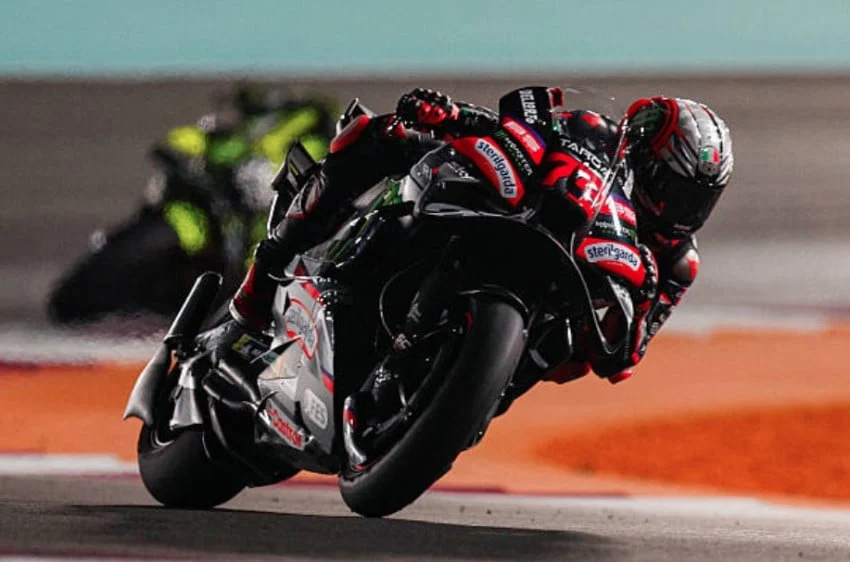
The 2026 MotoGP World Championship season delivered another masterclass in high-speed tactical execution under the floodlights of the Lusail International Circuit, where Aprilia Racing’s Marco Bezzecchi clinched a stunning and dominant victory at the prestigious Qatar Grand Prix. In a race defined by blistering pace, strategic tire management, and relentless pressure from behind, Bezzecchi orchestrated a flawless campaign from the pole position to the checkered flag, expertly resisting the advances of premier class heavyweights. Ducati Lenovo Team’s marquee signing, Marc Marquez, demonstrated his enduring championship pedigree by carving his way through the pack to secure a hard-fought second place, while Trackhouse Racing’s Raul Fernandez completed the podium in a stellar third-place finish that underlined the sheer competitiveness of the 2026 grid.
This comprehensive report examines the tactical layout of the Grand Prix, the chronological progression of the race, the underlying data points shaping the championship standings, and the broader technical implications of Bezzecchi’s triumph for the modern MotoGP landscape.
A Masterclass Under the Lusail Floodlights: Race Chronology and Key Battles
The Lusail International Circuit, renowned for its challenging layout featuring a blend of high-speed sweeping corners and heavy braking zones, provided the ultimate backdrop for the premier class showdown. As the red lights went out and the field roared toward Turn 1, Marco Bezzecchi, piloting his factory-spec Aprilia RS-GP, executed a text-book start. Seizing the holeshot, the Italian rider immediately established a psychological advantage by controlling the tempo from the front.
Behind the leading Aprilia, Raul Fernandez of Trackhouse Racing capitalized on his strong qualifying form to slot directly into second place, applying immediate pressure on the race leader. Meanwhile, Marc Marquez, operating within the factory Ducati Lenovo ecosystem, faced a congested opening lap. Starting further up the grid with ambitions of seizing an early victory, the Spaniard found himself embroiled in a fierce mid-pack scuffle before settling into a rhythm that would allow him to preserve his Michelin tires for a late-race charge.
By the completion of the third lap, the race order at the front had begun to stabilize temporarily. Bezzecchi continued to dictate the pace, maintaining a fragile yet consistent buffer over Fernandez. Pedro Acosta, representing the Red Bull KTM Factory Racing squad, put on a dazzling exhibition of raw speed and fearless aggression, holding down the third position. Marc Marquez, meanwhile, lurked dangerously in fourth place, carefully calculating his overtakes and studying the racing lines of the riders ahead.
The pivotal turning point of the 27-lap Grand Prix materialized as the field entered the 13th lap. Marquez, having conserved his machinery through the grueling mid-race phase, unleashed a sudden burst of pace. Executing a calculated maneuver, the multi-time world champion swept past Acosta to seize third position. With clean air now ahead of him, Marquez wasted no time in shifting his focus toward the battle for the silver and gold steps of the podium.
Displaying the tenacity that has defined his illustrious career, Marquez successfully gapped the pursuing Acosta, effectively neutralizing any threat from behind. He then systematically closed the deficit to Fernandez, eventually bypassing the Trackhouse Racing rider to secure second place. Despite Marquez’s late-race surge and blistering sector times, Bezzecchi proved unreachable. The Aprilia rider managed his tire degradation impeccably, crossing the finish line with a comfortable margin to claim the winner’s trophy and etch his name into the history books of the Qatar Grand Prix.
Technical Triumph and Strategic Precision for Aprilia Racing
Marco Bezzecchi’s victory at Lusail serves as a monumental milestone not only for the Italian rider but also for the Noale-based factory, Aprilia Racing. Over recent seasons, Aprilia has steadily evolved from an underdog contender into a consistent championship protagonist, capable of challenging the dominant hegemony of Ducati. Bezzecchi’s performance on the 2026 RS-GP highlighted the motorcycle’s exceptional stability through high-speed transitions and its refined aerodynamic package, which allows the rider to maintain superior corner-exit speeds without compromising rear-tire life.
Analyzing the data from the Lusail weekend reveals that Aprilia’s gains in traction management were the decisive factor in Bezzecchi’s success. While Ducati machines traditionally excel in straight-line acceleration and top speed, the RS-GP’s agility through the sweeping second and third sectors of the Qatar circuit allowed Bezzecchi to build a gap that Marquez and Fernandez struggled to close, regardless of superior slipstreaming capabilities down the main straight.
Furthermore, Bezzecchi’s mental fortitude under pressure cannot be overstated. Leading a Grand Prix from the opening lap to the final corner requires immense psychological discipline, particularly with a rider of Marc Marquez’s caliber hunting in your mirrors. By maintaining consistent lap times and avoiding unforced errors, Bezzecchi demonstrated the maturity of a bonafide world championship contender.
Marc Marquez and Ducati: Consistency and Adaptability
For Marc Marquez and the Ducati Lenovo Team, securing second place at the Qatar Grand Prix represents a highly lucrative haul of championship points, even if victory narrowly slipped through their fingers. Marquez’s transition phase within the factory Ducati setup has continued to yield positive developmental data, with the Spaniard proving his ability to extract maximum performance from the Desmosedici across vastly differing circuit characteristics.
Marquez’s race craft was on full display in Qatar. Recognizing early in the race that an immediate blitz for the lead could result in excessive front-tire wear—a common hazard in the desert evening humidity—Marquez adopted a measured, patient strategy. His methodical climb from an early fourth position up to second place on lap 13 showcased his analytical approach to modern Grand Prix racing.
In post-race technical debriefs, Ducati engineers noted that while the Desmosedici demonstrated superior peak horsepower, the setup window required to counter Aprilia’s mid-corner speed in Qatar was notably narrow. Nevertheless, finishing on the podium underscores Marquez’s status as an omnipresent threat for the 2026 Riders’ World Championship, proving that his relentless pursuit of excellence remains undiminished.
Raul Fernandez and Trackhouse Racing’s Breakthrough Weekend
The story of the 2026 Qatar Grand Prix would be incomplete without recognizing the phenomenal performance of Raul Fernandez and the Trackhouse Racing team. Securing the final step of the podium in such an elite, highly competitive field validates the satellite team’s hard work and the growing competitiveness of the independent-team ecosystem within MotoGP.
Fernandez held his nerve against immense pressure from seasoned veterans throughout the race. Running in second place for a significant portion of the Grand Prix, the young Spaniard displayed racecraft well beyond his years. His ability to defend his position against Marquez for as long as he did highlights both his natural talent and the impressive baseline performance of his machinery. This podium finish not only boosts team morale within the Trackhouse camp but also signals to the rest of the paddock that satellite squads are increasingly capable of upsetting factory hegemony on any given weekend.
Broader Implications for the 2026 MotoGP World Championship
As the 2026 MotoGP circus packs its equipment and departs the Lusail International Circuit, the results of the Qatar Grand Prix have sent a clear message to the rest of the racing world: the championship battle is wide open.
With Marco Bezzecchi taking top honors for Aprilia, Marc Marquez anchoring the front for Ducati, and young talents like Raul Fernandez and Pedro Acosta pushing the establishment, the competitive hierarchy of MotoGP has never been tighter. The convergence of technological development, advanced aerodynamic research, and rider talent has compressed the field, ensuring that microscopic margins in setup, rider fitness, and tire strategy will dictate the outcome of every remaining round.
As teams prepare for the subsequent rounds of the grueling global calendar, the psychological momentum currently resides with Aprilia and Bezzecchi. However, with competitors of Marquez’s caliber endlessly analyzing data and refining their packages, the battle for supremacy in the 2026 MotoGP World Championship promises to deliver high-octane drama, tactical warfare, and elite athletic performance until the final flag drops at the season finale.
