
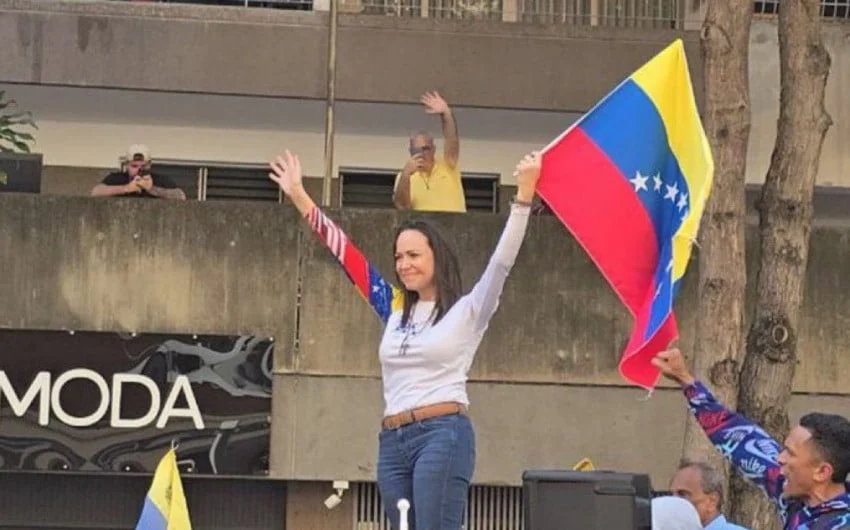
The return of Venezuelan opposition leader Maria Corina Machado to her homeland after ten months in exile marks a significant, albeit volatile, turning point in the nation’s prolonged political crisis. Her arrival, confirmed via social media on Sunday, signals a direct challenge to the administration of President Nicolás Maduro, occurring against a backdrop of shifting international allegiances and profound domestic instability. Machado, a figurehead of the opposition movement who has faced relentless legal and physical pressure from state authorities, appeared at a church service in the state of Lara before embarking on a high-profile journey to the capital, Caracas.
This homecoming is not merely a symbolic gesture of defiance; it is a calculated political maneuver aimed at revitalizing a fragmented opposition and signaling to the international community that the internal resistance against the Maduro government remains active despite months of systematic repression. As she traveled toward Caracas, greeted by cheering crowds and supporters lining the highways, the atmospheric shift in the capital was palpable. For many Venezuelans, her presence represents a rare glimmer of hope in a country grappling with one of the most severe economic and humanitarian crises in the Western Hemisphere.
A Chronology of a Fractured State
The trajectory leading to this moment is paved with years of civil unrest, international sanctions, and diplomatic isolation. To understand the gravity of Machado’s return, one must analyze the timeline of recent events that have shaped the current standoff.
Following her departure from Venezuela via a high-speed boat under the cover of darkness last year—a move taken to accept the Nobel Peace Prize in Norway and to safeguard her personal security—the political vacuum in Caracas became increasingly complex. Throughout her absence, the Maduro government intensified its crackdown on political dissidents, resulting in the imprisonment of key opposition figures and the tightening of control over civil society.
In January, the geopolitical stakes were raised significantly when the United States administration took decisive action against the Maduro regime. Following reports of electoral irregularities and human rights abuses, the U.S. moved to recognize Delcy Rodríguez, a former vice president and long-time loyalist to the government, as an alternative figurehead in a strategic effort to dismantle the economic infrastructure supporting the ruling party. This move, which involved the signing of lucrative oil agreements between the U.S. and the interim leadership, aimed to starve the Maduro administration of the petrodollars necessary to maintain the loyalty of the military and the security apparatus.
Machado’s return coincides with this recalibration of international pressure. While she was previously sidelined by an arbitrary ban from holding public office, her physical presence in the country nullifies the government’s attempt to render her a "distant, exiled figure," effectively forcing the administration into a reactive, and potentially dangerous, defensive posture.
The Economic and Humanitarian Context
Venezuela’s current condition remains dire, providing the structural backdrop for the opposition’s resurgence. According to data from the International Monetary Fund (IMF) and the World Bank, the Venezuelan economy has contracted by over 75% since 2014, a collapse rarely seen in a country not currently engaged in an active, conventional war. Hyperinflation, which reached astronomical levels in previous years, continues to erode the purchasing power of the average citizen, forcing millions to rely on meager government subsidies or remittances from the diaspora.
The humanitarian crisis is equally stark. The United Nations Refugee Agency (UNHCR) reports that over 7.7 million Venezuelans have fled the country, creating the largest displacement crisis in the region’s history. This mass exodus has drained the country of its professional class, leaving critical sectors like healthcare, education, and energy infrastructure in a state of terminal decay.
When Machado speaks of the "freedom of every political prisoner" and the "reunion of every family," she is addressing a population that is fundamentally exhausted by the status quo. Her message resonates with the millions who have seen their families fractured by forced migration and their livelihoods destroyed by systemic corruption.
International Reactions and Strategic Implications
The international community remains divided on the path forward for Venezuela. While the U.S. and a coalition of Western nations continue to push for democratic transition, regional powers such as Brazil, Colombia, and Mexico have engaged in varying degrees of diplomatic outreach, often attempting to act as mediators.
The recent U.S. engagement with the interim leadership has sparked debate within diplomatic circles. Critics of the move argue that focusing on oil-based power dynamics ignores the grassroots reality of the Venezuelan people. Supporters, however, contend that economic leverage is the only language the Maduro government understands.
Regional analysts suggest that Machado’s return will force the Maduro government to make a choice: either engage in a new round of suppression—which would risk further international isolation and potential criminal charges for human rights violations—or begrudgingly tolerate her presence to avoid inciting a massive public uprising. The risks are high for both sides. For the opposition, the danger of arbitrary detention remains constant. For the government, the presence of a charismatic leader rallying the masses could prove far more destabilizing than the threat of external sanctions.
The Path Forward: Analysis of Potential Outcomes
The days following Machado’s return will be critical. The government’s response to her arrival in Caracas will serve as a bellwether for the regime’s long-term strategy. If the state chooses to escalate, it risks triggering widespread civil disobedience, a scenario that has historically been met with heavy-handed force. Conversely, if the government maintains a degree of restraint, it may inadvertently provide the opposition with the space required to consolidate a national movement.
From a tactical perspective, Machado’s return shifts the focus from "diplomatic maneuvering in foreign capitals" back to "street-level mobilization." This is an arena where the opposition has historically faced immense hurdles due to the government’s control over the media and the security forces. However, the sheer size of the crowds welcoming her suggests that the climate of fear, while still present, is being eclipsed by a collective desire for change.
Furthermore, the role of the Venezuelan military will be the decisive factor in any transition. Historically, the military has acted as the ultimate arbiter of power in Venezuela. As long as the high command remains loyal to the current administration—partly due to shared interests in state-run industries and the fear of post-transition prosecution—the opposition’s path remains narrow. Machado’s strategy appears to involve peeling away the lower and middle ranks of the security forces by highlighting the shared suffering of their families, who are also victims of the economic collapse.
Conclusion: A Nation in Transition
The return of Maria Corina Machado is a manifestation of the deep-seated yearning for systemic change in Venezuela. While the structural obstacles—a captured judiciary, an entrenched military, and a broken economy—remain formidable, the political equation has fundamentally changed. By placing herself in the center of the storm, Machado has successfully pivoted the narrative from one of passive resistance to active engagement.
Whether this leads to a democratic opening or a period of intensified repression remains to be seen. What is clear, however, is that the status quo in Caracas is increasingly unsustainable. As the international community monitors the situation, the focus will likely shift toward whether any credible dialogue can be established to ensure a peaceful transition, or if the country is destined for a period of heightened confrontation. For the people of Venezuela, the sight of their leader emerging from the sunroof of her vehicle, surrounded by supporters, serves as a potent reminder that the struggle for their country’s future is far from over. The coming weeks will likely determine whether this moment is the dawn of a new political era or merely a temporary flare of defiance in an otherwise protracted conflict.
