
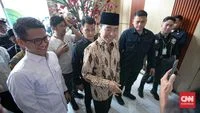
The political landscape in Indonesia has entered a period of heightened uncertainty following intensifying calls for the impeachment of Vice President Gibran Rakabuming Raka. These demands, which have resonated within legislative circles and public discourse, stem from ongoing legal challenges regarding the authenticity and validity of the educational credentials submitted by Gibran during his candidacy for the 2024 Presidential Election. Former President Joko Widodo, the father of the Vice President, has officially weighed in on the matter, signaling a commitment to institutional processes while maintaining a posture of constitutional respect.
Speaking to the press after attending a separate legal proceeding regarding his own educational background at the East Jakarta District Court on Thursday, November 5, the seventh President of the Republic of Indonesia addressed the burgeoning crisis. "We respect all existing legal processes, and we also respect the rights provided for within our constitution," Jokowi stated. His response reflects a strategic attempt to de-escalate the rhetoric surrounding his son’s tenure, emphasizing the necessity of adhering to the rule of law rather than succumbing to political pressure.
The Genesis of the Impeachment Discourse
The discourse surrounding the impeachment of the Vice President did not emerge in a vacuum. It is the culmination of a protracted legal battle that has scrutinized the administrative requirements for the 2024 election. At the heart of the controversy is the document of equivalence for Gibran’s high school education, which was a mandatory prerequisite for his registration as a candidate for the vice presidency.
The friction reached a critical juncture on October 30, when the Supreme Court (Mahkamah Agung/MA) issued a ruling that sent shockwaves through the political establishment. The court granted a petition filed by HM Subhan, ruling that the certificate of equivalence for Gibran’s high school education was legally invalid. This decision directly challenged the foundational documentation used by the Vice President to fulfill the educational requirements stipulated under the Indonesian Election Law.
Prior to the Supreme Court’s intervention, the Constitutional Court (Mahkamah Konstitusi/MK) had also scrutinized the matter. During a session on October 6, the Constitutional Court found a lack of substantive evidence indicating that Gibran possessed a foreign diploma or certificate that could be officially recognized as the equivalent of a senior high school education (SMA/MA/SMK), as required by the law. However, the Constitutional Court maintained a narrow scope of authority, clarifying that it lacked the constitutional power to unilaterally disqualify or remove an elected Vice President from office. By delegating the resolution of this administrative failure to the House of Representatives (DPR), the Constitutional Court effectively pushed the dispute from the courtroom into the halls of parliament.
Chronology of Legal and Political Developments
To understand the gravity of the current situation, it is necessary to examine the timeline of events that have led to the current parliamentary deliberation:
- October 6, 2024: The Constitutional Court hears arguments regarding the educational credentials of Gibran Rakabuming Raka. The court concludes that it does not have the authority to disqualify the Vice President, citing that such a decision lies outside its primary constitutional mandate.
- October 30, 2024: The Supreme Court issues a landmark ruling in response to a civil petition by HM Subhan, declaring that the letter of equivalence for Gibran’s high school education is invalid.
- Early November 2024: Members of the House of Representatives (DPR) begin internal discussions and informal caucuses to explore the feasibility of impeachment proceedings, following the Supreme Court’s signal that the matter is one for the legislature to handle.
- November 5, 2024: Former President Joko Widodo responds publicly to the situation, urging calm and respect for the constitutional framework while emphasizing that all legal avenues must be exhausted.
Legislative Implications and the Impeachment Mechanism
In Indonesia, the impeachment of a President or Vice President is a complex, high-stakes procedure governed by the 1945 Constitution. Under Article 7A, the President or Vice President can only be impeached if they are proven to have committed a crime, such as treason, corruption, or bribery, or if they are deemed to no longer meet the qualifications required by law.
The process is inherently political and requires a rigorous multi-stage approach. Initially, the House of Representatives must vote to initiate an inquiry. If the inquiry leads to a finding that the official has breached the law or no longer meets the qualifications, the case is elevated to the Constitutional Court. If the Constitutional Court upholds the allegations, the case returns to the House for a final plenary vote, which then requires the approval of the People’s Consultative Assembly (MPR).
The current discourse among legislators is in its infancy. While some political factions are actively exploring the potential for an impeachment inquiry, others remain cautious, fearing that such a move could destabilize the nation’s governance during a sensitive transition period. Analysts suggest that the Supreme Court’s ruling on the invalidity of the education certificate provides a legal anchor for critics, but the leap from an administrative credential error to a formal impeachment motion remains a significant political hurdle.
Broader Impact on Political Stability
The challenge to Gibran’s educational credentials has broader implications for Indonesia’s democratic health. It raises fundamental questions about the rigor of the General Elections Commission (KPU) in verifying candidate data before the ballot is cast. If the documentation provided by a candidate is found to be deficient after the inauguration, it places the entire legitimacy of the election process under intense scrutiny.
"The situation represents a stress test for our constitutional system," says an independent political observer. "If the legislative body decides to move forward, it will be the first time in the modern era that an impeachment is triggered by a dispute over the initial eligibility requirements of a sitting official."
Furthermore, the involvement of the judiciary—both the Constitutional Court and the Supreme Court—highlights the increasing reliance on legal institutions to resolve political conflicts. While this is a hallmark of a functioning democracy, it also risks politicizing the judiciary, as both sides of the aisle look to these courts to validate their respective agendas.
Official Responses and Future Outlook
As the discourse continues, the public remains divided. Supporters of the Vice President argue that the credential issue is a technicality that should not override the mandate given by the voters in the 2024 election. Conversely, critics argue that the rule of law is absolute and that any official who fails to meet the basic educational prerequisites stipulated by law must be held accountable to maintain the integrity of public office.
The Palace and the Vice President’s office have yet to issue a formal rebuttal beyond the statements provided by the former President. However, as the legislative session progresses, pressure will likely mount for a more comprehensive explanation regarding the status of the documentation.
The Indonesian political elite is now faced with a difficult balancing act: ensuring that the law is upheld with transparency and precision, while also ensuring that the country’s stability is not jeopardized by prolonged constitutional crises. As the House of Representatives continues its consolidation of views, the coming weeks will be pivotal. Whether this discourse leads to a formal impeachment motion or settles into a protracted legal debate will determine the trajectory of the current administration.
For now, the country watches closely as the intersection of administrative law, parliamentary politics, and constitutional integrity converges on the status of the Vice Presidency. The outcome will likely serve as a defining precedent for how Indonesia manages the eligibility and accountability of its high-ranking officials in the future.
