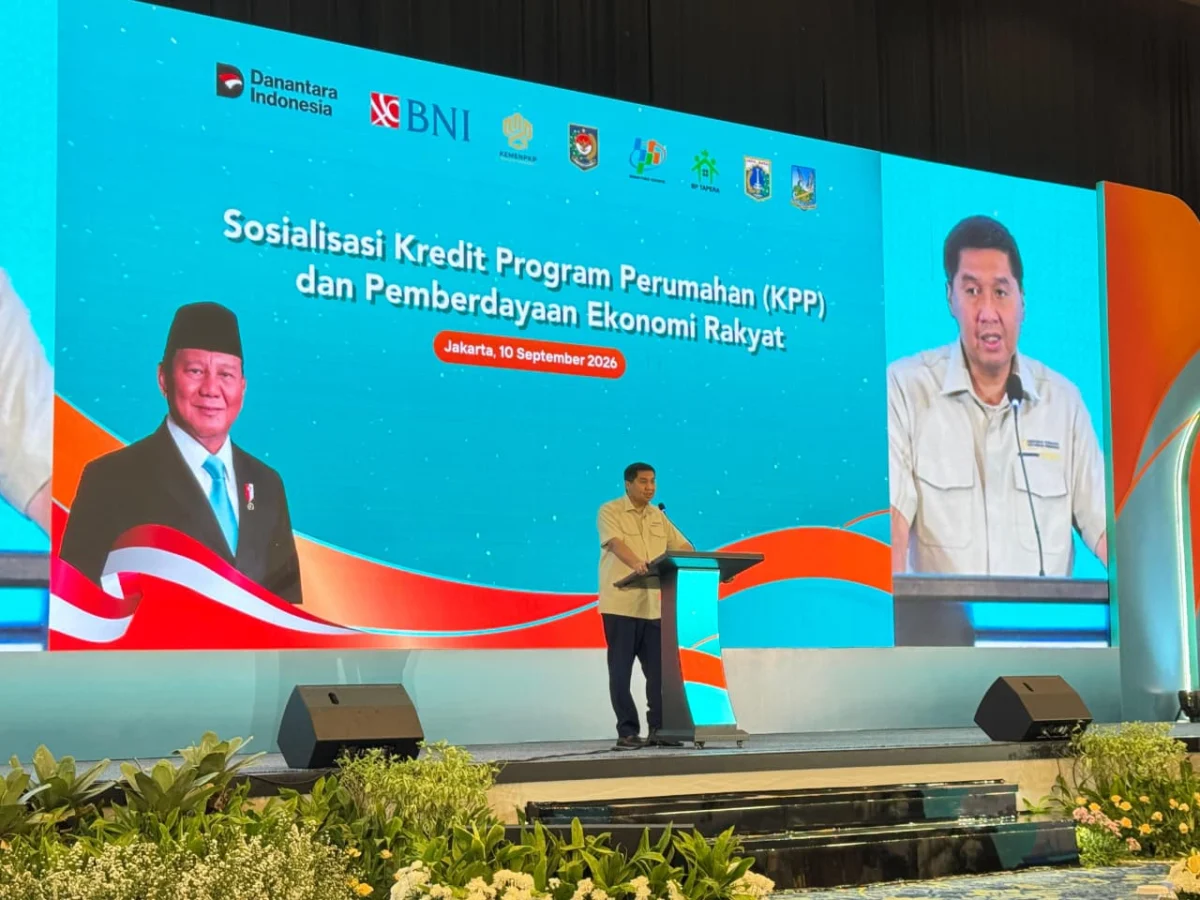
National banking institutions face an intensive year-end push to fulfill ambitious national housing finance targets with only two months remaining in the 2026 fiscal year. Financial institutions must disburse approximately IDR 12 trillion in housing program credits to reach the annual objective of IDR 41.17 trillion, according to data from the Ministry of Housing and Settlement Areas (PKP).
The urgency behind these figures reflects a broader initiative by the Indonesian government to secure affordable housing for lower-income demographics while simultaneously strengthening the economic ecosystem surrounding property development, construction supply chains, and urban residential planning.
As of November 1, 2026, the realization of the Housing Program Credit (KPP), frequently referred to as People’s Housing Credit (KUR Perumahan), reached IDR 29.17 trillion. This figure represents 70.85 percent of the targeted allocation, successfully delivered across 119,790 individual debit accounts. Despite the substantial volume achieved over the first ten months of the year, roughly 29.15 percent of the total financial target must be cleared before the budgetary clock runs out on December 31.
Simultaneously, the distribution of subsidized residential units via the Housing Financing Liquidity Facility (FLPP) scheme requires notable acceleration. Official records through October 31, 2026, indicate that FLPP deployment stands at 194,360 housing units. This accounts for 55.53 percent of the targeted 350,000 units slated for delivery throughout the entirety of 2026. Consequently, banks and developers share the burden of delivering the remaining 155,640 units within a compressed 60-day window.
The Call to Action from Minister Maruarar Sirait
In response to the tightening timeline, Minister of Housing and Settlement Areas Maruarar Sirait formally requested that PT Bank Tabungan Negara (Persero) Tbk (BTN) significantly ramp up the disbursement pace for both KPP and FLPP mortgages tailored for Low-Income Communities (MBR).
The directive was issued during a high-level strategic meeting in Jakarta between Minister Maruarar Sirait and BTN President Director Nixon L.P. Napitupulu, alongside members of the bank’s executive board. The government’s reliance on BTN is grounded in the institution’s historic status as a primary pillar of national housing finance. BTN currently holds the position of the second-largest lender within the KPP financing framework.
Minister Maruarar expressed explicit approval of the bank’s historical performance while acknowledging the heavy expectations placed upon its shoulders. "BTN possesses new and commendable breakthroughs that effectively support the acceleration of the FLPP subsidized housing progress," Maruarar noted during discussions, offering formal appreciation for the lender’s continuous commitment to national housing initiatives.
Understanding the Mechanics of KPP and KUR Perumahan
To appreciate the gravity of the IDR 12 trillion year-end deficit, industry analysts look closely at the structural role KPP plays within the broader economy. Established as a vital economic stimulus instrument, KUR Perumahan is engineered to reinforce both the demand and supply sides of the housing development ecosystem.
On the supply side, the financing mechanism is not strictly limited to end-buyers. It extends vital capital liquidity to residential real estate developers, local contractors, building material merchants, and various small-to-medium enterprises that populate the upstream and downstream sectors of home construction. By securing the financial health of these supply chain actors, the government aims to prevent bottlenecks in housing construction.
On the demand side, the credit facility directly empowers citizens, helping families fund the acquisition, construction, or comprehensive renovation of primary residential properties.
Detailed data released by the Ministry of PKP highlights BTN’s specific contributions. As of October 18, 2026, BTN alone had channeled IDR 6.03 trillion in KPP funding to 9,123 debit accounts, representing 60.26 percent of its assigned internal target. While this performance confirms BTN’s robust operational capacity, it simultaneously underscores the necessity of accelerating deployment over the remaining weeks to bridge the gap toward full compliance.
Addressing the FLPP Subsidized Housing Bottleneck
While KPP figures hover near the 70 percent completion mark, the subsidized mortgage sector governed by the FLPP framework presents an even steeper challenge. Reaching only 55.53 percent of its annual target by late October, the program requires a dramatic monthly output increase to avoid a significant under-delivery of units.
During consultations with the Ministry of PKP, BTN President Director Nixon L.P. Napitupulu outlined several pioneering financing innovations designed to streamline accessibility and resolve long-standing hurdles in the affordable housing market.
Among these innovations is a pilot project currently underway in the Bogor region. Under this operational model, developers complete standard housing construction entirely. Subsequently, BTN extends an additional secondary financing facility—capped at a maximum of 30 percent—to cover supplementary finishing touches. This ensures that the handed-over properties are completely move-in ready upon purchase.
The strategy aims to enhance overall habitability standards while saving lower-income homebuyers from seeking expensive, high-interest unsecured loans from alternative commercial sources to finish their homes.
Furthermore, BTN is actively advancing regulatory frameworks for a "recycle housing" initiative. This program seeks to optimize vacant, abandoned, or deteriorated older housing stock through targeted structural rehabilitation, converting underutilized properties back into functional, high-demand affordable dwellings.
Broader Economic Implications and Year-End Outlook
The dual challenge of disbursing the remaining IDR 12 trillion in KPP loans and finalizing 155,640 FLPP housing units carries wide-ranging macroeconomic implications. Housing sector expansions traditionally act as a major multiplier for national economic growth, generating employment for construction laborers, driving demand for domestic manufacturing industries, and improving regional development equity.
Economists note that failure to meet these targets could result in redirected budget allocations or compressed targets for subsequent fiscal years, potentially dampening developer confidence. Conversely, a successful year-end surge would validate the efficacy of public-private partnerships between state-owned financial institutions and ministerial regulators.
As the calendar turns toward the final two months of 2026, synchronized coordination between the Ministry of PKP, major lenders like BTN, property developers, and regional authorities remains critical. The ultimate success of these programs will dictate whether hundreds of thousands of lower-income Indonesian households secure stable, dignified shelter before the close of the fiscal year.