
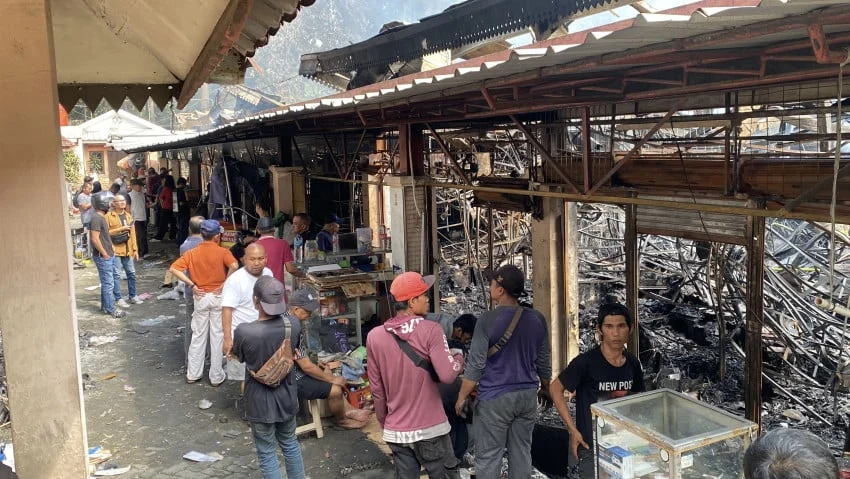
The Provincial Government of Jakarta has officially announced a sweeping transformation plan for the fire-ravaged Pasar Taman Puring located in South Jakarta. Rather than rebuilding the traditional commercial hub that was devastated by a massive fire in late July 2025, the administration under Governor Pramono Anung has decided to repurpose the land entirely. The site will undergo a comprehensive revitalization process to be converted into a dedicated, accessible public green space explicitly designed as a disability-friendly park.
This decisive shift in urban planning marks a significant milestone in Jakarta’s ongoing efforts to enhance public infrastructure, increase green open spaces (RTH), and foster inclusivity across the capital. While the decision champions urban accessibility and environmental standards, it simultaneously introduces a pressing socioeconomic challenge regarding the livelihood of hundreds of displaced merchants who depended on the marketplace for their economic survival.
The announcement, made by Governor Pramono Anung in East Jakarta, has set into motion a multi-agency logistical effort to balance modern urban greening initiatives with the protection of traditional livelihoods. As municipal authorities begin drafting the master plan for the inclusive park, stakeholders, urban planners, and affected vendors are closely monitoring how the relocation process and the physical transformation will unfold in the coming months.
Chronology and Background of the Pasar Taman Puring Fire
The genesis of the current revitalization initiative traces back to a catastrophic incident that disrupted the commercial landscape of South Jakarta. In late July 2025, a sudden and ferocious blaze tore through Pasar Taman Puring, a well-known local trading center historically celebrated for offering second-hand goods, sports apparel, shoes, and various household items.
Preliminary reports and eyewitness accounts from the day of the disaster indicated that the fire broke out during the afternoon hours, rapidly spreading through the densely packed semi-permanent and permanent kiosks. Due to the highly combustible nature of the merchandise stored within the market, coupled with narrow access roads that hindered early firefighting efforts, the flames intensified uncontrollably.
Emergency response teams from the Jakarta Fire and Rescue Department (Dinas Gulkarmat) deployed dozens of fire engines and heavy personnel to the scene. Despite exhaustive hours of battling the inferno, the sheer scale of the fire resulted in widespread destruction. By the time the flames were fully extinguished, historical data confirmed that approximately 500 shops had been completely burned to the ground.
The economic fallout was immediate and severe. Hundreds of kiosk owners and independent vendors lost their entire inventory, capital investments, and daily sources of income within a matter of hours. In the immediate aftermath of the tragedy, emergency tents were erected, and local government units stepped in to provide baseline humanitarian aid. However, the fundamental question remained: would the market be rebuilt on the exact same footprint, or would the disaster compel the municipal government to rethink the zone’s long-term utility?
Official Stance and the Vision for an Inclusive Public Space
Months of administrative deliberation, site assessments, and urban safety audits culminated in the definitive policy stance announced by Governor Pramono Anung. Speaking to members of the press in East Jakarta, the governor confirmed that the provincial government had formally approved the blueprint to convert the former market area into a specialized recreational zone.
"In principle, I have approved for Taman Puring, which burned down at that time, to be revitalized and used entirely as a park," Governor Pramono Anung stated.
The governor emphasized that the core design philosophy of the upcoming park would center on universal accessibility. Urban development experts within the Jakarta administration have been tasked with conceptualizing a space that accommodates individuals of all physical abilities. This includes the integration of tactile paving for the visually impaired, wheelchair-accessible ramps, sensory gardens, inclusive playgrounds, and specialized recreational equipment designed to serve citizens with diverse disabilities.
Jakarta has increasingly prioritized the development of inclusive public amenities in recent years, aligning with broader national mandates to create barrier-free urban environments. By dedicating a prime commercial plot in South Jakarta to this cause, the administration aims to set a new benchmark for municipal park design that prioritizes social equity and public health over commercial zoning.
Addressing the Plight of Displaced Merchants
While the transition of the fire site into a disability-friendly park represents a progressive leap for urban ecology and inclusivity, it leaves behind a significant administrative hurdle: the future of the displaced vendors. The destruction of approximately 500 shops displaced an equivalent number of primary business owners, alongside thousands of indirect workers, including store attendants, suppliers, and porters.
Recognizing the constitutional and social obligation to protect local micro, small, and medium enterprises (MSMEs), Governor Pramono Anung explicitly addressed the vendors’ plight. The administration has committed to securing alternative commercial locations to ensure that the affected business owners can resume their trading activities without facing permanent financial ruin.
"The vendors, of course, we must find a place for them so they can still trade and so on. Now, that is currently under discussion," the governor explained.
Finding a suitable alternative site in South Jakarta presents considerable logistical complexities. Municipal agencies, including the Department of Industry, Trade, Cooperatives, and SMEs (PPKUKM) alongside the Regional Asset Management Agency (BPAD), are currently evaluating several state-owned land plots and underutilized markets nearby. Potential solutions being explored include integrating the displaced vendors into existing municipal markets with vacant capacity, or developing a designated, modernized trading center nearby that meets contemporary fire safety and sanitation standards.
Socioeconomic and Urban Planning Implications
The decision to permanently close the commercial chapter of Pasar Taman Puring and convert it into a disability-friendly park carries multifaceted implications for Jakarta’s urban ecosystem.
From an environmental and urban planning perspective, the initiative directly supports the city’s ongoing quest to expand its green open spaces. Jakarta, like many rapidly expanding Southeast Asian megacities, has historically struggled with high population density, traffic congestion, and a deficiency in accessible public parks. Converting a high-risk commercial zone—which previously suffered from fire hazards, electrical safety vulnerabilities, and spatial congestion—into a regulated, open public space significantly enhances environmental quality, improves local drainage, and lowers urban heat island effects.
Conversely, from a socioeconomic standpoint, the permanent loss of a traditional market underscores the delicate tension between modernizing urban spaces and preserving informal economies. Traditional markets like Pasar Taman Puring have historically served as vital economic incubators for working-class entrepreneurs who may lack the capital to operate in modern shopping malls. The success of the Jakarta administration’s current intervention will largely be judged by how effectively and transparently the promised relocation of the 500 affected merchants is executed.
If the municipal government successfully relocates the vendors to a viable, high-traffic commercial alternative while simultaneously delivering a world-class, inclusive public park at the original site, the project could serve as a replicable model for disaster-zone urban renewal across Indonesia. However, any delays or bureaucratic friction in securing alternative livelihoods for the vendors risk deepening economic precarity among the affected families.
Next Steps and Timeline for Revitalization
As the administrative framework shifts from conceptual approval to physical implementation, several critical phases lie ahead.
First, municipal planning boards are finalizing the architectural and landscape designs for the disability-friendly park, ensuring compliance with international accessibility standards and local environmental regulations. Public consultations with disability advocacy groups are expected to be integrated into the final design phase to guarantee that the park meets the practical needs of its intended users.
Second, negotiations and spatial planning sessions regarding the relocation of the vendors are slated to intensify. The Jakarta administration has pledged to maintain open communication channels with vendor representatives to minimize anxiety and ensure that the transition process is conducted fairly and transparently.
Finally, land clearance and demolition of the remaining structural hazards at the old Pasar Taman Puring site will clear the path for civil engineering works to commence. While a definitive completion date for the new park has not yet been formally announced, municipal departments are under pressure to fast-track the development to restore economic vitality and spatial order to the neighborhood.
Ultimately, the transformation of Pasar Taman Puring stands as a defining test of Jakarta’s governance capacity—balancing compassion for displaced workers with a bold, forward-looking vision for an inclusive, green, and accessible metropolis.
