
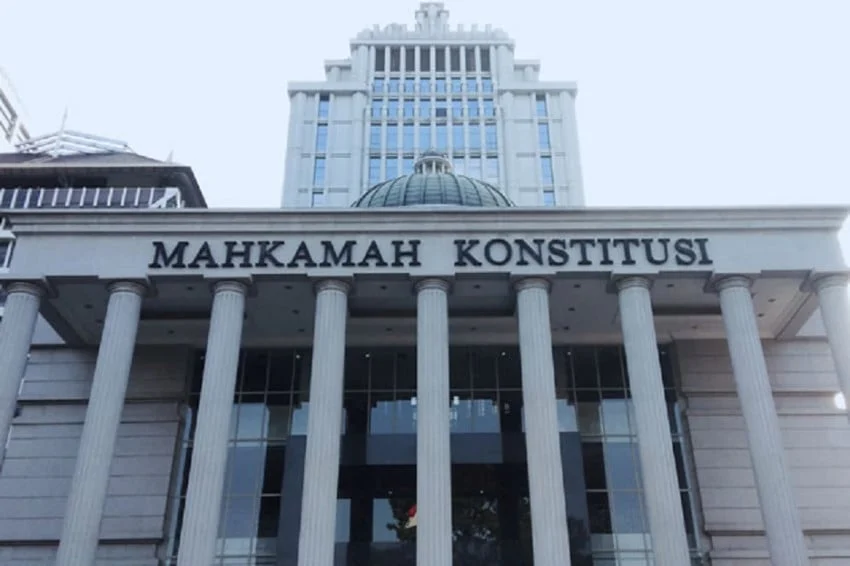
The Indonesian Constitutional Court (Mahkamah Konstitusi or MK) has delivered a landmark legal decision that fundamentally reinforces the checks and balances between the executive and legislative branches regarding the nation’s finances. In a ruling handed down on Wednesday, September 16, 2026, the Constitutional Court partially granted a judicial review petition registered under case number 100/PUU-XXIV/2026. The lawsuit was formally initiated by a civil society coalition operating under the name MBG Watch, which challenged the constitutionality of specific provisions within Law Number 17 of 2025 concerning the State Budget for the 2026 Fiscal Year (UU APBN TA 2026).
Chief Justice Suhartoyo, presiding over the hearing, read the decisive verdict, stating that the Court granted the petitioners’ requests in part. At the heart of the legal dispute was Article 8, paragraph (5) of the 2026 State Budget Law. While the Constitutional Court stopped short of declaring the entire provision unconstitutional, it ruled that the article is conditionally constitutional under strict legal interpretations. Specifically, the Court mandated that any subsequent adjustments, alterations, or restructuring of the state budget must secure explicit approval from the House of Representatives (Dewan Perwakilan Rakyat or DPR) before implementation. This ruling acts as a critical judicial guardrail against unilateral executive fiscal maneuvers, ensuring that the legislative branch retains its constitutional authority over national purse strings.
Background and Context of the 2026 State Budget Law
The enactment of the State Budget Law for the 2026 fiscal year had been a subject of intense political and economic debate long before the Constitutional Court’s intervention. Passed in late 2025, Law Number 17 of 2025 was designed to accommodate ambitious fiscal policies, large-scale infrastructure projects, and sweeping social welfare initiatives championed by the administration. Among these was the flagship "Makan Bergizi Gratis" (MBG) program—a massive national nutritional intervention aimed at school children and pregnant women—from which the watchdog coalition derived its name.
Given the immense scale of the 2026 state budget, which crossed historic expenditure thresholds, civil society organizations expressed deep concerns regarding potential fiscal overreaches. Critics and legal analysts argued that certain flexible provisions within the budget law granted the executive branch overly broad discretion to reallocate funds, shift spending priorities, and execute mid-term budget modifications without undergoing the rigorous scrutiny of parliamentary debate.
The formation of MBG Watch as a specialized civil society coalition was a direct response to these concerns. Composed of legal experts, budget transparency advocates, and public policy watchdogs, the coalition meticulously reviewed the statutory framework of the 2026 APBN. They concluded that several articles bypassed constitutional mechanisms outlined in the 1945 Constitution (UUD 1945), particularly concerning the legislative power of the purse and the requirement for mutual agreement between the government and the DPR in determining state finances.
Chronology of the Judicial Review Process
The legal battle initiated by MBG Watch followed a structured timeline through Indonesia’s highest constitutional tribunal:
- Initial Filing and Registration: In early 2026, following the official promulgation of Law Number 17 of 2025, the legal team representing MBG Watch formally submitted their material judicial review petition to the Constitutional Court. The case was officially registered under dossier number 100/PUU-XXIV/2026.
- Preliminary Examination: Throughout the spring of 2026, a panel of Constitutional Court justices conducted preliminary hearings to assess the legal standing (legal standing) of the petitioners. The Court evaluated how the implementation of the disputed articles directly affected the constitutional rights of citizens and the structural balance of power between state institutions.
- Expert Testimony and Government Responses: In subsequent sessions held during the summer of 2026, the Court invited constitutional law experts, fiscal economists, and representatives from both the House of Representatives and the executive branch (represented by the Ministry of Finance). The government defended the flexibility clauses, arguing that rapid global economic shifts and unforeseen national contingencies require the executive to possess agile budgetary tools. Conversely, the petitioners maintained that administrative agility must never supersede constitutional checks and balances.
- Final Deliberation and Verdict: Following months of rigorous evidentiary hearings and closed-door deliberations, the justices reached a consensus. On September 16, 2026, Chief Justice Suhartoyo delivered the final verdict, cementing the conditional constitutionality doctrine regarding budget amendments.
Legal Analysis of Article 8 Paragraph (5)
To fully comprehend the gravity of the Constitutional Court’s decision, one must examine the legal standing of Article 8, paragraph (5) of the 2026 State Budget Law. The article originally outlined procedures for executing budget adjustments under specific macroeconomic scenarios. The petitioners argued that the wording was dangerously ambiguous, potentially allowing the government to bypass parliamentary authorization when shifting substantial budget allocations between ministries, agencies, or major national programs.
In its legal considerations, the Constitutional Court reaffirmed the foundational principles enshrined in Article 23 of the 1945 Constitution, which explicitly dictates that the state budget must be established annually through law with the agreement of the DPR. The Court emphasized that while the executive branch holds the mandate for budget execution, the legislative branch holds the uncompromised prerogative of budget determination and modification.

By declaring Article 8, paragraph (5) to be conditionally binding (konstitusional bersyarat), the Court established that the provision does not violate the 1945 Constitution—provided it is interpreted and executed strictly under the condition that any adjustment or alteration to the APBN must obtain prior approval from the DPR. If implemented without parliamentary consent, any such budget modification would automatically lose its legal validity and be deemed unconstitutional.
Reactions and Institutional Responses
The verdict has triggered widespread reactions across Indonesia’s political and legal landscape, drawing praise from transparency advocates while prompting careful calibration from government technocrats.
Representatives from MBG Watch expressed profound satisfaction with the ruling, hailing it as a monumental victory for democratic governance and institutional accountability. In a post-verdict press conference, spokespersons for the coalition emphasized that the ruling prevents the executive branch from exercising unchecked budgetary dominance. They argued that public funds, particularly those allocated for critical social programs like the free nutritious meal initiative, must remain transparent, accountable, and subject to continuous legislative oversight.
Meanwhile, members of the House of Representatives (DPR) welcomed the decision, viewing it as a reaffirmation of parliamentary authority. Several senior legislators from various political factions noted that the ruling restores the proper constitutional equilibrium. They stressed that parliament is not an obstacle to effective governance, but rather an essential partner designed to ensure that state expenditures align precisely with the public interest and statutory mandates.
Economists and fiscal policy analysts have offered a nuanced evaluation of the ruling. While generally supporting the reinforcement of democratic oversight, some financial experts have cautioned that mandatory parliamentary approval for all budgetary adjustments could introduce administrative delays. In an era of volatile global markets, sudden geopolitical shocks, or domestic emergencies, the requirement to secure formal DPR approval for mid-term budget shifts might reduce the government’s crisis-response agility. Consequently, experts suggest that both the executive and legislative branches must establish fast-track coordination mechanisms to handle urgent fiscal adjustments without violating the newly clarified constitutional boundaries.
Broader Implications for Future State Budgets
The implications of case number 100/PUU-XXIV/2026 extend far beyond the immediate execution of the 2026 fiscal year. This ruling establishes a definitive constitutional precedent that will shape how all future State Budget Laws are drafted, debated, and implemented in Indonesia.
First, the decision serves as a stern reminder to legislative drafters within both the executive ministries and parliamentary commissions. Future laws can no longer rely on ambiguous catch-all clauses that grant blanket discretionary authority over state finances. Clarity, precision, and explicit adherence to constitutional oversight mechanisms are now mandatory prerequisites for statutory survival.
Second, the ruling fortifies the integrity of public expenditure tracking. Civil society watchdogs and anti-corruption organizations now possess a powerful judicial tool to monitor government spending. Any attempt to reallocate funds away from mandated public welfare programs or critical infrastructure projects without legislative sign-off can be legally challenged on constitutional grounds.
Ultimately, the Constitutional Court’s decision on September 16, 2026, reinforces the core tenet of Indonesia’s constitutional democracy: that public money belongs to the people, and its management must be governed by a transparent, collaborative dialogue between the government and the people’s elected representatives in parliament. As the nation navigates complex economic landscapes, this ruling ensures that fiscal efficiency will never come at the expense of constitutional accountability.
