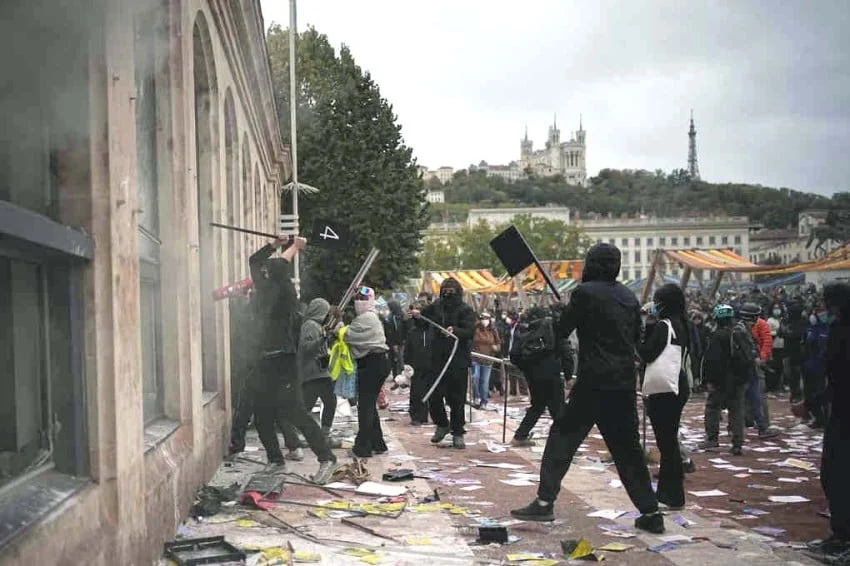
The streets of Paris and major urban centers across France have once again become the stage for widespread civil unrest, as thousands of citizens gather to protest against what they perceive as deepening socioeconomic inequality. At the heart of these demonstrations lies a profound sense of disillusionment with the administration of President Emmanuel Macron. Among the protesters is Louise, a 38-year-old graphic designer, who represents a growing segment of the population that feels alienated by current economic policies. For Louise and many like her, the slogans of the French Republic—Liberté, Égalité, Fraternité—have been replaced by a grim reality of systemic injustice, widening wealth gaps, and the concentration of power among a privileged elite.
The Sentiment on the Ground
Louise, standing amidst the clamor of a demonstration in Paris, carries a symbolic protest accessory: a pair of earrings shaped like guillotines. The imagery is not lost on observers; it serves as a stark reminder of France’s revolutionary history and a warning regarding the volatility of a society pushed to its limits. "Orang miskin menjadi semakin miskin, sementara orang kaya menjadi semakin kaya," she remarked, echoing a sentiment that has permeated the discourse of the working and middle classes across the nation.
Her participation in these rallies is not merely a show of solidarity with student movements; it is a manifestation of long-standing grievances regarding the cost of living, stagnant wages, and the perceived indifference of the Elysée Palace toward the plight of ordinary citizens. The concern is that the social contract, which promised equal opportunity, is buckling under the weight of neoliberal fiscal reforms that have favored capital holders over laborers.
Historical Context and Economic Drivers
The current unrest is not an isolated event but rather the latest chapter in a series of social upheavals that have defined the Macron presidency since 2017. The roots of this discontent can be traced back to the "Gilets Jaunes" (Yellow Vest) movement, which erupted in late 2018. Originally sparked by a proposed fuel tax increase, the movement quickly expanded into a broad critique of the government’s perceived urban-centric elitism and the decline of purchasing power in rural and peri-urban France.
Statistically, the concerns raised by protesters are grounded in observable trends. According to data from the National Institute of Statistics and Economic Studies (INSEE), while France maintains a robust social safety net compared to many of its peers, the gap between the wealthiest households and the lowest decile has remained persistent. Inflationary pressures—exacerbated by the post-pandemic recovery and the energy crisis following the conflict in Ukraine—have hit low-income households disproportionately hard. Food inflation, in particular, has surged, forcing many families to make difficult trade-offs between essential goods and services.
Chronology of Escalating Tensions
The timeline of recent French instability suggests a cyclical pattern of legislative reform followed by public backlash:
- 2018–2019: The rise of the Yellow Vest movement, marking a period of intense, often violent, confrontation between protesters and security forces.
- 2022: Re-election of Emmanuel Macron, followed shortly by legislative elections that resulted in a hung parliament, significantly complicating the executive’s ability to pass reformist agendas without resorting to constitutional bypasses.
- Early 2023: Nationwide strikes and protests against pension reforms, which raised the retirement age from 62 to 64, further inflaming public sentiment.
- Late 2023 – Present: Renewed civil unrest, fueled by a combination of economic stagnation, debates over migration policies, and police conduct in marginalized neighborhoods.
The Dilemma of Violent Protests
A recurring challenge for organizers and participants like Louise is the risk of co-option by fringe elements prone to violence and looting. During recent demonstrations, footage of shattered storefronts and burning barricades has dominated news cycles. This shift in the narrative is a primary concern for peaceful protesters, who fear that the destructive actions of a minority will overshadow the substantive issues of social inequality and institutional reform.
"My main concern," Louise noted, "is if the images of looting end up overshadowing the issues I care about most." This sentiment is shared by labor unions and political opposition groups, who often find themselves in the difficult position of balancing the need to exert pressure on the government with the need to maintain public support by condemning violence.
Official Responses and Political Implications
The French government has consistently maintained that its reforms are necessary to keep the French economy competitive in a globalized market. President Macron has frequently argued that the "trickle-down" effects of his business-friendly policies—such as the abolition of the solidarity tax on wealth (ISF) and the streamlining of labor laws—are essential for long-term growth and job creation.
Government spokespeople have emphasized the importance of maintaining public order, often highlighting the strain placed on the police force, which has been stretched thin by consecutive waves of protests. Interior Minister Gérald Darmanin has frequently defended the use of security measures, arguing that the protection of property and the rule of law are prerequisites for democracy.
However, political analysts argue that the government’s reliance on Article 49.3 of the French Constitution—which allows the executive to push through legislation without a parliamentary vote—has deepened the crisis of legitimacy. By bypassing the National Assembly, the government has arguably provided fuel to those who claim that the current administration is disconnected from the democratic process.
Implications for the Future of the Republic
The ongoing situation poses a significant threat to the stability of the Macron administration and, by extension, the broader political landscape of the European Union. As France prepares for future electoral cycles, the rise of populist movements—both on the far-right and the far-left—suggests that the center-ground of French politics is rapidly eroding.
The failure to address the core grievances of the protesters—namely, the perception that the system is rigged—could lead to a permanent state of agitation. Economic experts suggest that without a more inclusive approach to policy-making, the risk of "social fracture" will continue to grow. This includes addressing structural issues such as the lack of affordable housing, the quality of public services in suburban "banlieues," and the need for a more equitable tax system.
Furthermore, the international community is watching closely. France, as a founding member of the EU and a nuclear-armed power, plays a pivotal role in shaping continental policy. Persistent internal instability weakens its diplomatic standing and complicates its role in mediating international conflicts. If the administration cannot reconcile its reform agenda with the realities of the living standards of its citizens, the cost may be a prolonged period of governance paralysis.
Conclusion: The Path Ahead
The story of Louise, with her guillotine earrings and her frustration with the status quo, is a microcosm of the current French zeitgeist. It is a story of a citizenry that feels its voice is being ignored and its future is being mortgaged. While the government continues to push its economic agenda, the protests serve as a constant, loud, and increasingly urgent reminder that fiscal policy cannot exist in a vacuum, separated from the lived experience of the people.
As the country moves forward, the primary question remains whether the administration will opt for a policy of containment and confrontation, or if there is space for a renewed social dialogue. Given the current trajectory, the latter seems increasingly difficult to achieve. The coming months will likely be decisive for President Macron’s legacy and for the social stability of France. Whether the Republic can successfully navigate these turbulent waters depends on its ability to prove that its founding principles—liberty, equality, and fraternity—are not just historical relics, but tangible commitments that apply to every citizen, regardless of their station in life.
The international implications are equally significant. As democratic nations globally grapple with the rise of populism, the French experience serves as a cautionary tale of what happens when the disconnect between the ruling class and the working class reaches a critical threshold. The resolution of this crisis will likely require more than just rhetoric; it will require concrete, structural shifts that address the very inequality that so many now feel compelled to march against. As the dust settles from each demonstration, the fundamental question remains: can the state evolve, or will it remain locked in a cycle of protest and reaction that threatens the very fabric of the Fifth Republic?